

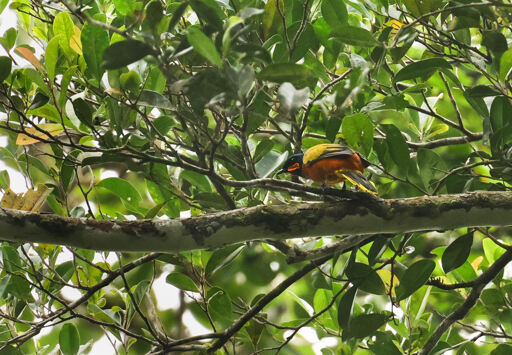
When Paulo Ditzel first laid eyes on the bird, he knew he’d seen something special: a vibrant orange body with yellow and black wings and tail feathers, topped by a dark head set off by almost-whimsical splashes of copper on its cheek. “My brain registered, it’s the Ghana cuckooshrike,” Ditzel, a field research fellow with the International Bird Conservation Partnership (IBCP), tells Mongabay. A surge of excitement rippled through him, he says. Still, the sighting also immediately sparked “the most chaotic calm,” as he stood next to his partner and teammate Stephanie Bartlett on a bridge not far from an ecological research station in Côte d’Ivoire’s Taï National Park. “OK, what do I do?” he says he remembers thinking. “Priority right now is that Stephanie gets a picture.” Over the next few moments, Ditzel locked onto the bird with his binoculars and called out its movements to Bartlett, also an IBCP field research fellow. In almost-choreographed coordination, Bartlett trained her camera lens on the branches across the stream and pressed the shutter button. “I got a photo of the bird before I saw it,” Bartlett says. In six months of bird surveys in West Africa supported by U.S.-based IBCP, she says, she’d come to expect only fleeting glances of the region’s birds. “They’re scared of you. You don’t get to get close to them, and so often you have to use the camera as a tool for identification.” “If I had seen that bird with anyone else, it wouldn’t have…This article was originally published on Mongabay
From Conservation news via This RSS Feed.