

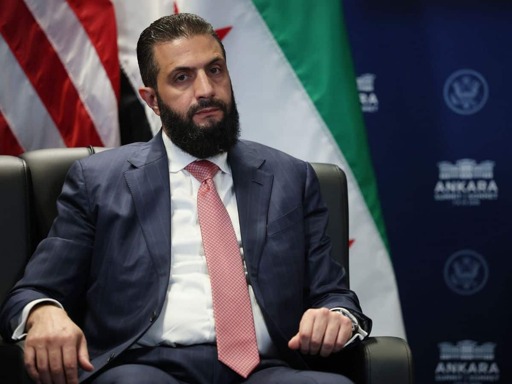

A military onslaught in January 2026 helped Syria’s new regime to secure an agreement to integrate autonomous northern areas with the rest of the country. But terrorist-turned-dictator Ahmed al-Sharaa (Al Jolani) has since focused more on boosting private profit than creating an inclusive Syria. And ordinary people are getting increasingly restless.
Syria’s fragile integration process
Amid Syria’s devastating civil war, the multi-ethnic but largely Kurdish north (Rojava) built a progressive revolution despite attacks from all sides. It focused on diversity, inclusion, women’s rights, environmental protection, and co-operatives.
Al-Sharaa’s mission is different, as January’s offensive showed. His forces attacked civilians, with chauvinist motivations fully apparent. And there were real concerns about ethnic cleansing.
Under the subsequent integration deal, Rojava’s soldiers could keep their weapons as new members of the official security forces, and there was a pledge to recognise Kurdish people and their language as legitimate parts of Syrian society. But in a country that’s not yet a democracy, there have been no constitutional guarantees.
The government has also taken away fuel subsidies, failed to ensure the safe return of refugees, excluded Rojava’s female fighters from the military, and only treated Kurdish as a ‘national’ language rather than an ‘official’ one. This final point is key, as the regime has sparked unrest over plans to reduce the role of Kurdish in Rojava’s schools.
Unrest as regime fails to take Kurdish rights seriously
Protests over the de-Kurdification of schools have taken place since early September, with children staying at home and educational professionals rejecting the move. Critics have said Syrian stability requires recognising everyone’s rights, but that the new national regime is pursuing similar policies to those of the regime it replaced.
After years of Kurdish education in Kurdish-majority areas, the Syrian regime plans to limit Kurdish language teaching to just three optional classes per week.
In the context of these protests, regime forces arbitrarily detained people and made racist comments. The abduction and brutal murder of a Kurdish soldier, meanwhile, added to the unrest. And the attempt to transfer detainees away from their local area led to a prison fire that killed ten.
As many Kurdish people fear a return to repression of their rights, there’s a strong feeling that the regime isn’t taking their concerns seriously.
Various groups believe there are cynical attempts to derail the integration process, insisting that dialogue is necessary to de-escalate the situation.
And it’s not just in Rojava where al-Sharaa’s regime is falling seriously short.
The rest of Syria isn’t much happier, either
Syria as a whole still has big problems. Those include the forcible abduction of 257 people since the start of 2026. They also include sectarian attacks that have killed 100 Alawites this year, along with the largely elusive justice in the wake of 2025’s anti-Alawite massacres. And serious state tensions with Druze communities are ongoing too.
In August, however, the US showed its total disinterest in those issues. Because it finally took Syria and al-Sharaa’s religious extremists off its terrorism lists, largely to allow the expansion of foreign corporate investment in the country. And that fits in very well with al-Sharaa’s policy of elite bootlicking.
Syria’s new leader had already signalled early on his intentions to serve the interests of the rich and powerful. And his privatisation efforts and clear elitism now seem to be threatening his already fragile legitimacy.
In a country where two thirds of people live in comparative poverty, prices have increased significantly and living standards have fallen. As a result, the regime has faced its biggest protests so far, already forcing it to undo some of its measures.
Ahmed al-Sharaa absolutely isn’t someone we should trust to give the Syrian people justice, peace, or democracy. But if he doesn’t start listening to ordinary people a bit more and serving corporate interests a bit less, he will have an increasingly bumpy ride in power.
Featured image via the Canary
By Ed Sykes
From Canary via This RSS Feed.