


WARNING: This story contains disturbing details about boarding schools. If you are feeling triggered, here is a resource list from the National Native American Boarding School Healing Coalition.
Charles Fox
Special to ICT
While everyone else in the household was asleep, Nyché Andrew worked late into the night at the computer.
An Indigenous research specialist with the Alaska Native Heritage Center, she’d been assigned the task of finding the origins and descendants of the Alaska Native students still buried at the former site of the Carlisle Indian Industrial School in Pennsylvania.
Historical archives and the Carlisle school records were often a labyrinth of frustrations, with numerous dead ends. Then she stumbled across a photo of one of the Alaska students, Tummassak, in the Sheldon Jackson Collection at the Presbyterian Historical Society.
“I stared in awe at her photograph because it instantly reminded me of the only photo of my great-great-grandmother, Mary Agugaq Avessuk,” Andrew, Skavaq Sivulliuqti (Yup’ik/Iñupiaq), originally from Anchorage but now living in New Jersey, told ICT.
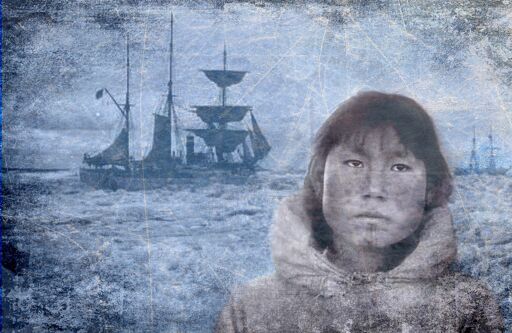
What caught her attention was not simply the family resemblance or the way they both fixed their eyes away from the camera, but the tavluġun, a tattoo on her chin signifying a young woman’s transition into maturity. It was the same tavluġun she had seen in photos of her great-great-grandmother.
Then came the sudden realization that the young woman she’d been researching was actually a relative.
“Tummassak was a very special find,” she said. “As a researcher, I never anticipated finding my family members.”

Side-by-side photos show the same chin tattoos on Tummassak, at left, an Alaska Native student who died while attending the Carlisle Indian Industrial School, and Mary Agugaq Avessuk, the great-great-grandmother of Indigenous researcher Nyché Andrew who realized the tattoo linked Tummassak to her own family. Credit: Photos courtesy of Nyché Andrew and Presbyterian Historical Society
The next morning, Andrew showed the photo to her mother, Jacqueline Agugaq Walluk.
“She softened at the sight of an Iñupiaq girl with a tattoo like Mary’s and remarked on how beautiful Tummassak was,” Andrew said. “We agreed that she looked incredibly similar to my sister, Farrell Agathluk Asiaq Stoudt.”
Tummassak is among more than 100 Native students still buried at the Carlisle cemetery, including 11 from Alaska, but she will soon be headed home.
Family members and community leaders from Alaska are set to arrive in Carlisle on Thursday, Sept. 24, for the disinterment and later a ceremonial transfer of the remains of Tummassak and three other Alaska Native students whose remains will be repatriated this year – Mabel Booth, whose last name is listed as Stack or Stock in school records; Edward Angalook; and Lucy Spaulding.
The repatriations are among 12 this year from the Carlisle cemetery. The remains of three students from the Fort Peck Assiniboine and Sioux Tribes were returned home to Montana in early September, and the remains of another five students from five different tribes are set to be repatriated by mid-October.
Officials with the Office of Army Cemeteries, which oversees the Carlisle Barracks Post Cemetery where the children are buried, have not released details about which of the remaining five students have been repatriated so far.
Twenty-two graves in the cemetery remain marked, however, as “unknown” because the children’s remains cannot be identified, the result of a mix-up that likely occurred when the cemetery was moved in 1927.
Benjamin Jacuk, Dena’ina/Sugpiaq, the director of research at the Alaska Native Heritage Center, said the Office of Army Cemeteries reached out to the center in 2024 for help identifying family members of the children buried there.
“A lot of the times really the best places to look are more local,” Jacuk told ICT. “What research is, at the end of the day, is making sure that we’re uncovering every stone to figure out how to be able to bring our families back.”
‘Another death’
Tummassak was 12 years old when she arrived at the Carlisle school on Nov. 14, 1897, and died of tuberculosis less than three years later on April 8, 1900. She is listed as Tomicock on her gravestone and as Tomiclock in Carlisle archives.
The school newspaper, The Indian Helper, recorded the details of Tummassak’s final moments in the April 13, 1900, issue.
“We are grieved to record the death of another of our Alaska pupils — Tomicock (Tummassak),” the article stated.
“She was patient, gentle and brave. She bore her illness in silence. Her smile was ready even when too weak to talk. She was conscious to the end,” the newspaper reported. “She asked Miss Barr to hold her and breathed her last while resting in those kindly arms, ever ready to help one in distress. Annebuck was her chosen friend and close companion, and the bereft child has the sympathy of all who knew the tender and sisterly feeling between the two.”

The grave of Tummassak (spelled Tomicock on the gravestone) is among more than a dozen Alaska Native students buried at the Carlisle Barracks Post Cemetery in Pennsylvania after dying while attending the school. Tummassak is set to be repatriated starting Sept. 25, 2026. Credit: Photo by Charles Fox/Special to ICT
The Carlisle Indian Industrial School operated from 1879 to 1918. Established on a vacant military base, hundreds of miles from the influences and traditions of most tribes, it was the first federally funded, off-reservation Native American boarding school in the United States and served as a model for schools across the U.S. and Canada.
Almost 8,000 Native American and Alaska Native students attended the school, part of a oppressive government attempt at forcefully assimilating Native students into White civilization. Its aim was to change them forever by cutting links to their family, language and culture.
Records indicate that 232 students died while enrolled at the school, and many did not return home. Prior to 2017, when repatriations began at Carlisle, there were 186 students buried in the cemetery. Another 37 were returned to their homes for burial, nine died while on the school’s outing program and were buried near those locations, and three died while enroute home from the school, according to Jim Gerencser, associate dean for archives and special collections at Dickinson College and the Carlisle Indian School Digital Resource Center.
Of all the students who were shipped to Carlisle, none had to travel as long and as far to get there as the Alaska Native students.
The first two Alaska Native students were brought to Carlisle by Sheldon Jackson, who managed the western states and Alaska for the Presbyterian Board of Home Missions. He was also named the general agent of education for Alaska.
He took Fred Harris (Ko-woot-ke-ish) and Henry Phillips (Ka-ka-ish), to Carlisle in December 1887 to learn the trades of tin smithing and printing.
On Sept. 20, 1897, a group of six Iñupiat youths, including Tummassak, boarded the US Revenue Cutter Bear, an early version of an ice breaker, at the Teller Reindeer Station in Port Clarence for transport to Seattle in Puget Sound after a side trip to Siberia. Following a 2,700-mile, cross-country train ride, they arrived in Carlisle almost two months later on Nov. 14, 1897, where they were photographed in their parkas.
Though they escaped the “Great Deaths” in Alaska when flu and other illnesses wiped out entire villages, they were not as lucky in Carlisle. Laublock, or Lablok, the only male in the group, died on Sept. 15, 1899, and Tummassak died the following year. Student Cooki Glook, also known as Kokiglook or Cookiglook, died on Jan. 4, 1904. All died of tuberculosis, known as “consumption” at the time, though Cooki Glook also suffered from rheumatism of the heart, according to school records.
Laublock and Cooki Glook remain buried in the school cemetery and, according to Jacuk, are expected to be returned home in 2027.

A group of Inupiat children from Alaska arrive at Carlisle Indian Industrial School on Nov. 18, 1897, in traditional clothing with fur-lined hoods. Credit: Photo courtesy of the Presbyterian Historical Society.
Over the years, 127 Alaskan students attended the Carlisle school, and 14 died and were buried in the school cemetery, according to records.
Three Alaska Native students have been returned home during the Carlisle repatriation efforts prior to this year. And at least one student, Ephraim Alexander, Yup’ik, died from tuberculosis while spending his final days with Moravian missionaries in Lititz, Pennsylvania, where he remains buried in a Moravian cemetery, according to the research of Lucy Rath while at Franklin and Marshall College.
One of his best friends, Henry Rose, who was at Alexander’s bedside when he died, lies in an unknown grave in the school cemetery.
Finding the families
Jacuk said the Office of Army Cemeteries reached out for help identifying students because they felt they’d “exhausted the documentation in the primary source material that’s useful in trying to return home these children buried at Carlisle.”
The Office of Army Cemeteries had initially refused to repatriate children unless descendants could be found, rejecting requests from tribes that their members be released to them under the federal Native American Graves Protection and Repatriation Act, or NAGPRA.
The dispute prompted a federal lawsuit in 2024 from the Winnebago Tribe of Nebraska, asking the court to order the government to honor the tribe’s request to return two boys who died at the school more than 100 years ago. A judge ruled in favor of the government and dismissed the case, but an appellate court in May 2026 overturned the lower court’s decision and ruled that NAGPRA regulations would apply to the repatriation of children.The ruling allows the Winnebago lawsuit to proceed against the government.
The Office of Army Cemeteries has declined to comment on whether it is honoring tribal authority to obtain repatriation of their children while the case is reconsidered. But the need to find a specific family member for each child had created additional pressure on Andrew.
“A big part in doing this research is not just looking at the places that everyone else has looked at, it’s making sure that we are looking at the places that they might not think to look at,” Jacuk said. “And so, that’s when we really went to looking at things like baptismal records, finding names and correspondence.”
Jacuk stressed the importance of being connected to communities to weed through inaccuracies in the school records and cemetery gravestones.
“We’re here to represent all peoples of Alaska,” he said. “And so, as a result, it becomes really easy to find connections very quickly within our communities. Because if someone doesn’t know what family to talk to … they know someone who can do that for us very easily.”

Native Alaska students enjoy a laugh on the grounds of the Carlisle Indian Industrial School. From left are Tummassak, Cooki Glook, Annie Coodlalook, and Annebuck. Tummassak’s relative, Nyché Andrew, says it is the only photo she has seen of the young woman smiling. The man is not identified. Credit: Photo courtesy of Dickinson College Special Collections
Ironically, the records and correspondence of the churches and people who took the children to Carlisle are the very documents that often now allow them to be repatriated home. The Alutiiq Museum and Archaeological Repository in Kodiak, Alaska, for example, used similar techniques to bring Anastasia Achwack, a member of the Aleut Nation, home in 2022, using Russian Orthodox records.
The successes of the Alaska Native Heritage Center’s investigations were not limited to Tummassak.
“A big reason why a lot of kids came from Alaska to Carlisle was really connected to churches,” Jacuk told ICT. “Looking at a lot of these church archives, we’ve been able to find and figure out where a lot of these children actually came from, and have been able to connect them directly with their families.”
Looking for students
Other Alaska Native students set to return home this year are Mabel Booth and Lucy Spaulding, who were part of a group of 33 students who arrived from southeastern Alaska on Oct. 24, 1903.
That was the last significant group of students recruited by Richard Henry Pratt, the school founder and superintendent. By using Presbyterian baptismal records, researchers were able to determine that Edward Marsden, the Presbyterian missionary who accompanied the group to Carlisle, had made a number of mistakes, including enrolling students under incorrect names.
In advance of Pratt’s arrival in Alaska, articles appeared in local papers such one in the Daily Morning Alaskan in Skagway on Aug. 14, 1903, promoting that “a limited number of bright Alaskan Indian children will have an opportunity to get an education at the expense of the federal government at the famous Carlisle Indian college.”
Pratt came looking for 20 students but after his stops in Saxman, Metlakatla, Skagway, Juneau, Sitka, and other locations he left with commitments from 33. Marsden, the Presbyterian missionary, chaperoned the group on their lengthy trip.
Andrew believes the success of the recruiting trip was not due to Pratt’s sales pitch or the persuasiveness of the Presbyterian Church.
“During this time, choice was not a privilege that was afforded to any Native families,” she said. “There might have been illusions of choice if some students were doing well in one school and were recommended to go to a different school for more training. But the nature of the boarding schools and what makes them a force of assimilation is that there was not a choice. I think it was able to happen because there was such a demoralization and subjugation of the Native people.”

Alaska Native students Lucy Spaulding (shown as Spalding on the gravestone) and Mabel Booth (shown as Stock) died while attending the Carlisle Indian Industrial School in Pennsylvania more than 100 years ago. Their remains are set to be repatriated back to southeastern Alaska in September 2026. Credit: Photo by Charles Fox/Special to ICT
Mabel, Tsimshian, arrived in Carlisle at age 11, and died about 10 months later. She was born in Loring, Alaska, after her family moved there from Metlakatla, likely to work at a fish cannery. Her father died in the 1890s. His wife remarried a non-Native man in 1897, whose last name was Stack. Marston used this name despite having been the one who baptized her, and her gravestone at Carlisle incorrectly lists Stock as her last name.
There was also some confusion with Lucy’s name, since her stepfather’s name was Guthrie. Lucy, who like Mabel was Tsimshian, died on March 25, 1905. Her sister Lizzie had previously been sent home ill on March 28, 1904, but died soon after she arrived, her niece, Myranell Bergtold, told ICT recently.
Mary Kininnook arrived at the school from southeastern Alaska the same October day in 1903 with Lucy, Mabel, and Mary’s brother Paul among the group of 33.
Mary was just nine years old when she arrived at the school, and she died of tuberculosis in December 1908, three days after her 14th birthday, struggling to breathe after five weeks in a hospital bed at the school. Earlier in the fall, she had agreed to stay at the school an extra year.
Mary is now among the “unknowns,” believed to be buried in the Carlisle cemetery but in an unknown location.

Eleanor Hadden looks over the cenotaph that memorializes her great-aunt Mary Kininnook, a Native Alaska student who died while attending the Carlisle Indian Industrial School in Pennsylvania. The cenotaph, a marker for those whose bodies have not been returned, is shown here at Totem Park in Saxman, Alaska, in July 2019. Mary died on Dec. 19, 1908, just shy of her 14th birthday. She is believed to be buried at Carlisle but is listed among the “unknown” graves because her remains have not been located.
Credit: Photo by Charles Fox/Special to ICT
Eleanor Hadden, Mary’s great-niece, made her first trip to Carlisle in the mid-1980s to find her aunt in the cemetery. She could not.
“I had to call my mother that night and let her know we didn’t find anything,” Hadden told ICT in 2024. “As soon as my mother answered the phone, I told her, ‘Mom, I couldn’t find her.’ We sobbed over the phone because we felt we had just lost a close family member. Indeed we had.”
Assimilation
Jackson, the Presbyterian leader, is believed to have been the driving force behind the selection of Alaska Natives for Carlisle.
Jackson established boarding schools for Alaska Natives such as the Sitka Training Industrial School and the Wrangell Institute, which were run in a military fashion where Native languages and cultural practices were forbidden. Though Carlisle is often associated with originating these practices, those schools predated the Carlisle School by two years.
“It’s one of those weird things where the closer you look at Carlisle, the more you realize the roots of this ideology and where they all came from as well,” Jacuk said pointing out the connection to Alaska and Jackson. “Pratt is trying to jump in and take advantage of systems that are already in place and Jackson a lot of the time is really that gateway into that system.”
Jackson’s wife, however, was from Carlisle, and his brother-in-law was the minister at the local Second Presbyterian Church. Dickinson College, in the center of Carlisle, was founded with strong Presbyterian roots and its first president, Rev. Charles Nisbet, was a Presbyterian minister and educator with connections to the Carlisle school.
Jackson was also an avid collector of Alaska Native cultural items and artwork, but believed the Indigenous language, identity and culture should be extinguished. The Sheldon Jackson Museum in Sitka contains over 5,000 items in its collection, of which 3,000 Jackson personally collected.
“Whenever these things were in the hands of Alaska Natives, it was understood as something to be eradicated,” Jacuk told ICT. “Yet whenever these items were in his possession, it was something to be celebrated.”
Jackson helped craft a so-called “Comity Plan,” which called for dividing up Alaska like slices of pie, with specific religious denominations controlling specific areas.
He learned his philosophical approach from Charles Hodge, at Princeton Theological Seminary, and Robert Loughridge, during a one-year teaching stint at Spencer Academy on the Choctaw Reservation in Oklahoma. Loughridge’s assimilation theory was to take the Native children away from their families.
“This whole idea of taking children away from their communities in order to change every aspect from them kind of starts in Oklahoma,” Jacuk states in an online lecture, “A Reindeer in Caribou’s Clothing: Sheldon Jackson’s Boarding Schools and Structural Violence.”
Despite the number of Alaska Native students who attended Carlisle, there was never a defined formal policy whether it was appropriate to educate Alaskan students at Carlisle.
“I don’t think this is something well thought-out or carefully handled by the government,” Gerencser said. “Different people in different positions at different times with different ideas, but it’s not a series of policy decisions playing out in the halls of Congress.”
Peak years at Carlisle
Edward Angalook, who is also set to be repatriated this year, was one of four students who arrived Nov. 23, 1903, from Golovnin Bay (Tasiq in Iñupiaq) on the Seward Peninsula of Alaska.
School records indicate Angalook was an orphan, like the other members of his group, but Jacuk disagrees, believing at least one parent and a sibling were alive.
“He definitely had family, but Jackson would find different ways … to forcibly take people to Carlisle and if not Carlisle, his own boarding schools that he ran in Alaska,” he said. “In his report in 1887, he does explicitly have a framework to legitimize kidnapping …stating that if you only have one parent still alive, you are considered an orphan, and really your family doesn’t have any hand or say in what happens to you.”
Edward, like so many other Carlisle students, died from tuberculosis on Sept. 24, 1905.
The years 1902 and 1903 were high-water marks for Alaska Natives at Carlisle, with roughly 50 students in attendance each of those years. Pratt justified the increase in Alaskan students since 1897 and the supporting economics.

This photo shows a group of Alaska Native students after their arrival at Carlisle Indian Industrial SChool Nov. 18, 1897. At left is Tummassak, who died at the school and is buried in the cemetery there in Pennsylvania. Credit: Photo by John N. Choate, courtesy of the National Anthropological Archives/Smithsonian Institution
“The Alaskan pupils were undertaken under pressure from the Bureau of Education through Dr. Sheldon Jackson,” wrote Pratt. He also emphasized the Alaskan students had not cost the government additional money.
“ You know that almost throughout the whole history of the school we have carried on our allowance a considerably greater number of pupils than appropriations provide,” he wrote.
But federal officials changed their attitude rather quickly, and refused to pay for Pratt’s expenses to Alaska in 1903. Pratt went on to increasingly denounce the Indian Bureau and reservation systems, and he left through forced retirement as Carlisle superintendent on June 30, 1904.
Then, in November 1904, the Commissioner of Indian Affairs announced that Alaska Natives attending Carlisle and the Chemawa Indian School in Salem, Oregon, would be sent home. By 1909, just 10 Alaska Natives remained in Carlisle classrooms.
Repatriation begins
The disinterment process is set to begin on Friday, Sept. 25, and the remains will face forensic examination to confirm that they are the children identified in cemetery records.
Some graves apparently were mislabeled, and some remains were merged together, when the cemetery was relocated. Forensic testing has determined eight times that disinterred remains are inconsistent with the age and sex of the child believed to be in the grave, leading to yet another grave marked “unknown.”
According to Hadden, discussions have continued between the OAC and the relatives and tribes of those in the unknown graves. All relatives must now agree before officials will disinter the remains and perform forensic tests.
“Basically, we all have to come to a consensus of some sort before anything else happens,” Hadden said.
Until her location is determined, Mary Kininnook is memorialized at Totem Park in Saxman, Alaska, with a cenotaph, a marker used for individuals whose bodies are not returned, such as fishermen lost at sea.
The Office of Army Cemeteries, meanwhile, says it is continuing to work with tribes and family members.
“This ongoing consultation is intended to develop a collaborative partnership and way forward to address the disinterment, analysis, identification and return of children with headstones marked as Unknown at the Carlisle Barracks Post Cemetery,” the office said in a statement to ICT
“The OAC team is committed to working closely with tribes and families to establish a way forward that values collaborative, ongoing, and direct tribal input and feedback.”
‘You’re going home soon’
The use of Tummassak’s tattoo to trace her lineage was a new discovery and is representative of the non-traditional sources that Alaska center’s researchers are using to bring Alaska Native students home.

Nyché Andrew, Yup’ik/Iñupiaq, is an Indigenous research specialist with the Alaska Native Heritage Center. Credit: Photo courtesy of Nyché Andrew
“Proving ancestry through traditional tattoos has never been done before for ancestral returns,” Andrew told ICT. “But with the help of [staff members] Benjamin Jacuk and Sophia Dupras, we were able to make a case for it. In addition, we traced Tummassak’s name to Shishmaref, on the Bering Strait, where Tummassak and Mary hail from. These are the methodologically-sound ways we proved Tummassak’s relation to me, my family and community.”
Andrew described the experience as being invigorating and exciting, validating the research she performs. Crossing paths with a relative 125 years after her passing was a reminder to Andrew of what’s at stake.
“My hope is that this is a story other families across Alaska and across the country can relate to,” she told ICT. “Native people across the country all have some tie to a boarding school, whether they know it or not. I am 23 years old now, and I went about 22 years without knowing that one of my ancestors went to Carlisle.”
She added, “I just feel very inspired to continue the research and very honored that Tummassak had come to me through archives, and that we could meet in this lifetime through that way.”
Assuming the forensic testing confirms the identities, the caskets of Tummassak, Lucy, Mabel and Edward are expected to lie in a white ceremonial tent during a formal transfer ceremony on Sept. 30.
They will then make their way into the daylight after officially being returned to families. In fitting fashion, it will be the National Day of Remembrance, also known as Orange Shirt Day, which was started in Canada in 2013 to remember those who attended the residential school system.
The atmosphere in the ceremonial tent will likely evoke dreams familiar to Andrew.
“I felt Tummassak in my heart and soul ever since I saw her photograph,” she said. “Before I confirmed her relationship to me through tattoo and naming practices, I met her in my dreams. I dreamt I was in some sort of sterile room, with my hand resting on a birch-colored box. In the dream, I knew I was holding onto Tummassak. In the dream, I told her, “I finally did it. I figured out who you belong to. You’re going home soon.’”
She later learned that the Department of Defense would provide a birch-colored casket for Tummassak’s return home.
“I don’t need to explain how serendipitous that is,” she said. “I am honored that I have got to meet and know Tummassak in this lifetime. I am grateful I get to bring her home.”
But it is not just a homecoming for Tummassak. It will also be an introduction for her and her family to the lands of their ancestors.
“Since my mother, aunties and I have never been to Shishmaref,” she said, “I am thankful Tummassak is bringing us home, too.”
HOMECOMING
The remains of 12 students who died at the Carlisle Indian Industrial School in Pennsylvania were set to be disinterred Sept. 1 through Oct. 12. The students include four Alaska Natives, three from the Fort Peck Assiniboine and Sioux Tribes, and students from five other tribes across the U.S. The Alaska students are sent to return home in early October, and the Fort Peck students were returned to Montana in early September.
Alaska Natives
*Mabel Booth (also known as Stack or Stock) arrived on Oct. 24, 1903, at age 11, and died Aug. 14, 1904, of tuberculosis. Her last name is listed as Stock on the gravestone and Stack in the Carlisle records, but Booth is believed to be her correct last name.
*Edward Angalook, who is listed as Angelook on his gravestone, arrived Nov. 23, 1903, at age 18, and died Sept. 24, 1905 of tuberculosis.
*Lucy Spaulding arrived Oct. 24, 1903, at age 14, and died March 25, 1905, of tuberculosis. She is listed as Spalding on her gravestone.
*Tummassak arrived on Nov. 14, 1897, at age 12, and died on April 8, 1900, of tuberculosis. She is listed as Tomicock on her gravestone and also as Tomiclock in Carlisle archives.
Fort Peck Assiniboine and Sioux Tribe***Peter Howe** arrived at the school on April 15, 1890, at age 16, and died six years later on June 5, 1896, of tuberculosis.
*Richard Morgan arrived April 15, 1890, at age 17, and died March 25, 1891, of tuberculosis.
*Christine Redstone arrived April 15, 1890, at age 15, and died July 19, 1899, of tuberculosis.
Comanche Nation*Frances Bones arrived on Nov. 8, 1894, at age 14, and died on May 7, 1895. Her cause of death was not listed in Carlisle records.
Absentee Shawnee Tribe***Fannie Gibson** arrived on Dec. 24, 1899, at age 17, and died on Dec. 6, 1900, of tuberculosis.
Shoshone Paiute Tribes***Della Atkins** arrived on Dec. 13, 1900, at age 17, and died 12 days later on Dec. 25, 1900. Her death was attributed to a brain tumor.
Grand Traverse Band of Ottawa and Chippewa Indians***Susie King** arrived at the school on Oct. 25, 1890, at age 16, and died Oct. 21, 1891. Her cause of death was not listed.
Keweenaw Bay Indian Community***Margaret Davis** arrived at the school on Sept. 15, 1889, at age 14, and died Dec. 21, 1892, of tuberculosis.
The post ‘Patient, gentle and brave’: An unexpected clue leads to family for an Alaska Native student who died at the Carlisle school appeared first on ICT.
From ICT via This RSS Feed.