

Leevin Camacho was brushing his teeth one day last fall when his mother called. The water is contaminated, she said. Moments later she texted him a photo of a flyer issued by the local water authority. “Cancer risk,” it warned. “Increased likelihood of adverse impacts on the liver.” And in bold capital letters, “DO NOT DRINK.”
Camacho stared at the message. Water flowed from the faucets as his children, who were 10 and 12, gulped and spit, their faces reflected in the mirrors above the two bathroom sinks.
Thumbing at his phone, Camacho googled dieldrin. The results included words like “organochlorine” and “insecticide” and “persistent environmental pollutant” that the United States had banned in 1987. Worse, high levels had been detected in his community’s water since at least 2008. “Our kids have been drinking the water,” he realized. “They’ve been cooking with the water for almost their entire lives at this point.”
Camacho lives in Yigo, a northern village on the island of Guam. In time, he would learn that the U.S. Air Force base next to the well serving his house had reported “very high levels” of the pesticide, which it had listed as a “chemical of concern” since at least 1993. The Pentagon’s investigation, led by officials at Joint Region Marianas, is in its early stages. Local officials caution that although they suspect the base is a source of the pollution, there may be others because dieldrin was once widely used.
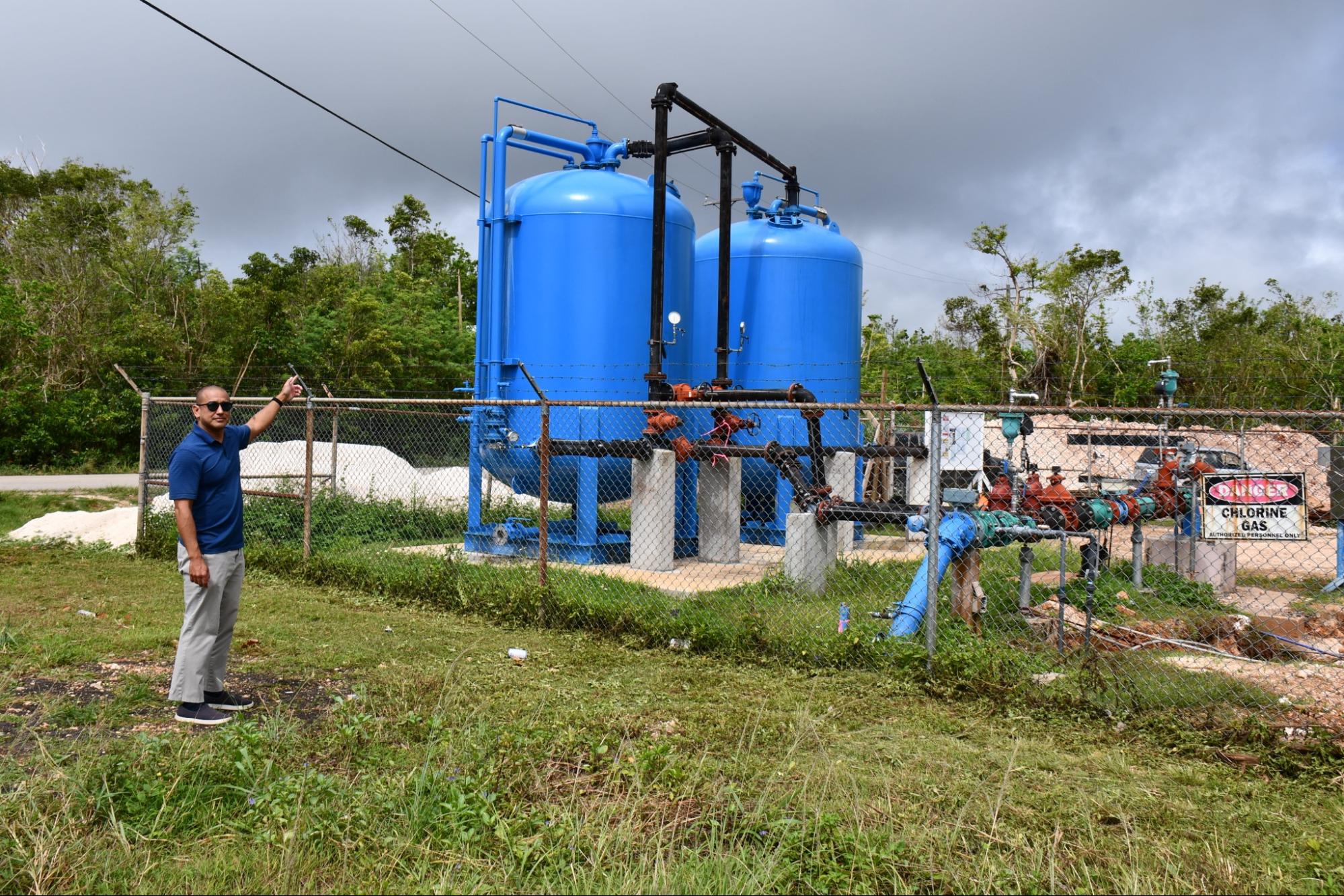
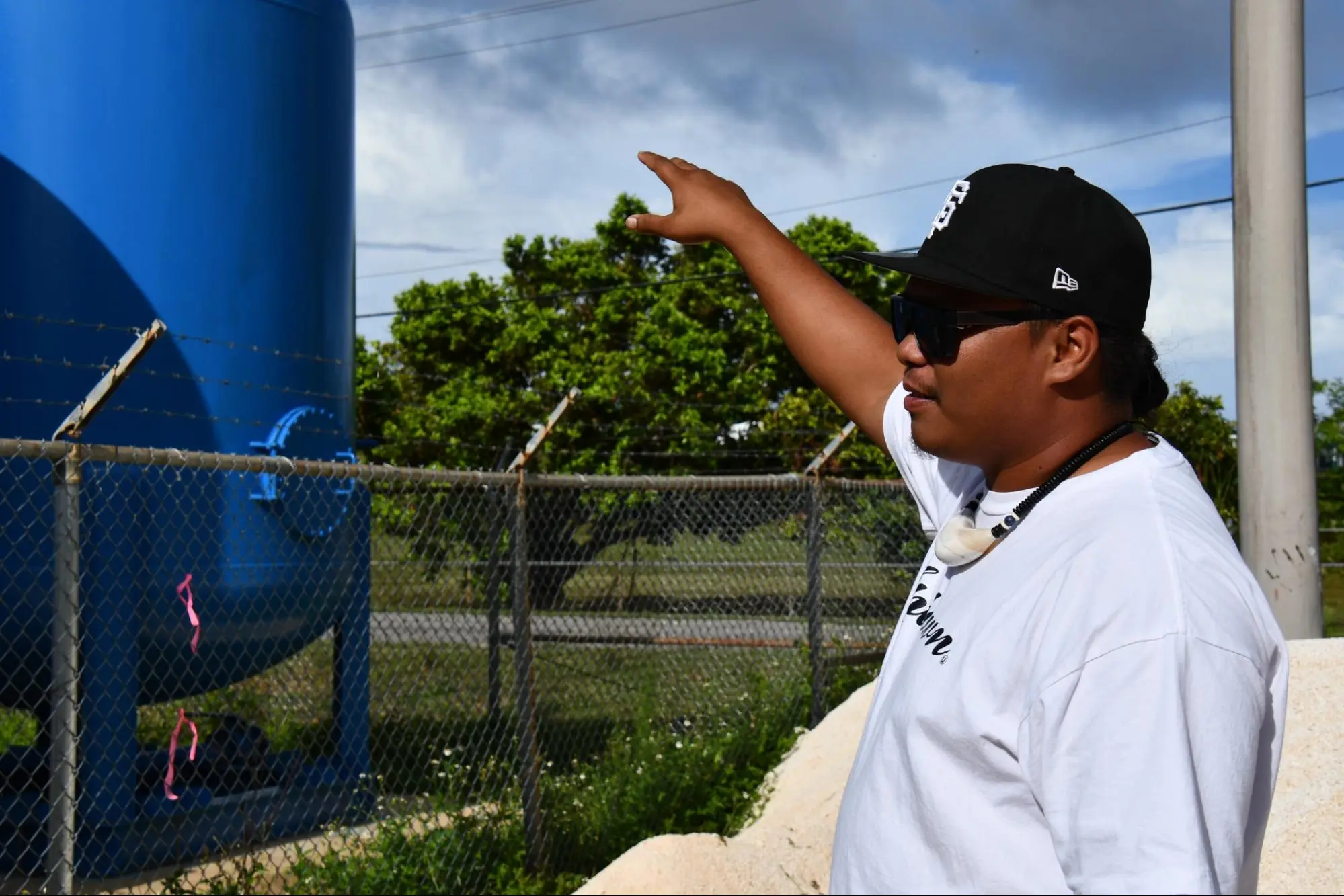
Leevin Camacho stands before the well serving his home in Yigo which was found to have been contaminated with high levels of dieldrin. Anita Hofschneider / Grist
For Camacho, the news felt like the unfolding of a familiar story — one both predictable and infuriating.
Camacho had grown up as an Army brat, raised to think of the United States as Guam’s liberator from Japan during World War II. But over the past two decades, his understanding of that legacy has changed.
“There are certain actions that the military takes that are contrary to the interests of the people who are from Guam and who live in Guam,” said Camacho, whose measured tone rarely changes, even when discussing something as emotional as what his children have been drinking.
To Camacho, dieldrin is the latest reminder that the people of Guam continue to bear the costs of militarization. Unexploded ordnance litters jungles and lagoons. PCBs contaminate the fish. Pollutants taint the groundwater. The island and its people, who are U.S. citizens, have been inalterably changed by more than a century of American military presence.
Rear Admiral Brett Mietus, the head of Joint Region Marianas, the U.S. Navy’s regional command for Guam and neighboring islands, said he can’t speak to past pollution but the command is committed to protecting the environment and the people of Guam.
“We spend a lot of time and we spend a lot of money making sure that we meet every U.S. regulation when it comes to anything that we’re going to do here,” he told Grist. “We’re meeting every letter of every law for environmental regulations and rules, and we’re doing that while we’re spending a ton of money to defend this island from the most advanced missiles in the world.”
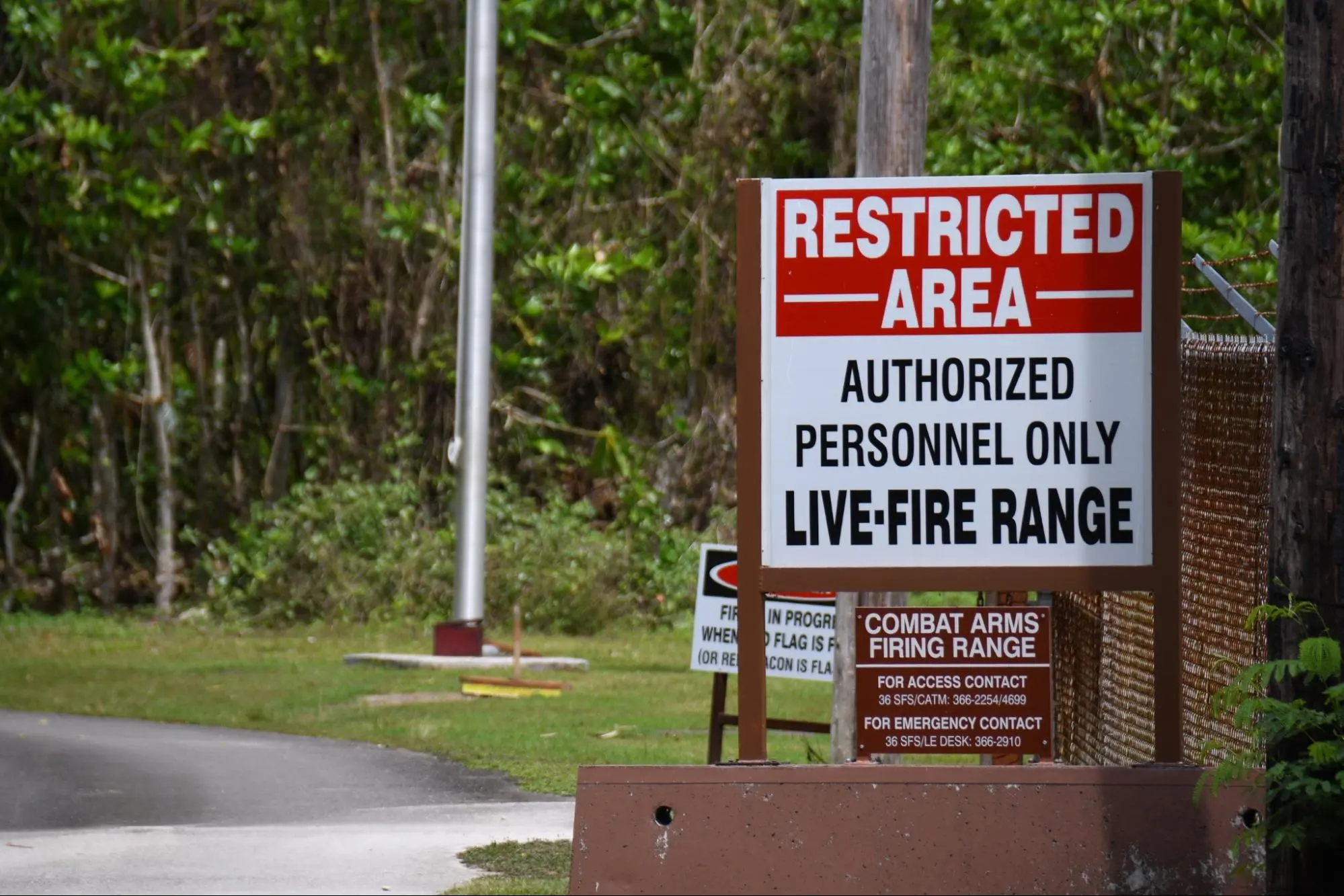
A sign warns passersby not to enter a live-fire range in northern Guam. Anita Hofschneider / Grist
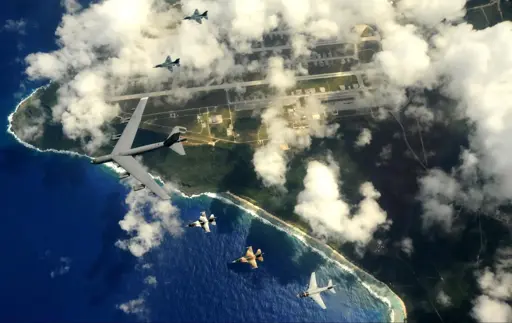
Today, Guam sits at the center of an ongoing military buildup, one that is reshaping the island even as it spreads across the Pacific. On Yap, more than 1,000 graves could be disturbed to make way for an American seaport and airfield. Indigenous leaders on Palau are suing to protect their lands. Less visible but just as impactful are the climate impacts of this expansion. The Pentagon is already the world’s largest institutional emitter of greenhouse gases, and its buildup will do more than contribute to the destruction of the region’s reefs, forests, and Indigenous sacred sites. It will accelerate the climate crisis that threatens the survival of Pacific islands.
The Pentagon often cites growing geopolitical tensions to justify the buildup. “The security environment in the Indo-Pacific is becoming more dangerous and defined by an increasing risk of confrontation and crisis,” Navy Admiral Sam Paparo, commander of U.S. Pacific Command, told Congress in April while seeking $122 billion for new weaponry to counter China, including offensive missiles on Guam. Three months later, a ballistic missile launched from a Chinese submarine flew near the island, underscoring why many on the island see America’s military presence as both a source of vulnerability and protection.
Sometimes it can be too much to think about. “I need to compartmentalize these things,” Camacho said. “That’s sometimes the only way that you can do this, because otherwise you will just be overwhelmed by the sheer amount of things that are out there, the amount of injustice that is out there.”
Read Next
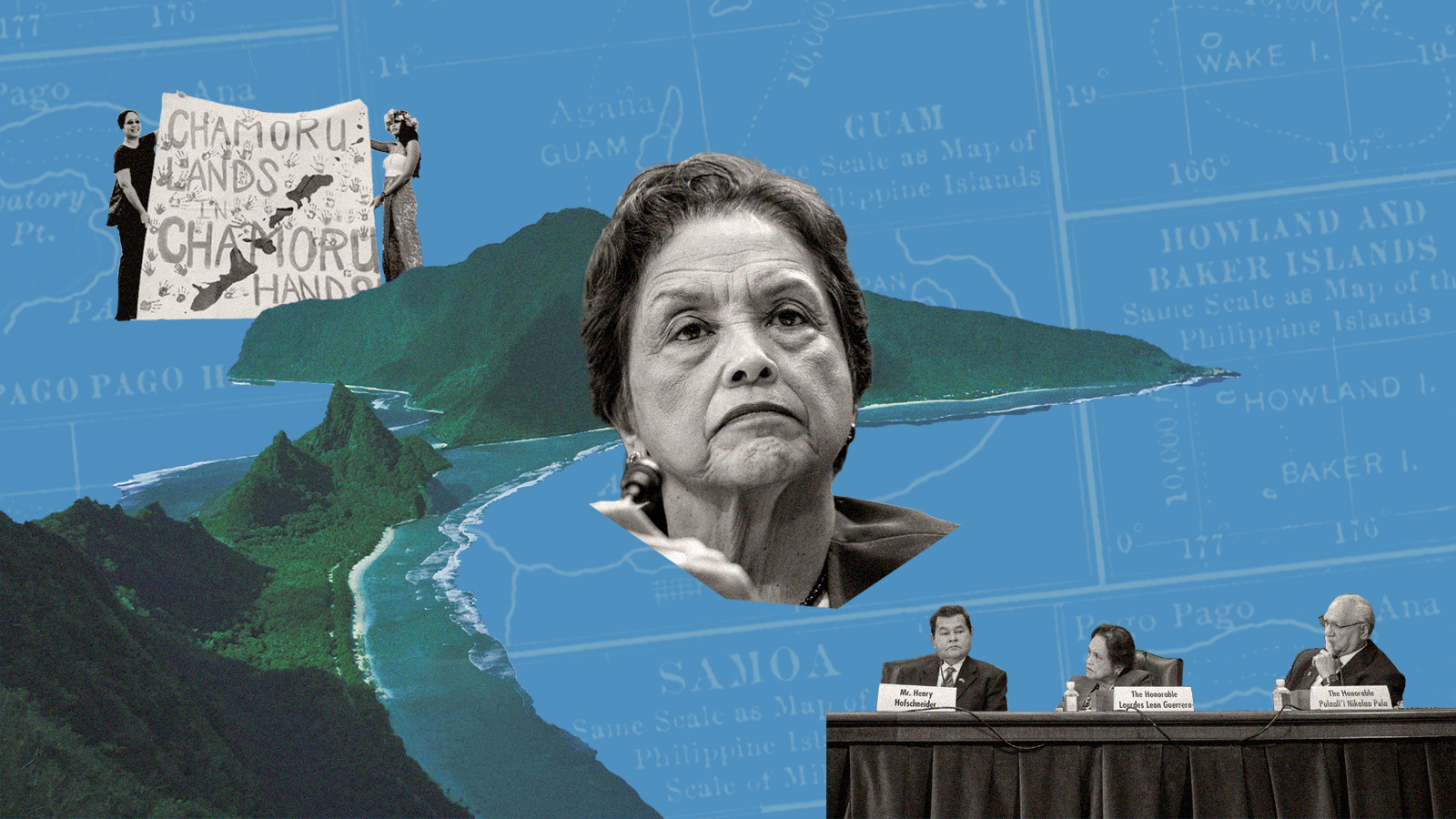
She governs a US territory. But she has no say in who mines its waters.
Anita Hofschneider & Sachi Kitajima Mulkey
Those injustices collide in Yigo. Neighbors lost their homes earlier this year to typhoons fueled by warming seas. The Army Corps of Engineers will soon begin clearing bombs from a nearby dump site created in 1945. A new machine gun range just opened alongside a federal wildlife refuge to support the arrival of 5,000 Marines from Okinawa.
Then there’s the dieldrin contamination. “At some point,” Camacho said, “someone has to force them to do what’s right.”
Years before he became one of Guam’s leading critics of the military buildup sweeping over the island, Leevin Camacho was a young lawyer who liked to run before work. As his sneakers hit the pavement, the sun rose over Yigo. Roosters crowed and streaks of pink lightened the sky. The road, little used and lined with jungle brush, was one of the few places he could run without encountering stray dogs or morning traffic. He always ran at first light, before oppressive heat would reflect off the asphalt and the concrete buildings. It was the perfect start to what was often a day spent listening to depositions and wading through case law.
It was 2009. Camacho had returned to Guam after law school and was making more money than he ever had as a school teacher. “You dream of going to law school to provide services and to fight for people who don’t have the ability to fight, right? I’ll be honest with you, I lost my way,” Camacho said. “I had a bunch of student debt and I was satisfied just kind of going by day to day and just focusing on myself and my family.”
The U.S. military was the backdrop to Camacho’s life but not something he worried about. He didn’t think much about the invasive tangan-tangan trees lining his running route, or the fact they had spread across Guam after the U.S. scattered their seeds to reforest the island following the war. On his morning runs, he was more likely to hear a military jet overhead than a native bird song.
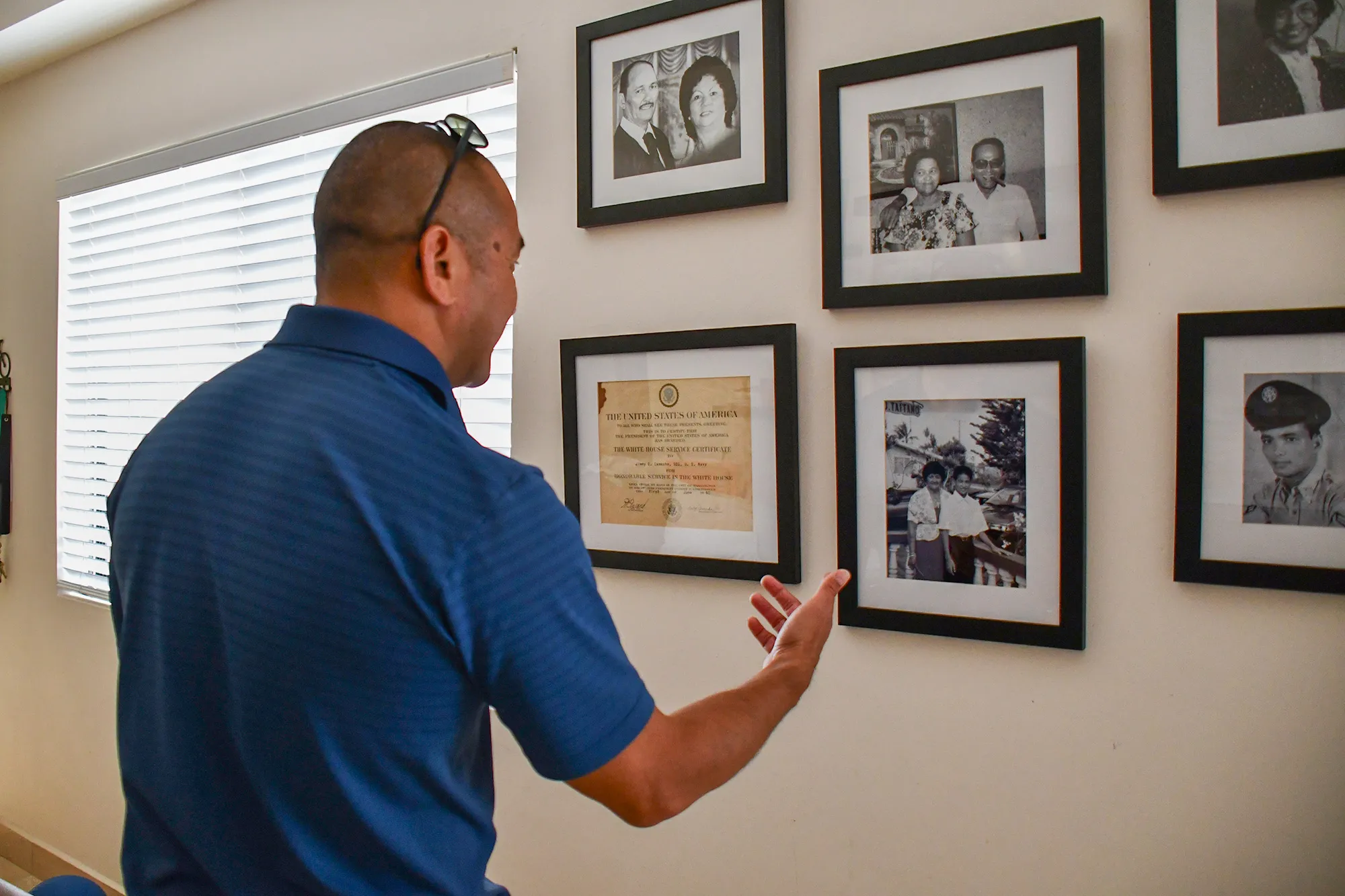
Leevin Camacho gestures at photos of his family in his home in Yigo. His grandparents lived through the brutal Japanese occupation of Guam and rarely talked about it. Anita Hofschneider / Grist
It hadn’t always been that way. Guam was among the first Pacific islands settled by seafarers from what is now the Philippines, who navigated by the stars and waves an estimated 3,500 years ago. The CHamoru people built a thriving island society known for its towering latte stones and swift outrigger sailing canoes.
That changed when Magellan landed on Guam in 1521. Spain claimed the island and the rest of the archipelago, beginning more than 500 years of ongoing colonization. The Spanish forced the Indigenous people to embrace Catholicism and banned their canoes. The United States took over the island from Spain in 1898 and imposed military rule. Naval governors burned CHamoru language books and blocked Indigenous efforts to gain U.S. citizenship.
Then came Japan. Its invasion in 1941, on the same day it attacked Pearl Harbor, wasn’t unexpected. The U.S. Navy evacuated sailors’ dependents but left 20,000 CHamorus to endure nearly three years of forced marches and labor, malnutrition, and sexual servitude. More than 1,000 would die. When American forces retook Guam in 1944, they were welcomed as liberators. The island still celebrates Liberation Day every July. “I can’t remember a single discouraging remark that my maternal grandmother would have made about the U.S.,” Camacho said. But he does remember her saying of the Americans, “They saved us.’”
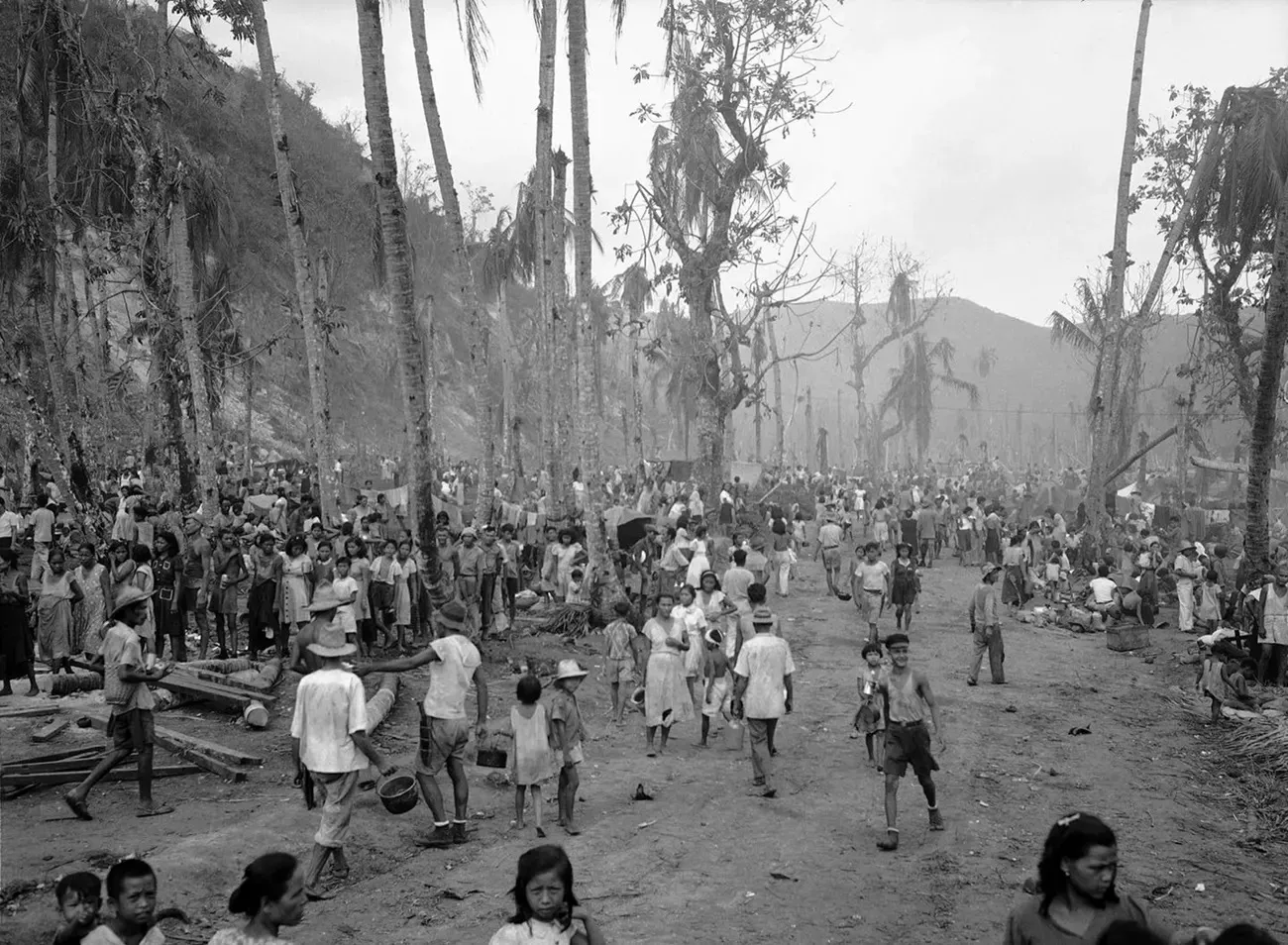
Nearly 18,000 CHamoru were relocated to Manenggon and other concentration camps before the Battle of Guam. Joe Rosenthal / AP Photo
That was the narrative that Camacho grew up with. Even the military taking his family’s land — part of a massive military land grab after World War II — was accepted by his grandparents as the price of freedom from Japanese oppression. It wasn’t until Camacho learned that the Pentagon’s expansion plans would close his running route that he began to question what it meant for Guam to be an American military outpost. He pored over the buildup’s planning documents and was struck by the disconnect between how the military described its plans and the reality as he knew it. “They paid consultants a bunch of money. The comment was, ‘We drove by and we didn’t see any cars, so there’s no impact,’” he said of the running route. “And that was it.”
As Camacho read thousands of pages of documents, he saw the same pattern again and again. Proposals for bombing and machine-gun ranges, expanded undersea explosives, and projects that threatened forests and ancient latte stones were accompanied by detailed assessments that minimized what they would mean for the islands.
Read Next
For Indigenous peoples, conflict means so much more than war
On a flight home from Honolulu, Camacho was reviewing the environmental analysis of the buildup on his laptop when one passage stopped him. The proposed influx of 80,000 people would leave too little water for fire suppression, particularly in Yigo. The solution, according to the document, was to send surplus water from Andersen Air Force base to civilian communities. “That was the first time I just kind of lost it, just how stark it was,” he said. “The aquifer is our aquifer, right? Like, you’re taking our water for your people and then we don’t have enough and they’re going to divert whatever you’re taking from us that is extra.”
Camacho and other concerned residents started We Are Guåhan, a community group focused on raising awareness about what was happening. (Guåhan is the CHamoru word for Guam.) He sued to stop a machine-gun range from being built at Pågat, an ancestral village that’s home to millennia-old latte stones. Their campaign protected the site and helped persuade the Navy not to expand its landholdings on Guam. The Department of Defense also reduced the planned transfer of Marines from Okinawa from 9,000 to 5,000.
But it didn’t stop the buildup. The Pentagon activated Marine Corps Base Camp Blaz six years ago, and opened a new machine-gun range alongside a federal wildlife refuge just north of Yigo. “It’s so heartbreaking,” said Lola Leon Guerrero, another member of We Are Guåhan. (She is not related to Governor Lou Leon Guerrero.) “All of that effort and it still happened.”
The yellow excavator scraped away at the pale rock that lies beneath Camp Blaz under the hot May sun. A limestone forest had already been bulldozed to make way for a new machine-gun training range. A sign next to the fence read, “Guam National Wildlife Refuge” with an arrow pointing to the left and a picture of a turtle.
“Wow,” said Moneaka Flores, one of Camacho’s clients in the lawsuit he filed against the Navy to protect the island’s endangered species. She stopped at the side of the road to watch the digger work. It had been months since she’d been here, and they’d cleared so much more forest than she realized.
Busy construction vehicles are the most obvious sign of the Pentagon’s buildup. Beyond the new Marine Corps base, the Department of Defense is upgrading the island’s port and strengthening its infrastructure to support docked nuclear submarines. The agency is also pouring $8 billion into 16 new missile defense sites. After World War II, the Navy took two-thirds of the island. “Whatever made most sense for the military, the island was theirs for the taking,” said Michael Clement, a historian at the University of Guam. “Everyone was in refugee camps. They had the bulldozers. They built where they wanted to build. And then a year or two later, they started saying, ‘OK, where are we going to put the natives?’”
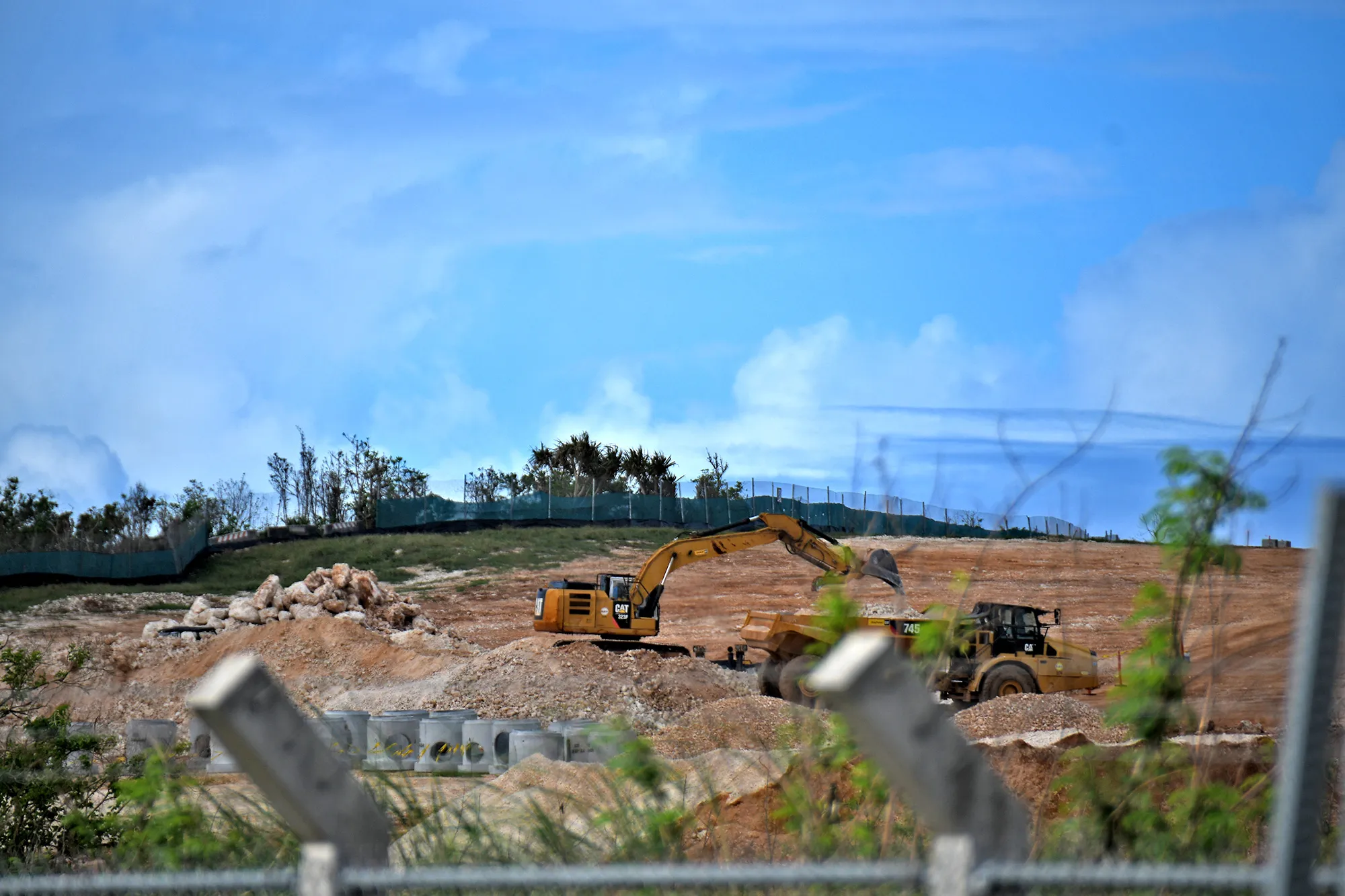
Construction on Camp Blaz proceeds in May 2026. Anita Hofschneider / Grist
The military later relinquished some land but still owns at least a quarter of the island. “If you look at where the villages were set out in 1946 and ’47, it’s the land the military didn’t need. So that’s why Guam is kind of weird to drive around, right?” Clement said. “To go across from Tumon to Mangilao, you’ve got to go around Tiyan and the airport. It wasn’t redesigned for civilians. It was redesigned for military purposes.”
Even the island’s main highway, the six-lane Marine Corps Drive, was designed for the military, not the people. It connects Andersen in the north and Naval Base Guam in the south.
Governor Lou Leon Guerrero is among the many who welcome the financial boost that comes with the military’s investments. “They’re spending billions on their readiness plan,” she said.
One in nine Guam residents joins the armed forces. Last year, a local economist told the Legislature that every dollar the Pentagon spends adds 75 cents to the island’s GDP and called the buildup an “unprecedented economic opportunity.” The funding infusions have helped Guam become far more commercialized than other Pacific islands, with multiple shopping malls, numerous high-rise hotels, and a growing real estate sector.
Leon Guerrero thinks activists should pursue political self-determination instead of resisting the buildup. “These guys can yell and scream all they can,” she said. “They’re going to do the military buildup regardless, right? So why don’t we work with them and see how we can benefit?” She wants the Department of Defense to help harden local power lines and fund a hospital. “Our hospital cannot absorb mass casualties,” she said.
There are about 20,600 military personnel on Guam, a figure that’s expected to reach 29,400 by 2037. While the military is investing in additional housing both on and off base, the population influx will almost certainly continue pushing up construction and housing costs. The median home price on Guam was $216,100 in 2010, when Camacho sued the military to protect Pågat. Today it is approaching half a million dollars.
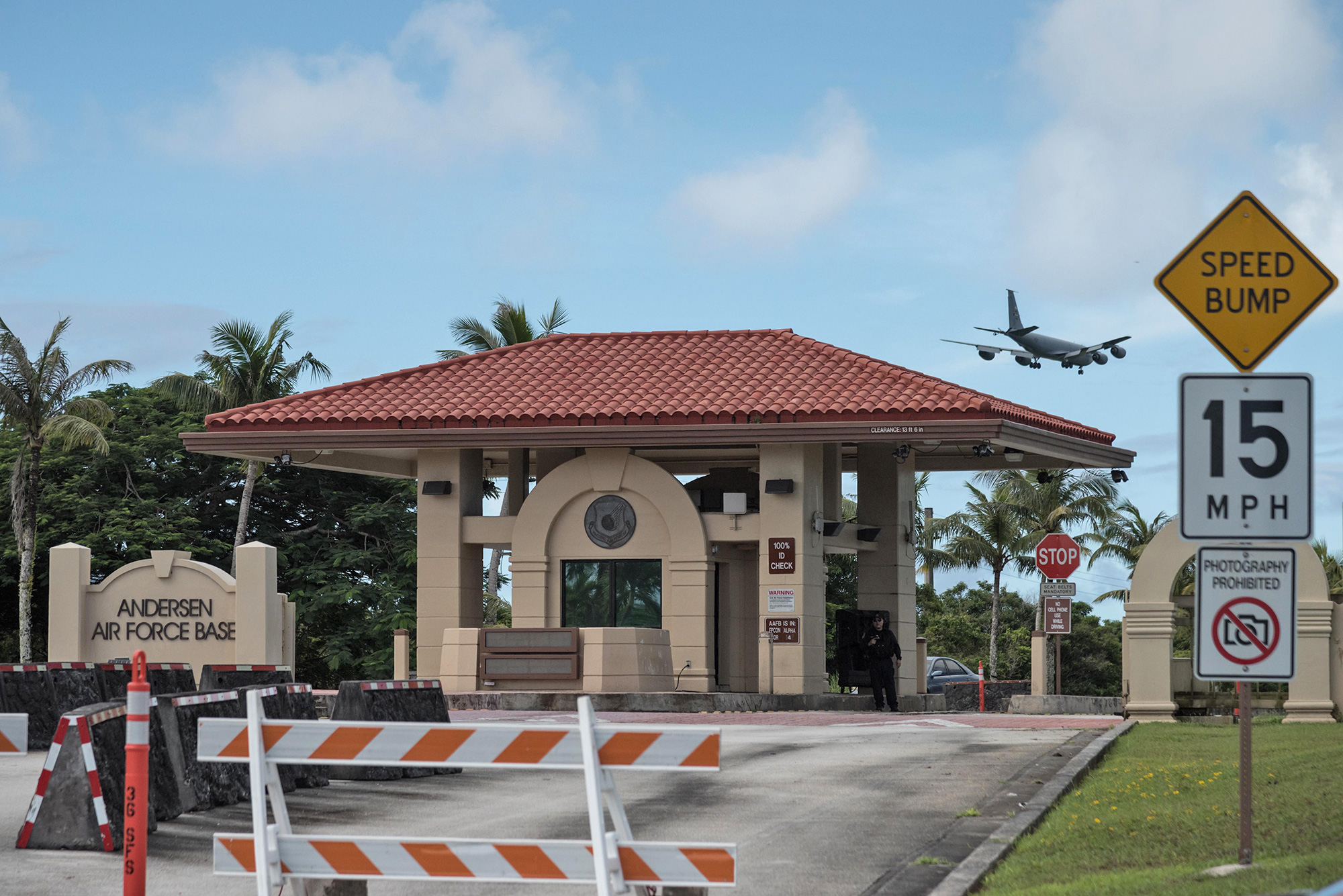
Andersen Air Force base in northern Guam is among the sites of an ongoing U.S. military buildup that stretches across the Pacific. Anita Hofschneider / Grist
Fear of another war also fuels support for the buildup. “We’ve always been a target regardless, because of where we are geographically located,” Leon Guerrero said. Guam is the largest island in the Micronesian region of the Pacific. It’s just north of the equator, a three-hour flight from Tokyo, and has a deep-water harbor that supports naval submarines. “We were a target for Spain. We were a target for the U.S. We were a target for Japan.” She worries about China, which has a ballistic missile nicknamed the “Guam Killer.” “If I’m going to have a choice, I’d rather be under the U.S. than China.”
To Flores, more military presence on Guam heightens the risk of war. In March, President Donald Trump’s decision to bomb Iran prompted military bases on the island to raise their threat level. She feels that, as in World War II, the Indigenous people of Guam are expendable in a broader contest between empires. “What are they really here to protect if there’s so much harm taking place? Are we just collateral damage?” she said. “Because just looking at our history of being occupied by war, being used for weapons testing, it feels like the message is that we don’t matter. Our future doesn’t matter. Our survival doesn’t matter.”
Rear Admiral Brett Mietus, at Joint Region Marianas, said he understands such skepticism. “If I was born and raised on Guam, I would have similar concerns,” he said. But he believes the militaryʻs investment proves the opposite of what Flores fears. “Choice A is not to defend Guam against ballistic and hypersonic missiles,” he said. “Or the other choice, which is the one that we’ve made, is to spend billions of dollars to defend Guam from hypersonic and ballistic missiles. And so from my perspective, that shows a commitment not just to the military things that are on Guam, but also to the people of Guam.”
Yet Flores is far from the only Guam resident who feels expendable. When Pedro Blas, the vice mayor of Yigo, first learned about the dieldrin in his village’s water, his first thought was of his autistic sister. “All of us growing up, all our lives, our water bottles, we fill it up with the tap water, put it in the fridge: That’s our cold water,” he said. “Because we were instilled in our heads our whole lives: Tap water is OK.”
Pedro Blas, the vice-mayor of Yigo, has been hearing from many constituents who are concerned that long-term exposure to dieldrin could have caused cancer in their families. Anita Hofschneider / Grist
So far, Camacho’s firm has helped file more than 700 claims, worth $360 million, against local authorities on behalf of village residents. He hopes that pressures the island to seek compensation from the Department of Defense. “I’m so glad [Camacho] got involved,” Blas said. “We’re not letting it get swept up under the rug.” Mietus noted that Joint Region Marianas has not found high levels of dieldrin in military wells, and the Pentagon is working with local officials to determine the source of Yigoʻs pollution.
Still, Blas wonders why the investigations at Andersen Air Force base are occurring quietly behind the fence, while he hasn’t seen anyone in uniform hand out water to his constituents. “It’s beautiful to be a U.S. citizen, don’t get me wrong,” he said. “But if you really take a step back and look at exactly the impacts that [the military] brought to us over the years, we should have a say in whether or not these practices are going to happen to our island. Even just being called the ‘tip of the spear’ — we’re susceptible to any war that they’re going fight, and we just have to be OK with it.
“This contamination they bring to our island, it kind of just shows how much they really care about our people,” Blas continued. “And frankly, I think they look at Guam as real estate rather than, ‘Those are our U.S. citizens. Those are our people. Those are Americans.’”
The men and women gathered in the p’ebay, the traditional open-air Yapese meeting house with a triangular tin roof, and settled quietly on the tiled floor along each wall to listen to Camacho speak. A projector, perched above a cardboard box stacked on top of a red cooler, cast his PowerPoint presentation onto a screen. Slide after slide described the American military’s plans. A cool breeze fluttered the fronds on the palm trees surrounding the p’ebay.
It was April in the village of Tamil on Yap, one of four states in the Federated States of Micronesia. Camacho’s dieldrin work was far from over, but he’d put that aside when the island state’s government asked him to help dissect a Navy proposal to expand the seaport and airport. Tamil was one of several villages he visited to explain the plan.
Over the past decade, Camacho has become one of Guam’s leading environmental lawyers. “The one thing about Leevin is he shows up. Again and again,” said Julian Aguon, a human rights lawyer on the island. “And he brings with him not only deep competence but a deep sense of responsibility to the people and places he serves.”
“Regulatory agencies will bend over backwards to not pick a fight with the military because of the mission and the protection and all of that,” Camacho told Grist. “And ultimately, it’s people who aren’t lawyers who end up paying the price.”
He was elected attorney general in 2018 for one term and led a historic lawsuit to force the Navy to clean up a hazardous landfill it had abandoned in the 1940s. A lower court dismissed the suit, but the U.S. Supreme Court unanimously ruled in 2021 that it could proceed — a decision that eventually prompted the federal government to pay Guam $48.9 million.
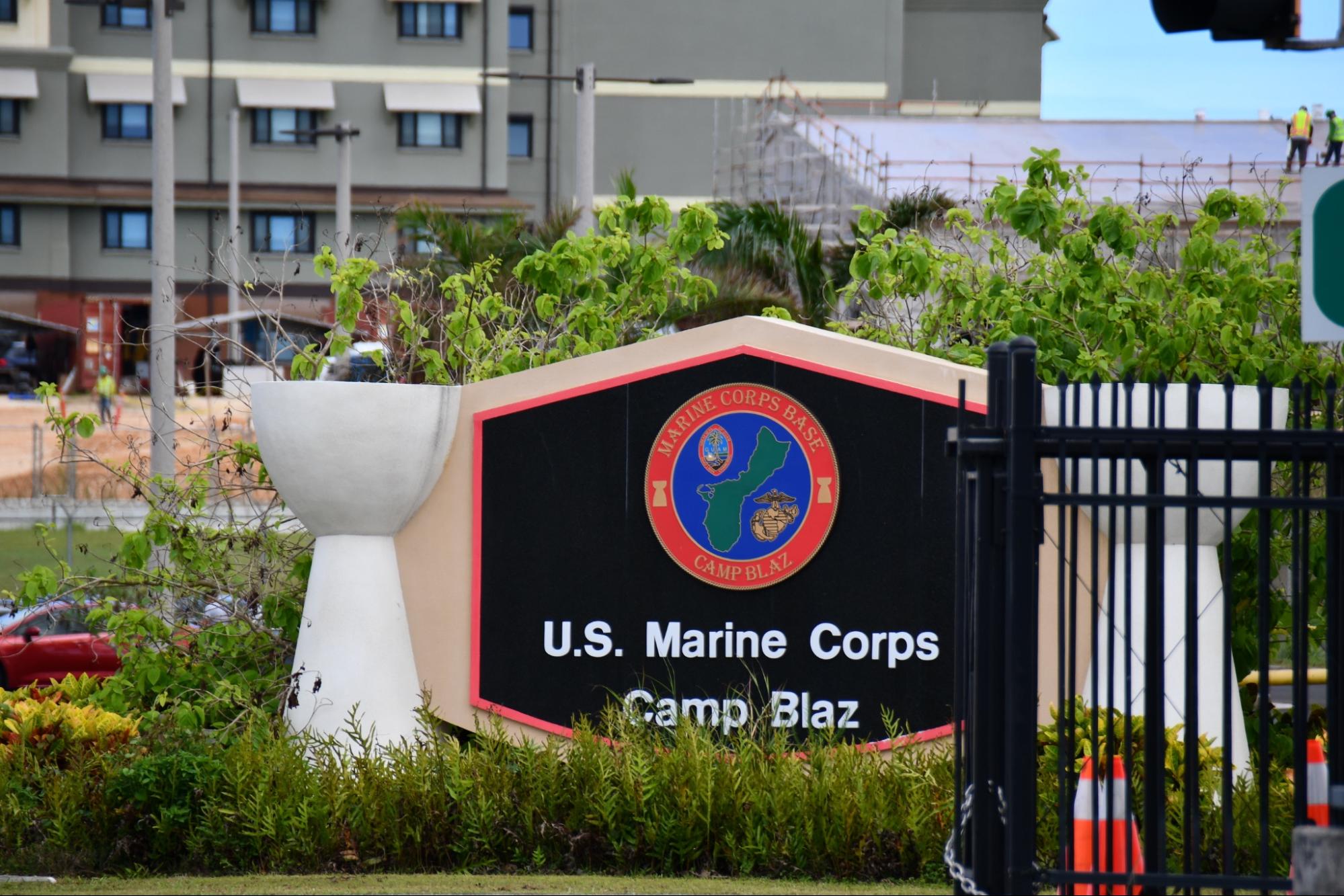
The newly opened U.S. Marine Corps Camp Blaz in northern Guam is expecting an influx of 5,000 Marines from Okinawa. Anita Hofschneider / Grist
He has sued the Navy to protect endangered species harmed by the construction of Camp Blaz. “For too long, our island has been treated as a sacrifice zone,” he said.
The risk of Guam falling into enemy hands, as it did in World War II, is so tangible that America’s Pacific military strategy involves spending billions of dollars to spread airfields, seaports, and training ranges across the region to remain competitive in case Guam is once again occupied by enemy forces. The U.S. is invoking decades-old agreements with the peoples of the Republic of Palau, the Northern Mariana Islands, and the Federated States of Micronesia to expand its presence on those islands and upgrade World War II-era seaports and airfields. Under President Joe Biden, the U.S. even signed a new agreement with Papua New Guinea to use its seaports.
On Yap, the U.S. military wants to dredge the lagoon, including two-thirds of an acre in a marine protected area, to create a seaport. The plan would remove enough sediment to fill 334 40-foot shipping containers and impact sea life, Indigenous fishers, and divers. “Plume spreads up to 800 m from disposal sites,” Camacho’s presentation noted. “Long-term reef decline and impact on reef species (fish, clams, sharks, turtles) not assessed.”
The Navy also plans to expand the airfield to facilitate two military exercises, each two weeks long and involving up to 200 personnel, per year. The project could disturb more than 1,000 graves, including the 19th-century tombs of Chief Orothin and Chief Yaloth. Camacho noted that the military’s draft plan acknowledges a “significant adverse impact” to these cultural sites and doesn’t commit to rebury the dead or preserve ancestral sites.
Yap has a population of just about 11,500, compared to Guam’s 170,000. Although Yap is less than a 90-minute flight from Guam, it has none of the military bases, six-lane highways, or big-box stores that define the American territory. “In some ways, this will be more transformative for Yap State than the buildup was for Guam because there’s no military presence there today,” Camacho said. On Guam, he said, “It’s normal to hear a fighter jet flying over. It’s normal to see a bomber or C130. They don’t have any of that there. So this would be such a radical change.”
One month after Camacho visited Yap, dignitaries from across the Pacific gathered in an air-conditioned conference room at the Hyatt Regency Hotel in Guam. The hotel sits on a long stretch of white sand beach and looks out over Tumon Bay, where high levels of dieldrin have also been found in fish samples.
Once everyone had taken a seat, the lights dimmed and the glow of a projector filled the room. A screen showed a map of military activity across the western Pacific: not just bases, but training exercises and the routes of research vessels searching the sea floor for the critical minerals essential to many military technologies.
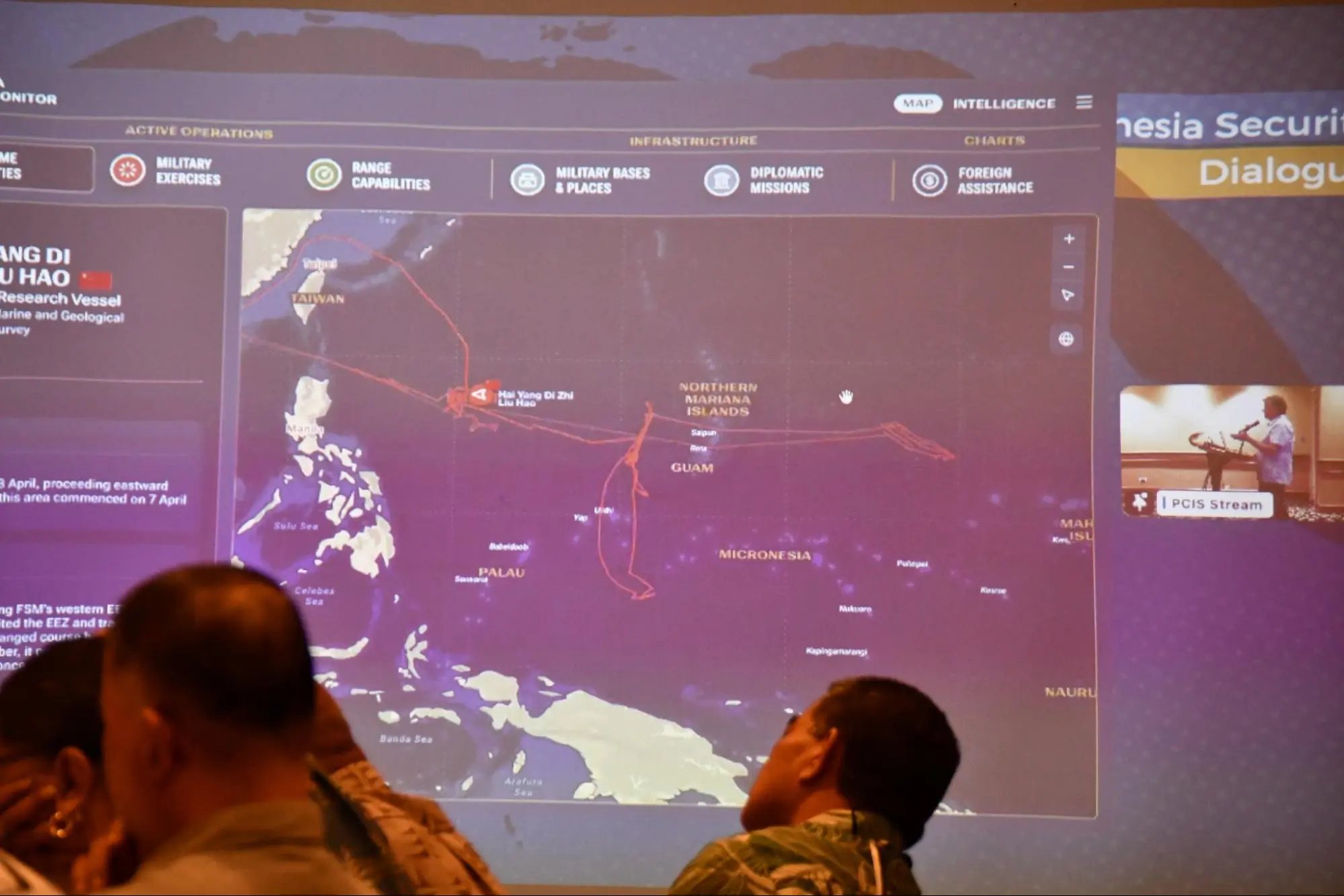
Political leaders from across the Pacific listen to presentations on the growing military presence in their region at a conference in Tumon, Guam. Anita Hofschneider / Grist
“We’re faced with the reality that we’re part of a larger strategic vision,” conference organizer and former Guam congressman Robert Underwood said. “All of you are in someone’s strategic plans whether you know it or not, whether you like it or not. All of us are in someone’s strategic plan.”
In Palau, Indigenous people are fighting the Pentagon’s expansion in local courts and international forums. Leaders of Angaur, one of 16 states there, filed a lawsuit accusing the U.S. of violating environmental rules and its treaty with the island nation when it cleared land for a radar facility. Indigenous chiefs from Peleliu are suing to prevent a land transfer that would support American goals. Indigenous Palauan youth filed a complaint at the United Nations alleging the U.S. military violated their right to free, prior, and informed consent to what happens on their land.
In the Northern Mariana Islands and the Marshall Islands, the U.S. military presence that started with World War II is ramping up. On Tinian, the Marine Corps is building an airfield and two live-fire training ranges, one of them for explosives. The Navy is extending its undersea sonar and explosives training across half a million square nautical miles, along with bombing practice on the neighboring island of Farallon de Medinilla.
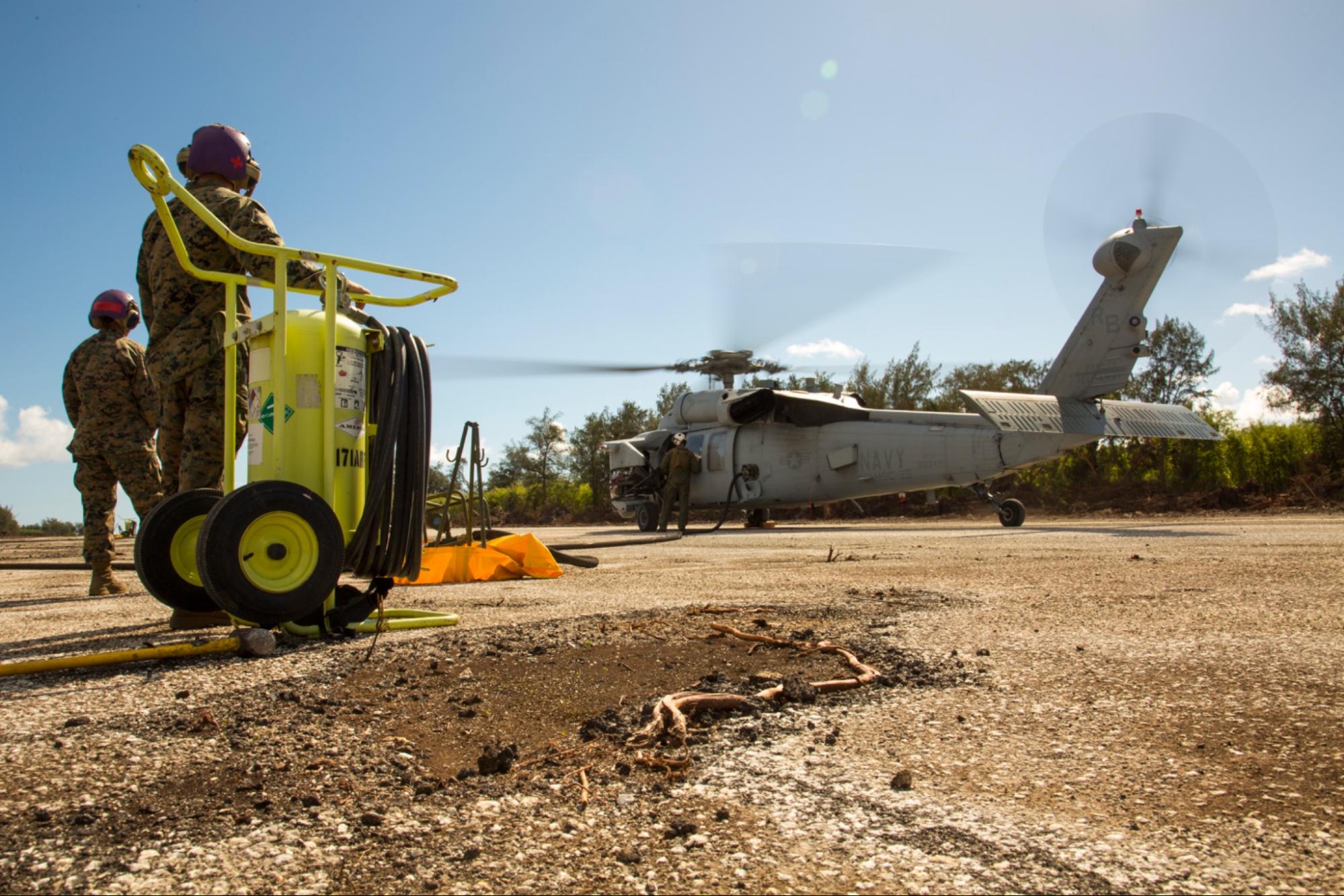
A U.S. Navy MH-60S Seahawk helicopter assigned to Helicopter Sea Combat Squadron 25 refuels during forward arming and refueling point training at North Field, Tinian, Northern Mariana Islands, on Dec. 9, 2013. Lance Cpl. Antonio Rubio / U.S. Marine Corps / Department of Defense
Some hope the military’s regional expansion will enable other island nations and territories to experience the economic growth seen on Guam. But others worry about the pollution and cultural loss, and other risks that come with being a U.S. military stronghold.
In public comments written in response to the Navy’s proposal, Jennifer Dugwen Chieng noted that Camacho’s fight to have the Navy address hazardous waste at Ordot Dump went all the way to the Supreme Court. “Additionally, there are sacred private lands and culturally significant ecosystems that no amount of money can ever replace,” she wrote. “The desecration of graves violates the general principles of respect for burial sites and human remains upheld in Yap’s traditional custom.”
She’s also worried about becoming a target in the next war. Like Palau, Yap was held by the Japanese during World War II and experienced heavy bombardment by the United States. Since then, the Pentagon hasn’t paid much attention to the island state — until now.
“With rising tensions in the region between the U.S. and China, what does the DoD envision combat to look like?” Chieng wrote. “Will it be based on a WWII tactic of island hopping? What is the likelihood of the island becoming a battlefield if tensions were to escalate into war? Yap will be caught in the crossfire. Does the DoD intend to protect and defend the people of Yap, and if so, how does the DoD intend to do that?”
Mietus told Grist thereʻs always a level of risk in being allied with the U.S. during a conflict.
“Sometimes people believe it’s a plan to evacuate U.S. service members or family members if a war starts — there is not,” he said. “I’m in this, living in the same risk as every other person here.” He’s pushed back against Guam lawmakers’ calls for the Defense Department to fund bomb shelters for civilians, contending that the existing military projects like strengthening Guam’s harbor are a better investment. “Oftentimes people see this Department of War as kind of having an infinite amount of money, and we don’t.”
Unlike Guam, Palau and the Federated States of Micronesia are independent countries that have achieved the political self-determination that Indigenous CHamoru on Guam have been denied for centuries.
Camacho wants a plebiscite to determine Guam’s political status. He believes the island’s status as a U.S. territory — without a vote for president or voting representation in Congress — isn’t working. But while some of his colleagues in We Are Guåhan have focused on independence, Camacho sees his own role as making the government answer for its actions.
“Unless someone’s forcing the issue,” he said, “the Department of War isn’t going to voluntarily agree to be held accountable and agree to do all the things that it’s supposed to do.”
That’s why he feels compelled to seek reparations for the dieldrin contamination. So often, toxic pollution lingers on Guam and no one takes responsibility. “As a lawyer, I don’t want to fall into this situation where we’re like [the village of] Malesso, and they show up every year and say you still can’t eat the fish. That’s just not satisfactory,” he said.
One question that drives him is what Guam will be like when his kids are grown. Will they be able to afford living there? Will they want to, given how much the island is changing? It’s a constant effort to find the right balance between working toward their future and being there for them day to day.
“I’m going to try to do the best that I can to protect my island and to have a safe place for my kids to want to live on Guam,” Camacho said. “But also be there for them and help them get better dribbling with their left hand and be good human beings.” Even though Camacho moved a lot growing up, his family never considers leaving. “That is not a choice,” he said. “Guam is home — there is nowhere else we are going to be.”
This story was originally published by Grist with the headline As the Pentagon expands across the Pacific, Guam offers a warning on Sep 24, 2026.
From Grist via This RSS Feed.