

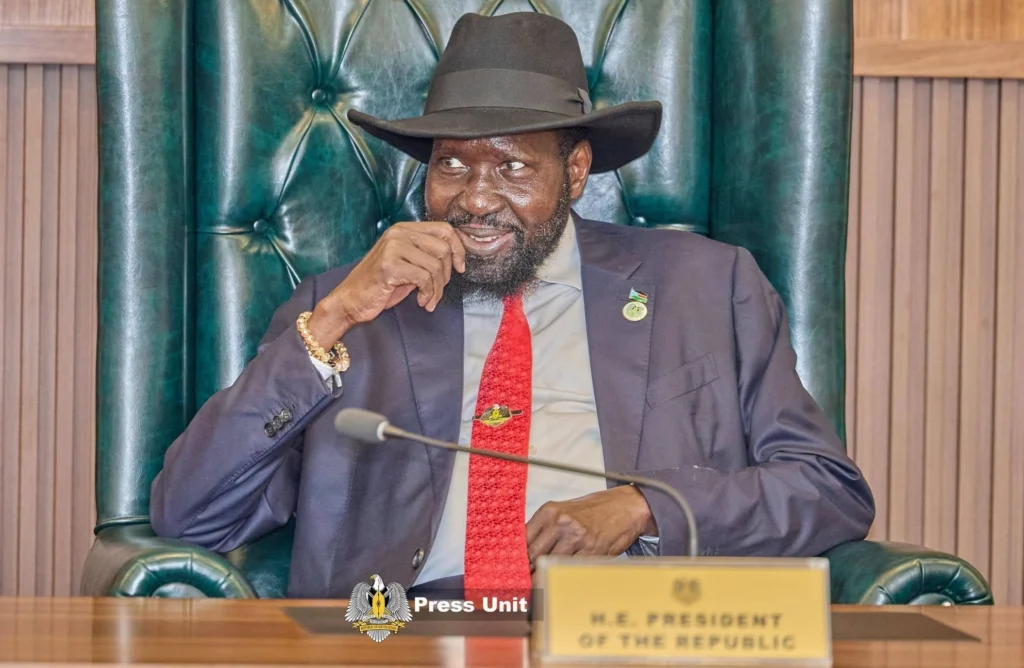
South Sudan’s President Salva Kiir dissolved the transitional government and legislative assemblies, effectively taking absolute control ahead of the country’s first general elections scheduled for December 22.
On September 23, President Salva Kiir issued a presidential decree dissolving the Government of National Unity and the Legislative Assemblies of South Sudan. This move, announced via the national broadcaster, aims to establish a provisional administration ahead of the upcoming elections.
The decree removes all vice-presidents, ministers, and local administrators from their positions, while the national parliament and regional legislatures are also dissolved. Only the judicial system and security forces will remain operational during this period.
RELATED: Clashes In Sudan’s Border With Ethiopia Causes About 20,000 Displacements
Kiir will retain his executive functions without legislative checks until the newly elected president takes office. This restructuring marks the end of the power-sharing agreement established by the 2018 peace deal, which concluded five years of brutal conflict that resulted in approximately 400,000 deaths and millions displaced, according to UN estimates.
The presidential resolution came just 24 hours after the Parliament of Juba approved amendments to the National Elections Law. These changes allow the elections to proceed without completing the drafting of a permanent constitution or conducting a population census, both of which were previously linked to the transitional phase.
President Salva Kiir has sworn in South Sudan’s newly appointed caretaker government, calling on officials to unite, move swiftly, and prioritize service delivery as the country prepares for general elections in December. pic.twitter.com/slq5INs3W4
— South Sudan Government (@SouthSudanGov) September 23, 2026
In the week leading up to the decree, Kiir replaced the head of the electoral commission with Gabriel Bol Deng Majok, who previously led the South Sudan Broadcasting Corporation (SSBC). Majok’s new role involves coordinating the logistics of the electoral process.
Opposition Reaction
The legal amendments and the dismantling of the shared cabinet have drawn immediate rejection from the country’s main opposition alliance. Civil society figures and legal analysts have voiced concern over the concentration of executive and legislative power in a single political figure.
The pre-election scenario in South Sudan is unfolding under a tight security deployment in the capital, Juba. Police and military forces have established checkpoints and vehicular blockades around the government complex, with security personnel on high alert.
Several institutional commitments outlined in the 2018 roadmap remain pending, including the official registration of voters, the final drafting of the constitutional text, and the unification of armed forces loyal to different political factions.
The dissolution of the transitional government and legislative bodies has raised serious concerns about the democratic process in South Sudan. Critics argue that Kiir’s move consolidates his power and undermines the principles of the 2018 peace agreement. The opposition and civil society groups have called for international intervention to ensure a fair and transparent electoral process.
The international community, including regional and global actors, has expressed concerns over the developments in South Sudan. Diplomats and human rights organizations have urged Kiir to uphold the commitments made under the peace deal and to ensure that the elections are free, fair, and inclusive.
As South Sudan prepares for its first general elections, the dissolution of the transitional government has cast a shadow over the democratic transition. The concentration of power in the hands of President Kiir raises questions about the future of governance and the potential for renewed conflict in the country. The coming months will be crucial in determining whether South Sudan can achieve a peaceful and democratic transition or if it will be mired in further instability.
From teleSUR English via This RSS Feed.