

This article by Nancy Flores originally appeared in the September 22, 2026 edition of Contralínea, a Mexican investigative journalism magazine.
After the electoral fraud of July 2006, Felipe Calderón devised a trans-sexennial plan he called “Mexico 2030. Grand Vision Project,” in which he outlined the route for the total surrender of the country to US interests. Chapter 5 proposes that our nation would be governed by “Mexican-Americans” and will have been “integrated” into North America. The objectives: public policies dictated directly from the United States, the creation of “shared institutions,” subordination of the Mexican Armed Forces so that they would intervene in international conflicts for “hemispheric security,” thereby abandoning the principle of non-intervention. In addition, it established a route to abandon the concept of “sovereignty.” According to that Calderón plan, the country’s development should not be of the BRIC type (Brazil, Russia, India, China). Now, President Sheinbaum is promoting an initiative to prevent persons with dual nationality from reaching the Presidency of the Republic, which today was approved in general by the majority in the Chamber of Deputies.
Three months after the 2006 electoral fraud and when he had already received the certificate accrediting him as president-elect, the PAN member Felipe de Jesús Calderón Hinojosa, together with PRIAN politicians, right-wing intellectuals and communicators, as well as supposed members of “organized civil society,” outlined a document called Mexico 2030, Grand Vision Project. That plan established a route for the total surrender of the country to transnational interests, in particular to US ones.
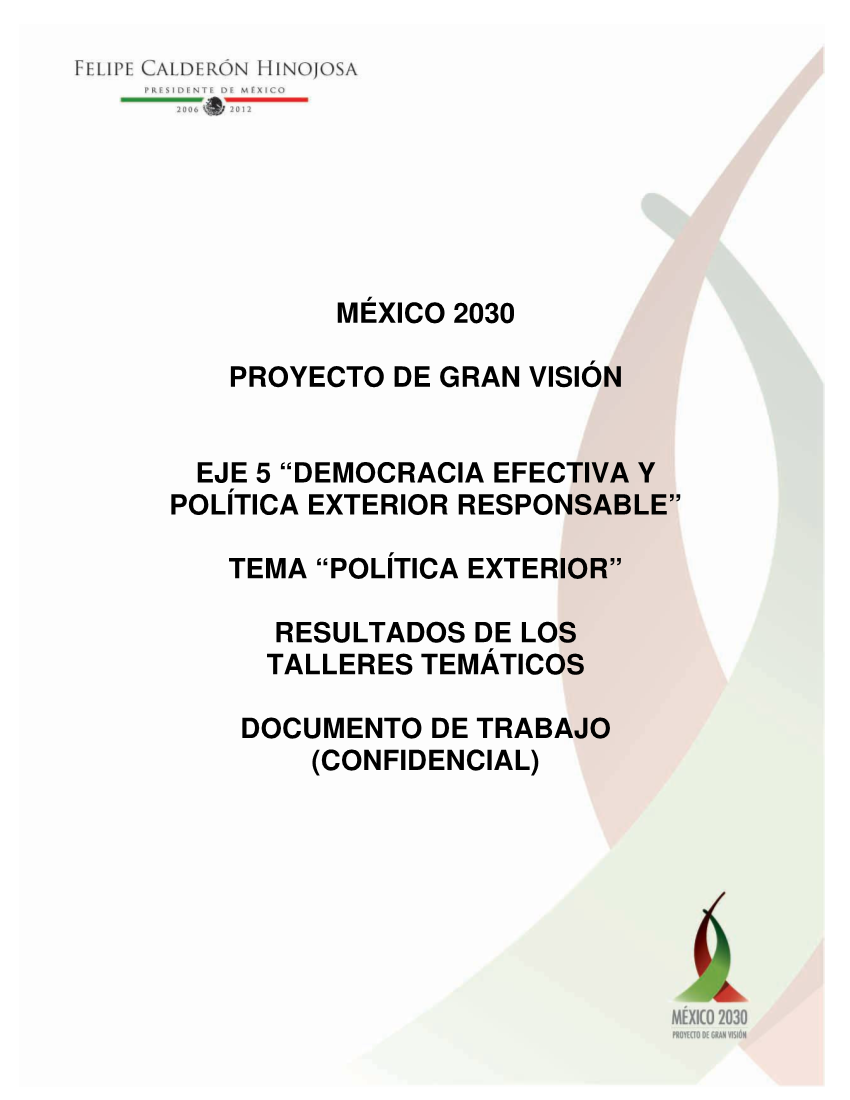
In its last chapter, “Axis 5. Effective Democracy and Responsible Foreign Policy,” the document in the possession of Contralínea highlights that among the objectives for Mexican foreign policy was the aspiration that by 2030 “some Mexican-Americans” would hold “relevant public positions in certain areas,” as part of the “process of integration with North America.”
The route for people born in the United States to begin governing Mexico was to start with positions related to the “financial, commercial and public policy areas.” With this, supposedly, the country would achieve a “consolidated leadership.”
The plan is especially relevant now that the Congress of the Union is discussing the reform initiative sent by President Claudia Sheinbaum Pardo so that people who aspire to govern Mexico or its federal entities do not have dual nationality, and which on the afternoon of this September 22 was approved in general in the Chamber of Deputies.

Asked this morning by Contralínea about the PAN’s surrender to foreign interests, and in particular about this plan by Felipe Calderón, President Sheinbaum commented that in the coming days she will review that information and even make it public at the morning press conference. In addition, she questioned the opposition that refuses to legislate so that there are no people with two nationalities in the Presidency of the Republic and in state governments.
“In the Constitution it was established that to be president […] your parents had to be –both of them– Mexican: mother and father. Later, the Constitution was changed so that one of the two could be born in another country. But beyond who your parents are –which ultimately you don’t decide–, you, as a Mexican, now to run, the issue is: to whom do you owe yourself? Do you have two flags? Do you have two homelands? No, you only have one, because you are the highest representation of Mexico. So, it is incomprehensible [why they don’t want to vote for it]. Because it is not taking away any right from anyone, it is only if you are going to run for president or for governor.”
You can only have one master, and that is the people of Mexico.
President Claudia Sheinbaum
Calderón’s Plan
The resistance of the opponents, especially the PRIAN, is explained by their own history of surrender to foreign interests, and especially by the neoliberal politicians who have systematically favored the interests of the United States. An example of this is precisely Felipe Calderón’s so-called “Grand Vision Project,” which also established that the country will be “a fundamental part of a North American community, encompassing Mexico, the United States and Canada.”
The document –made in the context of the thematic workshops convened by the PAN member Calderón Hinojosa in October 2006, amid social discontent over the imposition of his future government– added that this “North American community” will be “integrated with shared policies and institutions, including a common security space and a deep relationship in matters of migration, trade and investment.”
The document –which was originally classified as confidential and later declassified by the Calderón government– proposed abandoning the conception of sovereignty: “Concepts considered ‘sacrosanct,’ such as sovereignty, must be reconsidered, since they trigger debates that may come to contaminate the country’s international agenda.”

Military Annexation
The file Mexico 2030, Grand Vision Project consists of 14 documents totaling 831 pages. Originally classified as confidential, they contain the results of the thematic workshops convened by the PAN member Felipe de Jesús Calderón in October 2006, after being declared president-elect of Mexico by the Electoral Tribunal of the Federal Judiciary and in the midst of the post-electoral crisis.
These workshops were sponsored by the Trust to Support the Change of Administration of the Federal Executive and were divided into five axes: 1) rule of law and public security; 2) competitive and job-generating economy; 3) equal opportunities; 4) sustainable development; 5) effective democracy and responsible foreign policy.
In its note “xvi,” corresponding to the chapter “Axis 5. Effective Democracy and Responsible Foreign Policy,” the document reveals that the Calderón plan –accompanied by those who also backed the electoral fraud– sought for the Army and the Navy to participate in invasions and international conflicts. By agreeing in the workshops on the “vision” that Mexico will be “a country with leading armed forces that contribute to consolidating hemispheric leadership,” the authors of the plan agreed that “the role of the Army would not be limited to its intervention in conflict situations, since its collaboration was also very valuable in other non-belligerent situations, such as natural disasters.”
Another point of interest revealed by Calderón’s Grand Vision Project is that, by 2030, Mexico would be “a very active country in the international military security system, in order to be heard by other international actors of great weight”; it will share “security zones and perimeters in the hemisphere,” and will be a “middle power” with military capacity to “defend the world and its interests.”
In the military sphere, the objective was also pursued that our country be “a very influential actor in defining the hemispheric agenda,” and that it be a “promoter of conflict resolution and driver of priority issues, especially that of security.”
2030 Plan Rejected the Then-BRIC
In defining the type of relations that Mexico should establish with the world in that Calderón vision, the document dedicated to foreign policy not only prioritized the link with North America, but rejected BRIC-type development (Brazil, Russia, India and China). In addition, it marginalized the relationship with Latin America, by limiting it to five countries. At the same time, it emphasized its “interest” in Cuba.
By 2030, this will be “a developed non-BRIC country, with migratory flows toward Mexico which has ceased to be a labor-expelling country” (sic), the document indicates.

And it adds that, by 2030, Mexico would be “a country with a strategic relationship with four or five countries of South America.” In addition, among the factors inhibiting the plan, it identified that in Latin America there are personalized and populist leaderships of the past, in reference to the then-presidents Raúl Castro, of Cuba; Hugo Chávez, of Venezuela; and Evo Morales, of Bolivia. The references to Cuba go further: “To be part of and be a leader of the economic community of North and Central America, especially Cuba.”
Another point that stands out is that it said goodbye to Mexico’s non-interventionist tradition. This, because one of the objectives of the plan Mexico 2030, Grand Vision Project is that Mexicans forget their non-interventionist past, to transition toward “a country with a positive projection toward North America, with a 21st-century foreign policy capable of facing globalization, which has overcome the 20th-century foreign policy that in its time was effective in facing the Cold War.”

-
Calderón Planned That in 2030 Mexican-Americans Would Govern Our Country
September 23, 2026
“Concepts considered ‘sacrosanct,’ such as sovereignty, must be reconsidered,” says the declassified Calderón plan obtained by Contralínea’s Nancy Flores.
-
Trump Unhinged: Goes After Mexico at UN – Soberanía 125
September 23, 2026
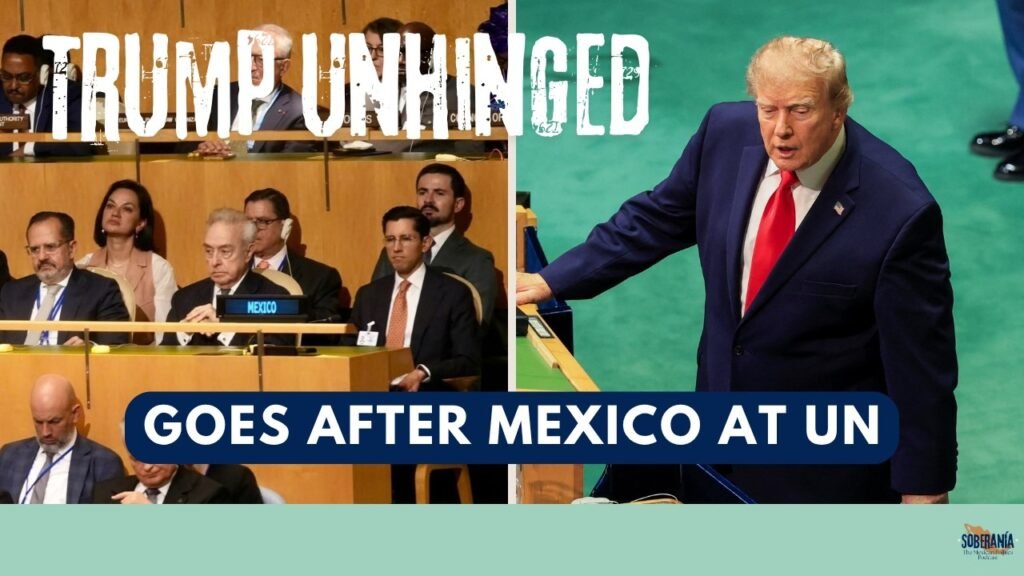
Trump’s UN attack on Mexico and Sheinbaum’s reply, Morena’s poll-based candidate selection for 2027, and the U.S. Embassy’s “made in China” Independence Day blunder.
-
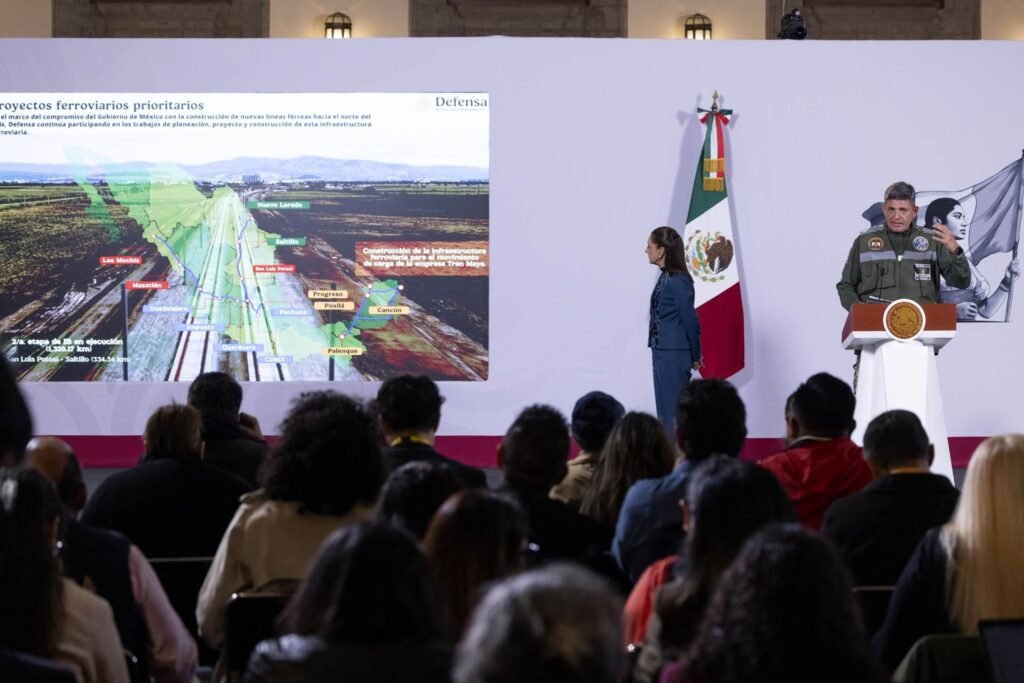
People’s Mañanera September 23
September 23, 2026
President Sheinbaum’s daily press conference, with comments on passenger trains, social programs, Brazil, single citizenship, and the Lie Detector.
The post Calderón Planned That in 2030 Mexican-Americans Would Govern Our Country appeared first on Mexico Solidarity Media.
From Mexico Solidarity Media via This RSS Feed.