

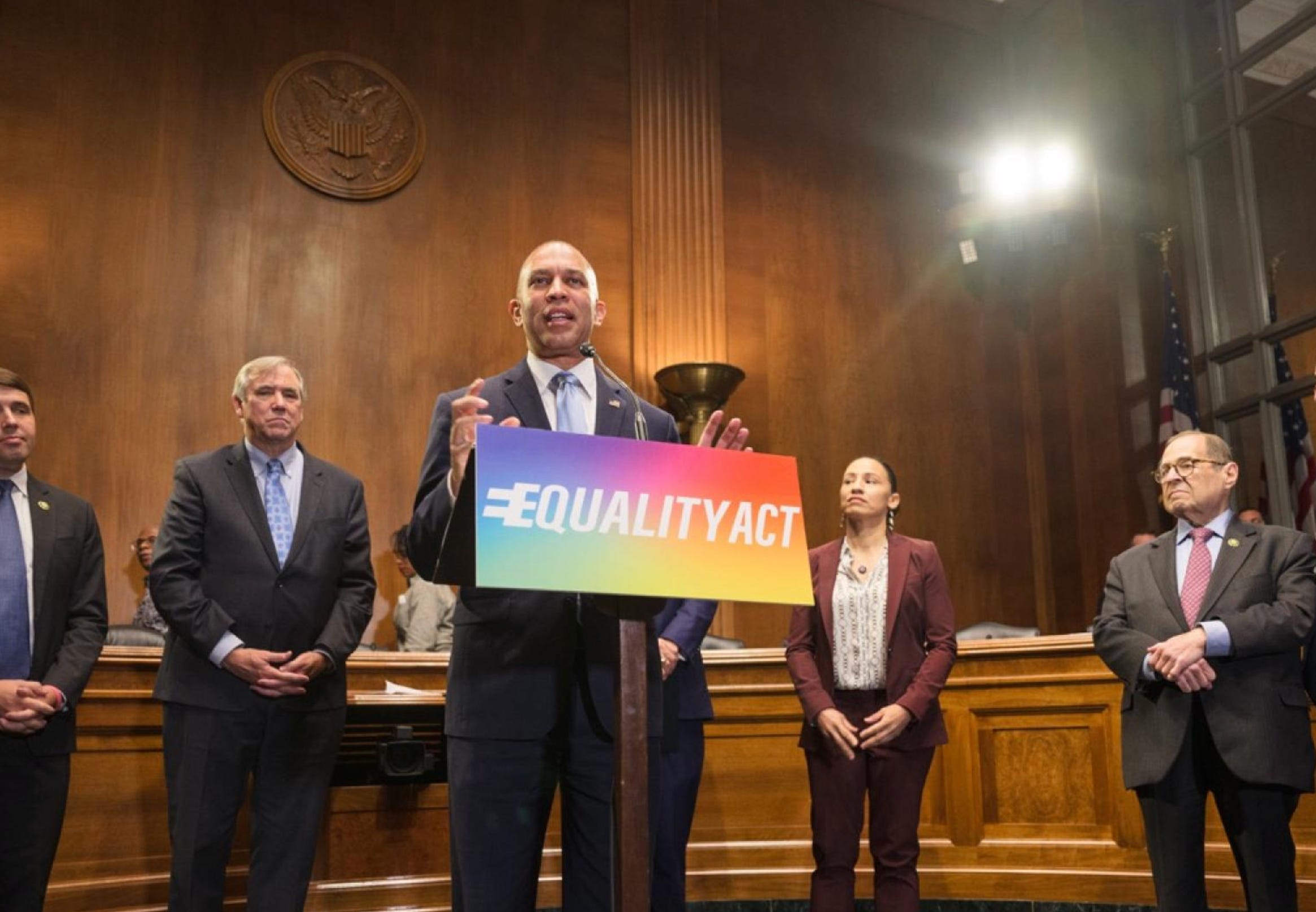
Congressional Equality Caucus // House.gov

Erin In The Morning is a reader-supported publication. To receive new posts and support my work, consider becoming a subscriber.
On Sept. 17, Marcy Kaptur—who is running for her 23rd term as an Ohio congresswoman—released an ad in which she declared: “I voted with Republicans to keep transgender ideology out of our schools, because parents know what’s best for their kids. And boys should not play in girls’ sports.”
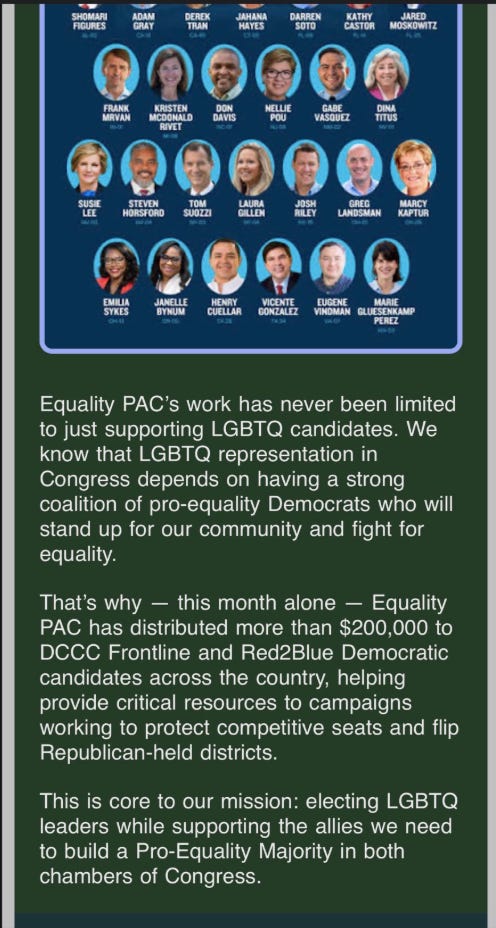
Less than a week later, Equality PAC, which brands itself as the “political arm of the Congressional Equality Caucus,” sent out an email blast endorsing Kaptur and other Democrats with anti-trans views as part of its “pro-equality” slate. Furthermore, it proudly announced it had distributed $200,000 to candidates in competitive “frontline” races.
It’s unclear how much of that went to candidates who have made an anti-trans pivot, but evidently, that’s not a disqualifier for Equality PAC.
“We can want Democrats to win and secure a Democratic majority while also recognizing that the queer community’s organized political power does not have to fund the first Democrats willing to abandon us,” said Tyler Hack, executive director of the Christopher Street Project, which also wields a PAC meant to fund campaign efforts to elect and retain unapologetically trans-allied politicians.
“It’s clear that the trans community needs independent political power that works to build a Democratic majority while ensuring our resources go to those who stand with us when it matters,” she said.
This latest endorsement represents a notable shift: Some Democrats have developed an increasing willingness to deviate from the party line when it comes to preserving equal rights for trans people. This includes everything from deploying anti-trans rhetoric, to supporting discriminatory athletics laws, to calling for restrictions on trans youth who need to access life-saving care.
“This is one domino to fall with the trans community. But it is not the last domino to fall if we don’t stand up,” said Arienne Childrey, vice chair of the Ohio Democratic Party Pride Caucus. She’s also a vocal critic of Kaptur’s anti-trans rhetoric. (Childrey emphasized she was speaking to Erin in the Morning in an individual capacity, not as a representative of the Caucus.)
Erin in the Morning reported earlier this month that over two dozen Democrats had espoused anti-trans rhetoric or voted in favor of anti-trans legislation. Even the Human Rights Campaign, a national powerhouse for the movement, came under fire for its decision to maintain endorsements of some of these candidates.
“I think they look at these issues through the lens of political expediency and triangulation, and try to say, ‘Well, this is what we need to get this person into office’—without realizing, in my opinion, that this person, these people, are undeserving of the office if they can’t represent everyone in their district,” Childrey told Erin in the Morning.
But establishment LGBT organizations—many of whom are led by cisgender queer people—have taken a different approach. After Amy Acton called transgender girls “boys” and vowed to uphold bans to exclude transgender children and students, many community members mobilized to oppose her. But Equality Ohio, the state’s preeminent queer rights organization, simply downgraded her from an “A” to a “B” rating in their voter guide. Some people felt that was an underreaction.The Human Rights Campaign also stood by a slate of candidates after they began spewing anti-trans rhetoric in an aggressive final stretch ad campaign. “Our theory of change is that we need to meet people where they are and move them towards support for our community,” a spokesperson told Erin in the Morning previously*.* “To that end, we do work with candidates and elected officials who have taken a vote contrary to HRC’s position—working to ensure they understand the impacts while moving them toward greater support of the LGBTQ+ community … This does not mean that every person we endorse has a perfect record, but they have demonstrated support for transgender people and equality more broadly.”
But Leigh Finke, a state representative from Minnesota, urged voters to rethink how these organizations operate within the broader political machine.
“Do we need to endorse people in order to support them? Do we need to support them in order to have power in Congress?” she said in an interview with Erin in the Morning. “I don’t know the answers to those questions.”
Finke’s state has been a flashpoint in numerous political debates over the last few years—from George Floyd protests of 2020 to the fallout of Renee Good’s murder by ICE agents earlier this year. As such, she said she approaches the issue from an intersectional lens.
“The way we change that is on-the-ground organizing in the district which she represents,” she said of Kaptur, but added that it applied to any candidate anywhere.
“My objective is not democratic majorities. It’s trans liberation,” she continued. “And to the extent that those things are moving in tandem, I’m there for it. To the extent that those things are not moving in tandem, then we need to be extra critical, and extra clear, on why that is the case, and how we need to change it.”
Erin In The Morning is a reader-supported publication. To receive new posts and support my work, consider becoming a subscriber.
From Erin In The Morning via This RSS Feed.
Wut?