


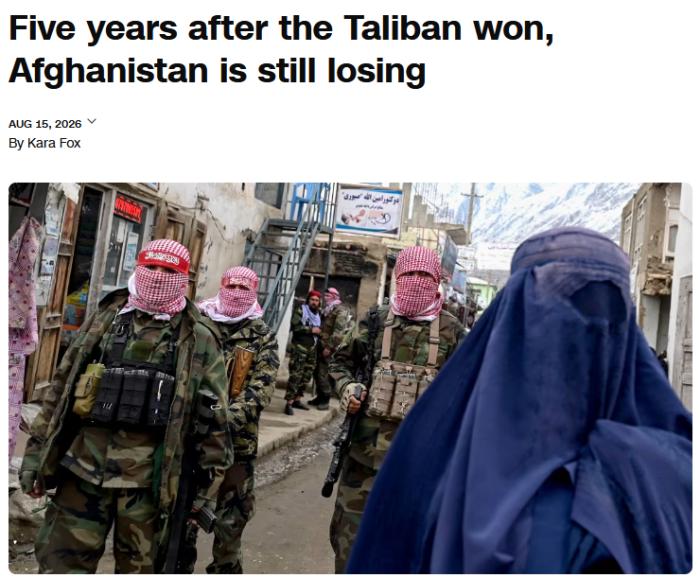
CNN (8/15/26) describes billions in Afghanistan assets seized by the US before the Taliban reestablished a government as “frozen by the US and its allies over the Taliban’s rights record.”
Last month marked five years since the US withdrew its military forces from Afghanistan and the Taliban returned to power. The US invasion and occupation of Afghanistan, and the resultant war, directly killed more than 176,000 Afghan people, including more than 46,000 civilians. Yet major US media outlets have covered the anniversary by muddying the US’s role in the country’s hardships—writing as though Afghanistan’s history began in August 2021.
A CNN article (8/15/26) by Kara Fox offered an egregious bit of historical revisionism:
In the five years since the chaotic US withdrawal from Kabul and the Taliban’s return to power, Afghanistan has become home to one of the world’s worst human rights and humanitarian emergencies.
Afghanistan hasn’t “become” a human rights and humanitarian emergency “since” the US troop withdrawal. It was a disaster during—and in no small part because of—the US war and occupation.
For instance, in November 2019, towards the end of the US occupation, the Integrated Food Security Phase Classification (IPC) estimated that approximately 2.44 million Afghan were in an “emergency situation” in terms of food insecurity. The next year, Amnesty International noted that four million Afghans were internally displaced and facing widespread problems of “inadequate housing, food insecurity [and] insufficient access to sanitation.”
Both years, the International Rescue Committee put Afghanistan in its top 10 “crises the world should be watching.” Evidently such conditions don’t meet CNN’s threshold for a “humanitarian emergency.”
In terms of rights, a 2019 Human Rights Watch (HRW) report documented Afghan strike forces that were “recruited, trained, equipped and overseen by the CIA” committing
serious abuses between late 2017 and mid-2019. They are illustrative of a larger pattern of serious laws-of-war violations—some amounting to war crimes—that extends to all provinces in Afghanistan where these paramilitary forces operate with impunity.
In 2020, HRW would go on to criticize the US-installed Afghan government for “fail[ing] to prosecute senior officials responsible for sexual assault, torture and killing civilians.” One can debate what constitutes a human rights “emergency,” but it’s clear that rights violations were a defining feature of the US occupation.
Refusal to be charitable enough
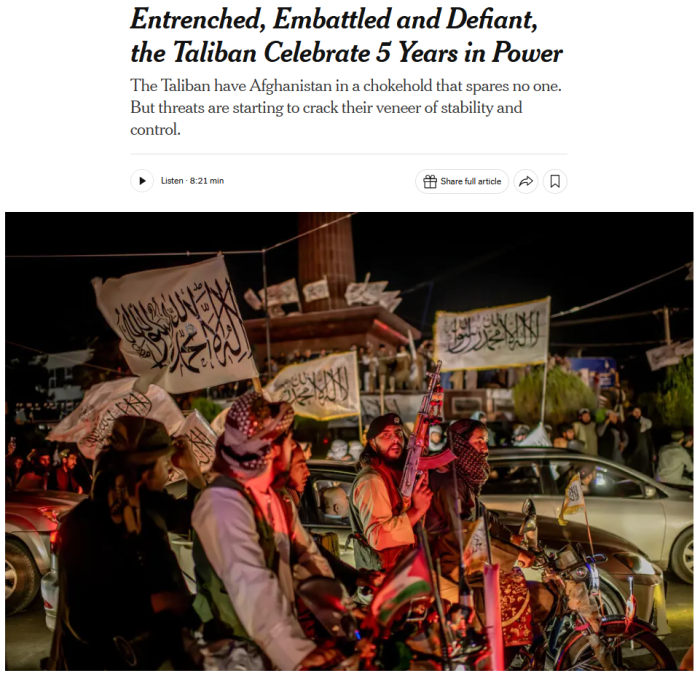
“Economic opportunities are nearly nonexistent” in Afghanistan,” the New York Times (8/15/26) reported—in a piece that never mentions US efforts to strangle the Afghan economy.
Corporate media likewise obscure how the US continues to co-author Afghanistan’s travails post-withdrawal. In the New York Times (8/15/26), Elian Peltier repeatedly referenced Afghanistan’s economic problems, noting that the country faces “mass unemployment,” and that “economic opportunities are nearly nonexistent.”
Peltier didn’t mention that the economic crisis was driven in large part by the economic warfare that the US has waged against Afghanistan since withdrawing its troops (Guardian, 2/6/22). Under Biden, the US not only imposed sanctions and cut aid, it unlawfully seized $7 billion of Afghanistan’s central bank assets that were held in New York banks, causing a liquidity crisis that spiraled into rampant unemployment (FAIR.org, 2/15/22).
According to development expert Sara Moussavi (New Humanitarian, 1/20/26), these sanctions have “restrict[ed] financial transactions, access to aid and the process of payments due to the asset freeze and exclusion from the global financial market.” Such measures, she pointed out, have “led to a strangling of Afghanistan’s economy that has exacerbated one of the world’s worst humanitarian crises.”
The Times‘ Peltier went on to write that “extreme hunger has been spreading fast from one [Afghan] province to another after aid cuts last year plunged millions into deeper food insecurity.” But it’s not just aid cuts from “last year” that are causing Afghans to go hungry; it’s also the sanctions, which are a form of war and have been in place for five years.
Peltier also declined to mention that sanctions and the asset freeze have helped drive the country’s food crisis. His wording implies that the US’s failure is limited to a recent refusal to be charitable enough to Afghans, but what the US state has done is worse than that: It has stolen Afghanistan’s money and sabotaged its economy for the last half decade.
‘Tax dollars feeding terrorists’
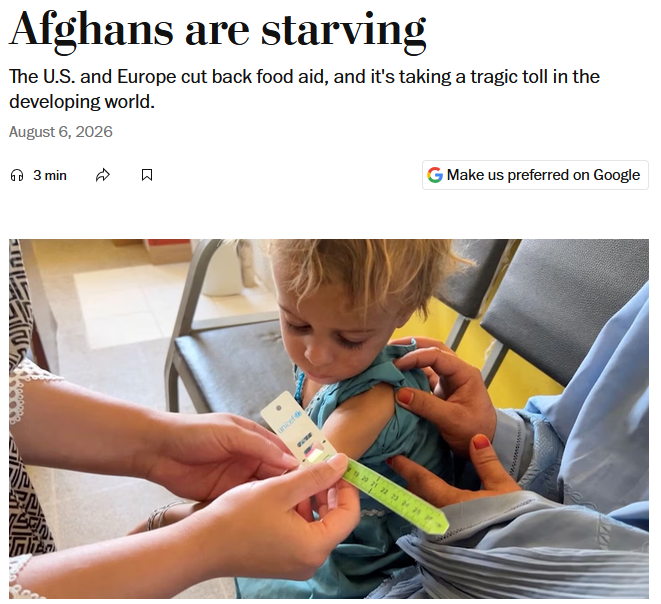
“Afghans Are Starving,” a Washington Post headline (8/6/26) acknowledges—and Post editors want to make sure that adult male Afghans don’t get to eat.
A Washington Post editorial (8/6/26) likewise admitted that the US aid cuts have contributed to Afghanistan’s humanitarian disaster, but didn’t mention the much larger economic war against Afghanistan. Instead, the paper wrote that Afghanistan’s hunger crisis is “mostly…due to the inept and barbaric Taliban government’s mismanagement, worsened by severe drought.”
The editors, moreover, wrote that
Americans don’t want their tax dollars feeding terrorists. Careful controls must be imposed to ensure that food aid goes to women and children, not military-age males. But Americans are generous, and the crisis calls for compassion.
Continuing to starve people who happen to be men of military age because of the racist view that they are all potential “terrorists” may be the most twisted definition of “compassion” ever put forth.
The Post framed Afghan hunger in terms of American generosity rather than vindictiveness, yet the World Food Programme USA is clear that
Afghanistan’s economy has shrunk significantly since 2021 due to instability and sanctions. With 69% of the population below the poverty line and reduced humanitarian aid, millions are food insecure.
Thus, the US’s implicitly non-“barbaric” policies are a major reason most Afghans don’t have enough to eat. Sanctions devastated the economy, and people became poorer and less able to afford food, but Peltier and the Post left out this part of the story.
‘One of the main bargaining chips’
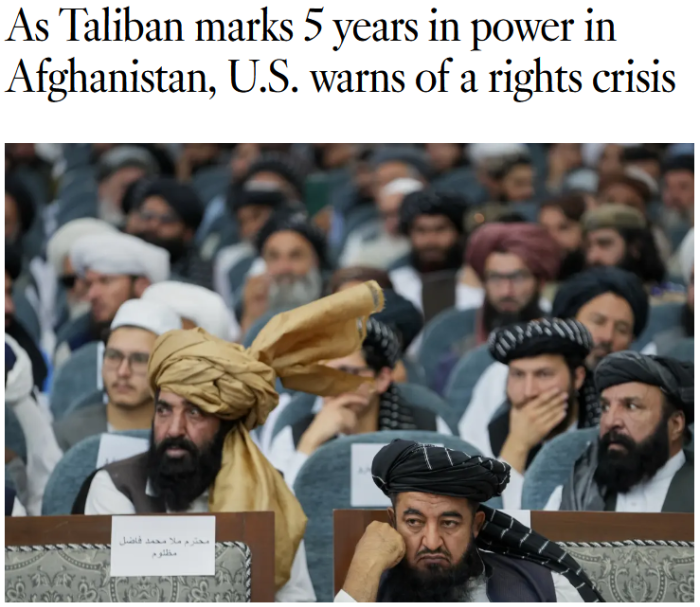
The LA Times (8/15/26) decries “child malnutrition” in Afghanistan without noting that the US has stolen billions of dollars from the country.
Similarly, the Los Angeles Times (8/15/26) reported the UN World Food Program’s warning that “child malnutrition has reached critical levels in a third of Afghanistan’s provinces and is expected to worsen due to funding shortfalls.” However, the piece did not refer to the US and EU sanctions, or to the asset freeze.
In her CNN piece, Kara Fox (8/15/26) discussed malnourishment among Afghan children and the lack of healthcare available to them, without bringing sanctions into the conversation. Fox did write that
billions in central bank reserves remain frozen by the US and its allies over the Taliban’s rights record. Unfreezing these assets is one of the main bargaining chips in talks with Western governments, with the ban on girls’ education a key sticking point—meaning the very money that once funded that schooling is now being withheld to try to restore it.
Fox didn’t question the right of the US to freeze Afghanistan’s assets. And at no point did she ask the obvious question: Why, if the US and its allies are truly concerned about girls’ education and rights, are they using an economic weapon that starves those same girls (along with their mothers, fathers and brothers)?
‘Wars collapse economies’
All of these articles overlooked another important factor in Afghanistan’s economic problems that scholar Brehanu Borji Ayalew highlighted in an academic article (Discover Sustainability, 5/20/26). “The broader financial toll of two decades of conflict,” he wrote, is “staggering: The United States spent $2.3 trillion on military operations, reconstruction and aid, yet these flows built a hollow, aid-dependent economy.” Ayalew noted, “Evidence from Sudan, Libya, Yemen, Afghanistan and Syria shows that wars collapse economies, displace millions and destroy social foundations.”
In the same vein, the International Monetary Fund pointed out that
Afghanistan has endured decades of war and political turmoil, leading to repeated waves of refugees. Since the 1970s, the country has faced numerous conflicts, including the Soviet invasion, civil war, the rise of the Taliban, and the aftermath of the 2001 U.S.-led intervention. These conflicts have resulted in political instability, security risks, and severe humanitarian and economic hardship.
Yet CNN, the New York Times, LA Times and Washington Post all wrote as if 20 years of US-led war and occupation didn’t shape Afghanistan’s economy. It’s not difficult to see that the function of corporate media coverage of Afghanistan post-occupation is to separate the US’s disastrous war from its ongoing effects, to downplay the damage done by that invasion to help legitimize present and future US aggression.
Telling readers over and over that conditions in Afghanistan have been dreadful since the US troop withdrawal, without mentioning the US’s starring role in past and ongoing misery in Afghanistan, is imperial stenography. It erroneously and dangerously suggests that nations are better off under US occupation than when they are independent.
From FAIR via This RSS Feed.