

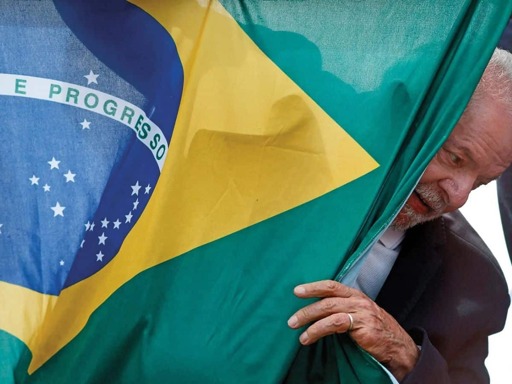

Brazil’s tight election on 4 October could be a pivotal moment for Donald Trump’s brash imperialist offensive in Latin America. And amid allegations of US interference, left-leaning Brazilian president Luiz Inácio ‘Lula’ da Silva used his 2026 UN speech to challenge Trump’s imperialism and the lack of global accountability for war criminals.
‘The UN is failing Palestinians and all victims of war’
Da Silva has openly condemned the US-backed genocide in Gaza, while his far-right opponent Flávio Bolsonaro has received the backing of Israeli war criminal Benjamin Netanyahu. And he told the UN on 22 September that:
Generations of Palestinians will carry the pain and trauma left by the genocide of women and children perpetrated by Netanyahu’s government in Gaza.
While praising past achievements of the UN, da Silva insisted that:
The UN is failing in one of its most important missions – to rid humanity of the scourge of war…
Its ability to protect the most vulnerable, those who have no army or arsenals, has never been so weak.
We are all held hostage by the inaction of the Security Council for failing to fulfill its role…
concessions to the ‘law of the strongest’ have surpassed all limits.
And it was clear he was calling Donald Trump’s regime out when he stressed that:
threatening civilisations with extinction will not bring stability to the Middle East.
He later implored the UN to break its “paralysis” and:
once again become a temple of peace
“Brazil does not fit in anyone’s backyard!”
The family of election rival Flávio Bolsonaro, however, is very fond of Trumpian politics. His father, ex-president and jailed coup-plotter Jair Bolsonaro, was almost a carbon copy of Trump. His controversial brother Eduardo, meanwhile, is a key lobbying force in the US, where he’s currently living to evade justice back in Brazil.
Flávio Bolsonaro has fawned over Trump, promising to be a loyal servant of Washington’s interests. For example, he has pledged to militarise law enforcement and introduce hardline measures while privatising assets, cutting spending, and attacking the left. And he successfully pushed for the US to designate Brazilian criminals as terrorists.
Da Silva, on the other hand, is critical of the Trumpian order. At the UN, for example, he addressed Trump’s current imperialist offensive in Latin America by asserting that:
Geographical proximity to the world’s greatest military power is inescapable, especially in the context of renewed hegemonic temptations. [But] Brazil does not fit in anyone’s backyard!
Responding to the US push to militarise the region again with far-right and corporate support, da Silva said:
We will not outsource the responsibility of defending [Brazil’s] borders and guaranteeing our population the right to live without fear.
We do not need aircraft carriers guarding our waters.
We need cooperation to block the flow of weapons and money that feeds organised crime.
He added that:
The countries in the region have experienced the horrors of authoritarian regimes…
Democracy is once again under threat.
We witness once more interference in the electoral processes.
Dividing the world into zones of influence and neocolonial incursions for strategic resources are anachronistic gestures.
Allegations of US interference in Brazil’s electoral process relate to tariffs, AI propaganda, and media manipulation. Referring to such intervention at the UN, he stressed:
We do not underestimate the challenge of misinformation networks that aim to distort public debate during the campaign…
We will not allow the enemies of democracy, whether domestic or foreign, to undermine popular will.
An election pitch of international order and progress
Da Silva has helped to spearhead the Partners for Multilateralism initiative, focusing on international cooperation, peace, and upholding the rule of law. And this seemed to be part of his election pitch at the UN. Summarising Brazil’s vote as a battle for democracy, he stressed that the international community must:
choose between multilateralism or unilateralism, democracy or extremism, sovereignty or subordination.
Another area he highlighted was science and the environment. While his record isn’t perfect, deforestation has dropped significantly under his government. And it has also sought to ensure close regulation of natural resource extraction. As he promised at the UN:
we will not abandon the environmental agenda.
We will move forward with the roadmap for the decarbonisation of the Brazilian economy.
Da Silva also mentioned the need to regulate artificial intelligence and the betting industry. While Brazil is investing heavily in artificial intelligence, for example, he has called for strong international regulation. He has also made a crackdown on gambling part of his election campaign, along with extra health and welfare support.
Bolsonaro, meanwhile, plans to serve corporate interests by increasing private exploitation of natural resources. This very much emulates his father’s time in power, which was disastrous for the environment. He also wants to put facial recognition cameras around the country.
Despite currently being under investigation on corruption charges, Bolsonaro still has a massive chunk of voter support. So the election is on a knife edge.
With just days to go, da Silva will be hoping that his progressive promises and UN speech — along with a growing economy, low unemployment, and a legacy of poverty reduction, fighting structural racism, and growing Brazil into an independent global power — will be enough to tip the balance in his favour.
Featured image via the Canary
By Ed Sykes
From Canary via This RSS Feed.