
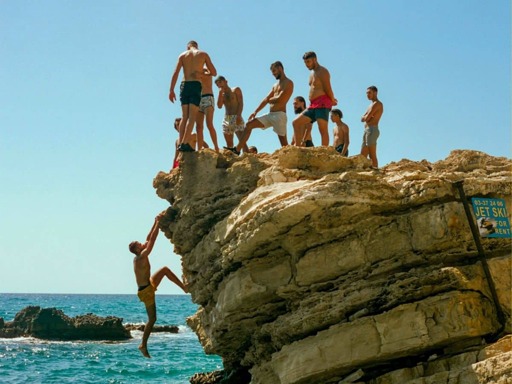

Earlier this month, Lebanese photographer Amal Ghamlooch exhibited On the Shore of Dreams at Studio 12 in Camberwell, south London. Over two days, the small space on Addington Square filled with images of the coast in Lebanon, shot on film over several years. Photos of sunlight breaking on waves, children digging at the water’s edge, young men hurling themselves off sea cliffs adorned the exhibition walls.
It was a quiet exhibition that functioned as a window to a country that has known very little quiet of late
 .
.
Learning the light in Lebanon
Ghamlooch started photographing Lebanon in 2019, the year the country’s economy began to collapse, at first as a way to learn her camera and get to know it. Over time, the sea took over. As the exhibition text puts it:
Over time, she became drawn to the sea; captivated by the way light meets water and the sense of stillness it offers amidst constant uncertainty.
The pictures bear that out. Some are barely pictures of anything at all — dark water catching the last of the sun, rocks sitting in a shimmer of light, a lens flare blooming red at the bottom of a frame. Others are full of people. Two boys crouch over a sandcastle at the tide line. Fishermen stand silhouetted on the rocks, their rods angled against a white sky. A boy clambers onto a moored jet ski. On a sun-bleached cliff, a group of young men wait their turn to jump, next to a hand-painted sign advertising jet skis for rent.
Ghamlooch leans into the textures of film. Grain, haze, light leaks and the date stamp burnt into the corner of a frame give the series the feel of a family album. One double exposure lays the silhouettes of figures over the sea itself, as if the people and the place had been folded into one another. A black and white shot of three swimmers on a floating platform, far out in grey water, could have been taken fifty years ago.


The sea as refuge
In Lebanon, the sea has always meant more than a day at the beach. It is where the country looks outward, and where so many of its people have left from. The exhibition plays on that double meaning:
The sea becomes both refuge and metaphor; a space that transcends borders, holds histories of departure and return, and offers a fleeting escape from the pressures of the present.
That idea of departure carries real weight. Lebanon has long been a country of emigrants, and the last few years have pushed yet another generation to leave.
In a country where many have been forced to leave, where others remain while imagining elsewhere, and where entire communities continue to negotiate the meaning of home, the shoreline becomes a threshold between reality and possibility.


Lebanon — Beauty in the shadow of collapse
These photographs were taken against a brutal backdrop. Since 2019, Lebanon has lived through one of the worst financial collapses in modern history, the devastation of the Beirut port explosion in 2020, and wave after wave of emigration. Then came Israel’s war on the country. Around a million people, roughly a fifth of the population, have been driven from their homes this year. Israel still occupies parts of the south, where it continues to order whole towns emptied.
The exhibition text acknowledges that “renewed violence along Lebanon’s southern border has displaced communities once again”. Yet very little of it appears in the frame. Ghamlooch made a deliberate choice:
The images acknowledge the political and social realities that shape contemporary life while resisting their totalizing weight. Rather than illustrating crises directly, they look toward moments of tenderness, beauty, and quiet persistence.
She is in good company. The Arab Image Foundation, set up in Beirut in 1997, has spent decades preserving the region’s everyday photographs — studio portraits, holiday snaps, family albums — as a record that outlives the wars around them. More recently, photographers such as Myriam Boulos have turned the camera on tenderness and intimacy in a country defined from the outside by crisis. Ghamlooch’s seascapes sit comfortably in that tradition.
The fact that these images exist matters, and it matters a lot. The Lebanon that reaches British screens is usually one of airstrikes and evacuation orders. The one hung on Studio 12’s walls — swimmers, fishermen, kids splashing in the shallows with their dogs — is the everyday life those strikes put at risk.


What we carry
The exhibition closes on a thought about what photography can hold onto:
Through hazy textures and fleeting scenes, On the Shore of Dreams reflects on photography’s ability to preserve not only places, but also the versions of them we carry in our dreams.
For people who have watched so much of their country damaged, emptied or left behind, that is no small thing.
On the Shore of Dreams showed at Studio 12, 1 Addington Square, London SE5 7JZ, on 3 and 4 September. You can find more of Amal Ghamlooch’s work here.
Featured image via the artist
From Canary via This RSS Feed.