

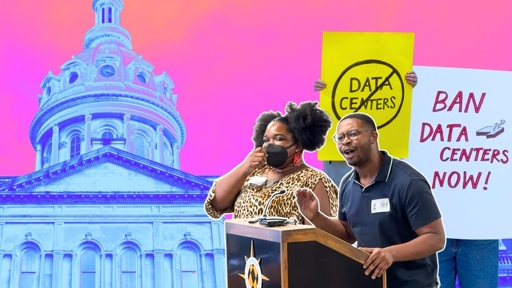
Editor’s Note: Council Bill 26-0174 (data centers) will get another public hearing in front of the Baltimore City Council’s Land Use & Transportation Committee on the 4th floor of City Hall on the morning of September 24.
Baltimore, Maryland, currently has a moratorium on new data center development, but a proposed City Council bill has residents nervous that the door is creaking open for data centers to come into the city—and that City Council views this as “inevitable.”
Council Bill 26-0174, sponsored by City Councilmember Phylicia Porter, would require new data center projects in Baltimore to go through a conditional use approval process that includes a health equity assessment. Residents opposed to the bill say that while the bill may be well intentioned, they want a full data center ban, not stricter guidelines for data centers operating in Baltimore.
In this on-the-ground report, TRNN takes you inside the August 27 Baltimore City Planning Commission public hearing on Council Bill 26-0174:
TRNN also published a full, unedited recording of the August 27 Baltimore City Planning Commission public hearing on Council Bill 26-0174, which is free and available to the public on our YouTube channel:
Credits:
- Videography: Maximillian Alvarez
- Post-Production: Dave Hebden, Cameron Granadino
Transcript
The following is a rushed transcript and may contain errors. It will be updated.
Speaker 1:
We all are well aware that we’re not dealing with good faith actors when it comes to the people who want to build data centers.
Speaker 2:
I currently work at a data center. That doesn’t mean that I approve of data centers. Every
Speaker 3:
Every time it storms, it seems that a bunch of lights go down in the city. I’m confused why we’re even talking about a data center if we can’t keep our own lights on.
Maximillian Alvarez:
Baltimore currently has a moratorium on new data center development while a city study examines the potential impacts that data centers would have on our city. However, even though that study hasn’t been completed yet, a proposed city council bill has residents here nervous that the door is creaking open for data centers to come into the city and that city council views this as inevitable. Council Bill 260174, sponsored by city council member Felicia Porter, would require new data center projects to go through a conditional use approval process that includes a health equity assessment. Now, residents who are opposed to the bill say that the bill may be well intentioned, but what they want is a full data center ban in Baltimore, not stricter guidelines for data centers to operate in Baltimore. Now, the bill is going to get another public hearing in front of the Baltimore City Council’s Land Use and Transportation Committee on the fourth floor of City Hall on the morning of September 24th.
And that meeting is open to the public. Now, I was there in the room during the last public hearing on Council Bill 260174, which took place on August 27th when the bill was reviewed by the Baltimore City Planning Commission and residents were given a chance to voice their public comments. Now, the planning commission ultimately declined to support the bill and opposition from members of the public to data centers of any sort was frankly overwhelming, but you don’t got to take my word for it. Watch for yourself.
Andy Ellis:
We’re here at the Baltimore City Planning Commission getting ready to hear a bill that would allow data centers to come in if they had a health equity assessment into Baltimore. This happens despite the fact that we have an existing moratorium. And so we’re here today to testify against the bill because we think that the moratorium should be extended or made into a ban so that we can stop data centers from coming into the community.
Blaire Postman:
Hi, I’m Blaire from Cat Ladies for America. I’m a resident of Baltimore and I’m here today because even though there’s a moratorium on AI data centers in the city, it seems like they’re laying the groundwork for them to allow them and allow them to come in without a lot of oversight. And that makes me very angry. Claws out!
Speaker 8:
The next item is number eight, city council bill number 26-017 zoning conditional use, health equity assessment data centers.
Councilmember Phylicia Porter,:
I am Councilwoman Phylicia Porter and I represent Baltimore’s 10th District and chair of the Public Health and Environment Committee and bill sponsor for 26-0174. The data center industry is looking at Baltimore at the peninsula, Fairfield, Hawkins Point and other industrial areas. At the same time, the federal government is accelerating AI infrastructure development and scrutinizing state and local laws. It regards its obstacles to that development. This creates a real risk for jurisdictions relying only on a temporary moratorium without a permanent framework under development, which will face legal and economic pressure. Other jurisdictions have already quickly learned how that pressure can arrive. Hill County, Texas faced a hundred million dollars in federal lawsuit shortly after adopting its moratorium and rescinded under that pause under the weight of that litigation. This lesson is not that Baltimore should surrender its authority. This lesson is that Baltimore must exercise its authority carefully, deliberately, and now.
A moratorium alone without companion framework and process is exposed to taking legal challenges. Moving bill 26-0174 through this process, hearings, testimonies, amendments, votes itself is a part of that good faith planning effort that the Supreme Court has been requiring. Bill 26-0174 does not promote or green light data centers. It strategically and administratively blocks development at every step of the way that does not align with community. It creates public accountable process for deciding whether a qualifying data center is appropriate for a particular location and under what conditions it may process. This is the foundational right of the conditional use ordinance process. Traditional zoning asks whether proposed use is compatible with the land around it. A health equity assessment asks an equally important question, what will this decision mean for the people who already live in those conditions surrounding that land? Bill 26-0174 puts that cumulative reality into the decision making process of the city council before approval, not after residents become ill, household costs rise and public infrastructure is strained.
This is environmental justice and it’s basic due diligence.
Jon Laria:
There are maybe some questions, but it took me a while to sort of get this straight in my head, but there are only written submissions opposed to this bill by people who are opposed to data centers and so are you. Yes. So it’s kind of odd because they’re opposing a bill and I think the reason that’s happening is because most people are starting with the idea that there’s a moratorium, meaning zero data centers. And your bill provides a path, a difficult path, but a path to data centers. No,
Councilmember Phylicia Porter,:
That’s not correct. So it is not correct. So the study adds a legal framework attached to the moratorium right now as shared within my remarks, right now we are under a moratorium where we are legally unrestricted. We are unprotected right now under this moratorium without the conjoining health equity framework attached to it.
Jon Laria:
I’m not sure I understand.
Councilmember Phylicia Porter,:
Yeah. So no worries. So when you have a data center and we currently have, I will say if you have a data center that comes into the city that’s under a moratorium right now, if they sue Baltimore City, they sue Baltimore City saying this is unjust. We understand that data center developers are getting very crafty in their arguments. They’re arguing First Amendment rights. They are arguing other rights that provide them a pathway forward. We are seeing that those moratoriums are getting overturned. The successful moratoriums that have been upheld are always assigned and/or connected to a framework that allows good faith effort to showcase that they are doing some sort of regulatory footprint with that moratorium, not just saying that you want a moratorium. So that is the issue.
Jon Laria:
Okay. Although we are doing this study, I mean the moratorium is not just a moratorium. A moratorium that just says moratorium because we feel like it, I see the weakness that you’re describing, but a moratorium so we can study it seems like a defensible position.
Councilmember Phylicia Porter,:
It’s not because again, what was mentioned in the planning commission report was that there is a lack of health equity associated with the current moratorium. This answers that response.
Jon Laria:
But it is sort of an odd posture because I think, and people should speak for themselves, but we have all these people who are opposed to data centers and they will come and testify and they’ve submitted testimony saying no data centers because I think they see in your bill a pathway to data centers and their view is we don’t want them at all. And under the moratorium – I’m not arguing with anyone. I’m just trying to get straight because they have all these people who are going to come up and say no data centers because they perceive perhaps your bill as loosening the restrictions, which is actually not how you intend
Councilmember Phylicia Porter,:
To bill. It’s not the intent of the bill. And I will also caveat, how many data centers have an application now with the current city of Baltimore that once this moratorium goes away, if we do not have the regulatory framework in place, how many of them will be actually going through the process?
Speaker 1:
But if I’m understanding the bill correctly, basically we currently have a moratorium that is pending a health review, health study review in the findings there. And that the bill is saying we need to do something that is stricter than a review and stricter than a moratorium because a moratorium can be overturned. And basically the bill is saying we’re going to provide a path to a data center, but the path is going to be very difficult. And so the hope, I believe if I’m understanding correctly, is that with the difficulty of the path, the data center should not be able to be built unless it passes very strict scrutiny that it likely will not pass. My concern as a citizen of Baltimore is this. I understand we all know full well, we cannot legislate the hearts and minds of people. We cannot put into a bill.
We all have to be nice to each other. However, we all are well aware that we’re not dealing with good faith actors when it comes to the people who want to build data centers. We’ve already heard testimony that there are people in rooms looking, combing through every law, probably across the country with fine tooth combs to see where they can actually exploit loopholes. And my concern is a citizen of the city and someone who cares about the city, who has young people who I care about in the city, who I want them to grow up in a place with clean air, clean water, not having the sound pollution and the headaches and all the things that come with having a data center in their vicinity. My concern is that if we know that we’re dealing with bad faith actors, then is it not our responsibility as citizens and as people in government to deal with the world that we have and not the world that we want to be?
You know what I mean? Deal with the people who we know are building these, which are bad faith actors and not deal with the fantasy of, oh, well, it’s going to be really hard so people aren’t going to be able to pass the test when people are looking to do everything they can to subvert every possible obstacle to getting these built.
Speaker 2:
So I’m a longtime Baltimore resident, electrician with IBW. I’m here to speak against obviously data centers. Obviously the contradiction here is that majority of the work for the IBW right now is data centers. I currently work at a data center. That doesn’t mean that I approve of data centers. One of the things that I think that we’re all missing here is that Baltimore is a city that has suffered from de-industrialization for a long period of time. Obviously the shutdown of General Millers, the shutdown of Bethlehem Steel. What we could be talking about instead of wasting our time with this is we could be thinking about how can we generate the power that the grid demands for something like this. We could be talking about solar farms, wind generation, be talking about battery storage. If you look at PJM’s own records, they say that Baltimore and the mid-Atlantic region is at risk of rolling blackouts, as others have said, by 2028.
Obviously our grid needs investment. Our infrastructure needs investment. The city needs investment. Investment from Google Meta does not solve our issues. If we actually care about having a city that functions, we’re going to need to be thinking about where are we putting power, not where are we taking power to? It’s really just that simple. And on that topic, if we’re talking about actually maintaining a labor force, we should be talking about how do we get the young people in our city into the trades that this type of work demands by doing some type of local hire mandates, something to make sure that our young people are not just left in the wind. Roughly 25% of young black men in the city aren’t working. Why are we not talking about what we can be doing for our city? It pains me. I just see no solutions, but we’re talking about something that can help billionaires become trillionaires.
Speaker 10:
Baltimore ordered the nine month study specifically required to recommend conditional use standards for data centers, yet this bill is already establishing conditional use framework. Why not finish the study and let the evidence inform the legislation? Second, under this bill, the company seeking approval prepares the health equity assessment evaluating its project’s potential health and environmental impacts. Subjection C9 even requires that applicants to explain the compelling public interest in its own project would serve. When a company has financial stake in an outcome, relying heavily on evidence prepared by that same company creates a conflict of interest. Why isn’t this assessment independent from the applicant seeking approval? Where is the scientific independence in this process? Finally, if this legislation is truly about putting community first, where is the community process when this hearing is being held in the middle of the day? As other people have stated, my friend, she had to leave.
Many working class Baltimoreans cannot take off to participate. So we are urging that this study be completed, that we require independent assessment, give affected communities meaningful participation. Please oppose this bill and enact a ban on data centers.
Blaire Postman:
I’m a 29 year resident of Remington in Baltimore. I want to tell you about a new building that’s being built. I know this hearing is not about that, but it’s relevant. This new building is going to use more energy than Remington and Charles Village combined. It required the building of a new electric substation. It’s going to be as big as the convention center. It’s on the edge of Stony Run, ground not appropriate for such a large building requiring very deep pilings. It’s displacing animals already. There are deer on my street. For the first time in 29 years, there are deer on my street. My street is five blocks from any wooded area. Deer are walking five city blocks to come to my street to eat all my flowers. I don’t care that they’re eating my flowers because they’re hungry. This building also has a truck road.
It’s going to result in this destruction of over a hundred trees. There was strong community opposition to this building. We were told that this building would not be a data center. I personally don’t know if it’s a data center. The amount of power it’s using, the size of it makes me wonder. So I have some questions. How did this happen? What’s the definition of a data center? And I just want to say that’s why I want to ban. I don’t believe this is a legal issue. I believe it’s a trust issue. There are bad actors. The megas of the world are bad actors and often our representatives do not support us. Odette supported our community. We voiced our opposition and yet Zeke Cohen voted for this and said data centers are inevitable and we need them.
Speaker 11:
I want to also remind everybody that people in Baltimore City, many, many are living on the edge. They’re living week to week. They’re living month to month already. Now, data centers are needed for AI. So you have AI and data centers working together. For some reason, we’re rushing into unregulated, unplanned black box of technology. I don’t know why, except I think it’s the investors who are creating this, creating this need and creating this bubble. So we have people, regular people striving to just get by. AI on the one hand is displacing jobs. It has displaced jobs. Everybody involved in AI says it’s going to massively destroy jobs. Sam Altman bragged about it. On the other hand, we have data centers which have raised utility rates for people around the city. As they’re built, they will raise more utility rates. Now we have people who are barely getting by.
What happens to them?
Speaker 3:
I love Baltimore. It’s a fantastic city. Fell in love here. We’ll have lots of friends and I’m connected to a lot of local art communities. It’s an important city to me and everyone in this room. And I say that because there’s a lot of conversations going on about water, about power. Every time it storms, it seems that a bunch of lights go down in the city. I’m confused why we’re even talking about a data center if we can’t keep our own lights on. I see streets and potholes all over the place and I would really like Baltimore to be a city that is ready for something like a data center. And to be clear, I want a ban on data centers.
But if I’m looking at the infrastructure we currently have just to support homes, just to support me, just to support my friends and family using regular water, I turn the heat down on my water heater. I’m doing what I can to try to make sure that I’m a good citizen in a drought, in a moment of contention. So I am asking council to put a ban on data centers, period, until we deal with potholes, until I can drive my car and not worry about it, period, until we can deal with power outages after storms, until we can make sure that all of our neighbors have access to grocery stores that are healthy for them in their local neighborhoods.
Speaker 12:
I’m a longtime participant in Baltimore’s professional filmmaking community. I’m also a longtime member of IATSE Local 487. So I think I’ll kind of address my concerns in terms of in sort of a cinematic fashion with a metaphor of sorts. When I think of the evolution of data centers as a topic of debate in the public consciousness, I can’t help but think of vampires as a metaphor for what they offer, both in how they mystify the impressionable and how they have the power to leach resources and destroy communities. When I look at this bill, it almost feels like they’re saying, “Hey, vampires want to come to Baltimore. We want to lay the groundwork to only allow the right vampires to come into the city. Vampires are risky. We want to make sure we know what a vampire is and then we want to make sure we get the old money vampires who have accumulated their wealth over hundreds of years and only bite certain kinds of people, maybe vampires that’ll make some of us super hot and young forever.
We want the best vampires for the community.” I don’t think I’m alone when I think of that and I go, “What if we just did no vampires?
From The Real News Network via This RSS Feed.