

https://www.spreaker.com/show/2952221/episodes/feed
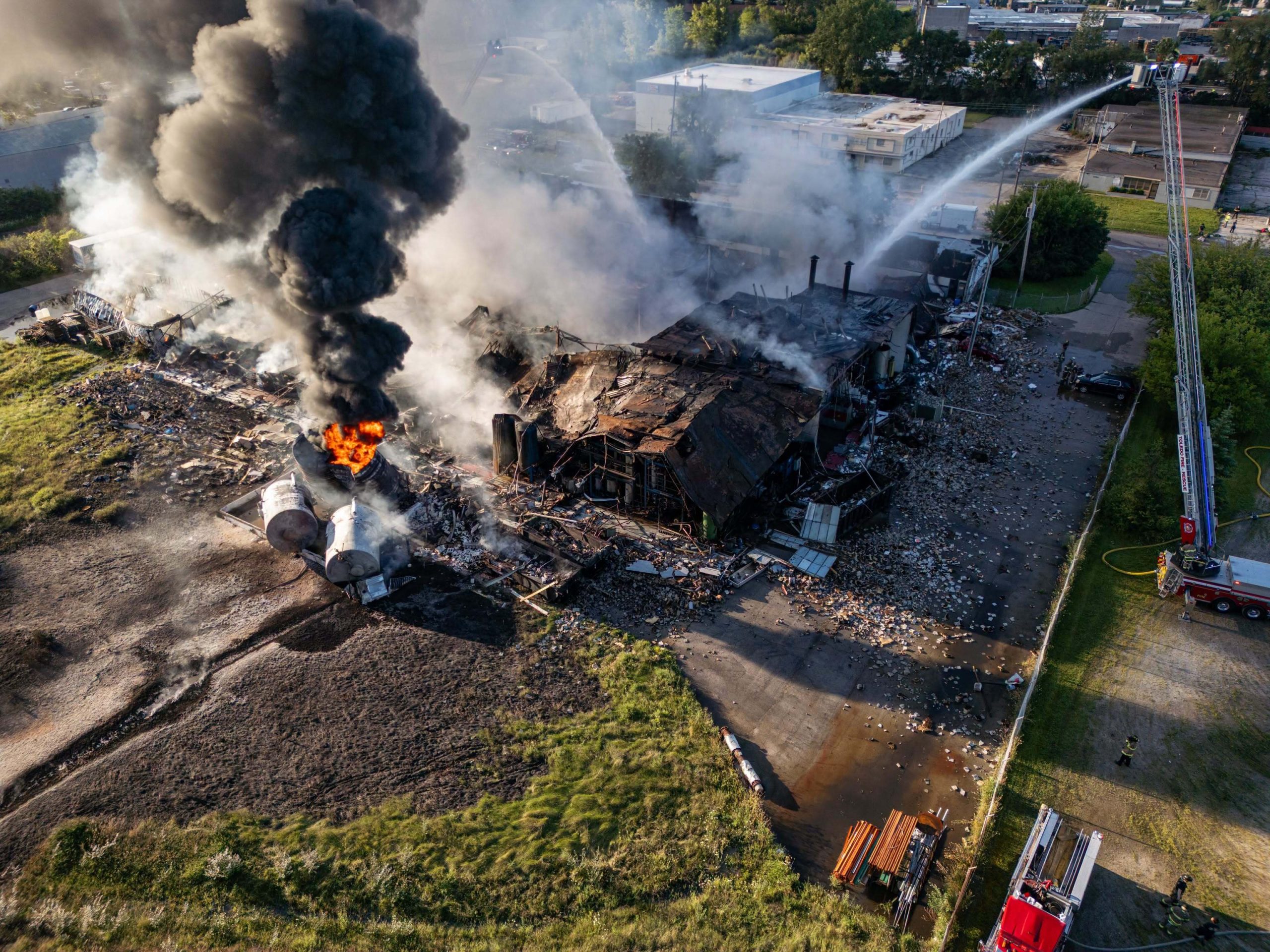
On the morning of August 18, residents living near the Brent Industries facility in Toledo, Ohio, awoke to a series of massive explosions and a towering chemical fire in their backyards. Two Brent Industry workers who were on shift at the time of the explosion were killed. Members of the surrounding community say they are experiencing symptoms of chemical exposure, and that they are not getting the answers they need from Brent Industries or the Environmental Protection Agency.
In this episode of Working People, we speak with a panel of Toledo residents about the industrial disaster at Brent Industries and the harrowing aftermath. Panelists include:
Toledo Councilwoman Dr Brittany Jones; Mike Balonek, Toledo-based filmmaker and sacrifice zone advocate; Sarah Locker and Kris Ramsdell, who both live right next to the Brent Industries facility where the deadly explosion occurred.
Editor’s note: According to WTVG Toledo, “The coroner’s office identified those who died in the [Brent Industries] fire as Heladio G. Perez, 46, and Mary Allen, 64. An autopsy revealed they both died as a result of blunt force trauma.”
Additional links/info:
- Toledo – Lucas County Health Department: Smoke Event Exposure – Public Health Information and Guidance
- Dave Collins & John Seewer, Associated Press, “Explosions and fire tear through Ohio industrial building, killing 2 workers”
- Kevon DuPree, WTVG Toledo, “Records show history of fires, violations at Brent Industries facility”
- Lily Lowndes, Alexis Means, & Brianna Weaver, WTVG Toledo, “Two dead after explosions rock Toledo industrial facility”
- Mike Balonek website, Facebook page, Instagram, and production company website
Featured Music:
- Jules Taylor, Working People Theme Song
Credits:
- Audio Post-Production: Jules Taylor
Transcript
The following is a rushed transcript and may contain errors. It will be updated.
News Clip 1:
A massive explosion and fire in South Toledo led to two people killed earlier today.
News Clip 2:
Firefighters rushed to the scene just before five this morning. The fire is still burning.
News Clip 3:
I was kind of about ready to get out of bed, oh, give or take about 4:45, 4:50. And all of a sudden I heard this huge explosion. I was scared to get out of bed to go see what it was. And then I heard a second one. It’s like this is like God of a movie. And then I stepped outside and then everyone was out in the street. I did see the fire and the flames were hundreds of feet up in the air.
News Clip 4:
People from all over Northwest Ohio could see this thick black smoke just pouring into the air and out of the rubble. Part of the building also collapsed. Two employees were killed, a man and a woman. We did hear from the family of Mary Allen. They say she was one of the victims and had worked at Brent Industries for 13 years, a dedicated worker, mother, and grandmother. And officials here say that there are still hazardous chemicals on the property, but the air here is considered safe.
News Clip 3:
OSHA teams are now involved in the investigation.
Sara Locker:
This is residents nearby ask more questions about what they have potentially been exposed to.
Maximillian Alvarez:
Welcome everyone to Working People, a podcast about the lives, jobs, dreams, and struggles of the working class today. My name is Maximillian Alvarez, and today we are in Toledo, Ohio. And we’re talking about the terrifying story behind the news clips that you just heard. As the Associated Press reported on the morning of August 18th, “Explosions rocked an Ohio industrial recycling business early Tuesday, killing two workers and sparking a large fire,” officials said. Flames and dark smoke poured from Brandt Industries in Toledo as fire engines surrounded the building TV news video showed. Cruz later discovered the bodies of two employees, a man and a woman. “Inside the smoldering building, “said Toledo Fire Chief Allison Armstrong. “Two or three other employees had minor injuries,” she said. “Two explosions occurred shortly before 5:00 AM during a shift change, “Armstrong said. Crews had to deal with hazardous materials, runoff and the threat of more explosions while first searching for victims and accounting for the other employees,” she said.
Aerial images showed that nearly all of the building’s roof was gone and that the blast blew out its walls. The Federal Occupational Safety and Health Administration, or OSHA, said it was investigating. “The agency has six months to conduct its investigation and it won’t release any more information until that’s completed,” officials said. Authorities encouraged people near the site who could see or smell smoke to keep windows and doors closed and avoid the area. Now the company, Brent Industries, based in Brent, Alabama, offers textile reconditioning and industrial recycling services aimed at reducing waste and saving money according to its website. It was founded in Alabama in 1977 and has operations in Brent and Toledo. The company’s Alabama location also had an explosion and fire in 2015 that killed one person. After that deadly explosion, OSHA determined that flammable vapor from mineral spirits, a petroleum solvent used for cleaning and other purposes, ignited in an industrial washing machine.
The company was cited for a half dozen violations and fined $27,000 according to OSHA records. Fire officials say tanks containing mineral spirits were at the Toledo plant. The company says on its website that it uses mineral spirits in the cleaning process for work gloves, wiping clothes and other textiles that contain hazardous substances. In 2004, OSHA cited Brent Industries for two serious violations at its Toledo plant, including failing to protect workers from death or serious harm when they were exposed to a 270 degree Fahrenheit or 97 degree Celsius steam release from a washing machine OSHA Records Show. So we got a lot to talk about here and to talk about all of this, I am really grateful to be joined today by a panel of guests who are all residents of Toledo, Ohio. Thank you all so much for joining me on the show today. I really appreciate it and I wish we were meeting under less horrifying circumstances.
And please, before we get rolling, introduce yourselves to our listeners.
Mike Balonek:
My name is Mike Balonek. I am a local filmmaker and advocate for Sacrifice Zones, have worked with Max in the past and worked on the East Palestine train derailment for the last three years.
Dr Brittany Jones:
Hi everyone. I am Dr. Brittany Jones, councilwoman at large, and I have basically been following a lot of these type of explosions and environmental hazards for quite some time. I would say that I’m very involved with trying to save our environment, but also with the health and the lives of our residents and just people in general surrounding these incidences is really what I want to focus on and try to provide more healthier living standards.
Sara Locker:
My name is Sara Locker. I live five doors down from the Brent Industries explosion. I’m here today to represent my fellow neighbors, my community, and the great city of Toledo, Ohio to make more people aware of it just doesn’t happen in East Palestine. It happens everywhere in a small little town like ours, in a small little neighborhood like ours, and our voices need to be heard and our questions need answers.
Kris Ramsdell:
And last but not least, I’m Kris Ramsdell. I live right around the corner from Brent Industries and I just want to call awareness so things like this don’t become the norm where a greedy business owner sacrifices not only his employees’ lives, but then also creates a disaster and a neighboring community in which their business operates in.
Maximillian Alvarez:
Well, again, thank you all so much for being here with us today, and I’m so, so incredibly sorry that you and your community are going through this. I really want listeners to hear directly from y’all what has been happening and what it was like to experience this firsthand. So can we please just start by going around the table and talk about the explosions at Brent Industries and the nightmarish 24 hours that followed? Walk us through what happened and how you experienced it all as it was unfolding.
Sara Locker:
Well, I had just gotten home from work early that morning, had just started to fall asleep. We have a train rail right behind us, so when the explosion happened, it was one of two things in my mind being ripped out of a deep sleep that either somebody hit a transformer or something happened in the train tracks behind us. It jolted our entire household awake. When the first explosion hit, it shook our house. It bowed our windows, it terrified our children. The second explosion hit almost immediately after, and that was when my husband flew out of bed and out the front doors and my 19-year-old followed behind and my 16-year-old and our nine-year-old little girl were absolutely terrified. They didn’t know what was going on. My husband ran down the street, phone in hand. I was trying to call 911. You couldn’t get through. 911, there was no 911 because of the flood of calls that was happening.
The mushroom cloud of smoke and flames that you could see, the smell, it was traumatizing. And then to realize what had happened and then finally see emergency crews showing up, the mounds of people that gathered in our front yard in tears crying. We actually had one lady that had reported to work that morning for her 5:00 AM shift, and she was absolutely horrified. My husband directed her to our house where she could park her car. She was crying. She had had a young lady in her car next to her, didn’t speak any English, and the look of terror on her face just broke my heart. I think we spent a better part of that day comforting neighbors and comforting people that were standing there wanting answers. They hadn’t heard from loved ones. They didn’t know if their family members were in that explosion. Unfortunately, two lives were lost innocently for no reason, no reason at all, and we have no answers, nothing.
Kris Ramsdell:
Yeah, and I’m just going to piggyback off of what Sara said. I was actually just getting up. First blast happened about, oh gosh, I want to say it was about 4:50, 4:55 AM. So I was just about to get ready to get out of bed, start my day. The first blast, it was so extreme. Well, they were both extreme, but the first blast was so extreme, I thought I must be kind of dreaming this. I didn’t really equate it to something that was actually happening. Well, then the second one happened a couple minutes later and it’s like, okay, this I’m not dreaming. This one actually, it shook my house and as I’ve described in the past, it felt like someone picked my house up and dropped it. Literally, it was that forceful.
At that point, I hate to admit this, but I was kind of scared to get out of bed because it’s like, well, did somebody run into my house? Did one half my house blow up? No. And I kind of stayed in my bedroom and I’m like, let me see if I smell anything. And thankfully I did. So I got out of my bedroom to see what was going on and seen everyone congregate down at the end of my street here. I should say, I do live two doors away from South Avenue. South Avenue is where Brun Industries is located. It’s about, I would say a block and a half away from my house. I knew it’s like if someone was even near that, I can’t imagine how anyone could have survived that. And so the first thing I thought of was, oh my God. God forbid, hopefully nobody was there.
Hopefully they only operate for second shift. I thought at one time they operated three shifts, but again, it was 4:00 AM, so my guess is the third shift was probably still on. So my first thing was hopefully no one got killed.
So within probably 15 minutes or so, this car comes speeding down the street and it was this girl, she was looking for her mother. And so similar to what Sarah had mentioned, my neighbor directed her to park in the driveway at the house next to me. It was vacant at the time and she’s like, “I need to go find my mother. My mother is there.” And I just put myself in her shoes going to find my own mother or going to find someone I love, not knowing, walking up to this building that has exploded, not knowing if your loved one was in there that may have perished in it. It’s got to be the worst thing to ever face in life and nobody should have to. Her car was parked there for several hours post the incident. I kept looking out my window every 20 minutes or so to see if I could see her, see if I could follow up with her.
I don’t know if she was one of the folks to which she lost someone in or not, but the car did end up leaving several hours later. So that’s my experience the day of the explosion.
Dr Brittany Jones:
Yeah. From my experience, I don’t live in the proximity of the actual incident, but I am on this side of town and I also have family on this side of town. And also a matter of fact, some of our staff from council, they actually live within the neighborhood. So when that happened, from what I can recall, as both Chris and Sarah had said, getting jolted out of the sleep, not because of the rumbling, but our electricity basically went out and came back on. And so when power comes back on, alarms and noises start happening and we were like, “What is going on?” So we’re just same as Sarah, probably somebody hit a transformer or something like that and didn’t think too much of it because the electricity was back on. So then my work phone started going off with text messages from our deputy mayor, also our safety director, and telling us about this explosion that just happened.
First and foremost, I definitely want to give thanks to fire and rescue and all of the first responders. There were about a hundred that were out there, if not more, and especially the residents around that was trying to do whatever they could to give comfort, give just any sort of support for that. And there’s not much you can do from an industry explosion, but that comfort is really what’s important. And just getting the reports, and especially afterwards, seeing all of the bad reviews, the citations of the actual company, that was something that was really concerning of me. Some of my colleagues, the next day they held a press conference and they came back and was saying that the smell, just the illness that they were feeling afterwards. And they were only out there for, I don’t know, maybe 20, 30 minutes, and they were already experiencing the symptoms of migraines and nausea and burning, chest burning.
And so it was very, very traumatic. And mind you, this was really coming off of the back-to-back incidences that we also had because we also had a fire at OmniSource, and then there was a tanker on the east side that had overturned that had hazardous materials. So there were three incidences within maybe three weeks of this caliber. And so that’s when a lot of questions started popping up like, “Well, what is the regulation and were they up to date with different things? And what more can we do, especially if people are experiencing these symptoms and having to go to the doctor if they can go to the doctor?” And it is just a lot of things that really bought to the forefront of what do we do as a city, as a neighborhood when it comes to these types of incidences moving forward really.
Mike Balonek:
So funny enough, I actually found out about this from some of my friends in East Palestine. They were messaging me, asking me if I was okay. Luckily, I don’t live in the immediate vicinity. However, just from some of the research that I’ve done on the weather patterns, how long this thing burned for, there’s a good part of the city that could have been affected by this. We don’t know because they’re not doing the kind of testing that’s necessary to find that out at this point. But for me, my initial reaction was, this looks serious. This looks like something that I’ve seen many times before. And as the day progressed, I kept following it. And within a few hours, the EPA came out and said that everything was safe, which I’ve heard this story before, and I know Max, you have as well over and over and over, unfortunately.
And so that was alarm bell number one, and I decided that I really need to start talking to some folks. Met Kris almost within the first 24 hours, I think, of all of this and just started talking about what was going on. Went down there myself for the press conference that Councilwoman Dr. Jones had mentioned, and I could taste it, I could feel it, all of the same things that I experienced in East Palestine. And so for me, immediately I knew this was something that was concerning. I wanted to do whatever I could to help because this is something that I’ve been doing for three years now, and anything that I can do to shine light on what residents are going through, I felt that it was something necessary for me to do.
Maximillian Alvarez:
I appreciate y’all so much laying this out, and I hate so much that this is a trauma that you have to relive because it’s a type of trauma that so many of us are getting a firsthand experience in, even if we though it might never happen to us. And I know what that feels like. Mike said we connected first in East Palestine, Ohio where that train derailed in 2023. And ever since then, I’ve had the same fear that I think so many have had who’s heard those stories is what if that happened in my hometown? What if that happened near my house or where my family lives? And then it happened to me in May of this year when I read the headlines, I wake up in the morning and I see GKN Aerospace facility experiencing a pressurized tank crisis. It could explode. 50,000 people have been evacuated.
Where? In Garden Grove, California, 10 minutes from where my family lives. And it was East Palestine residents, like you said, Mike, who were texting me about it, asking if my family was okay, asking if the EPA was giving everyone the same shtick and saying, “It’s all fine. Everyone go home. Whatever you’re breathing in is going to be okay.” And it was like seeing the same movie playing over again, but in my hometown. And I really can’t stress enough for people listening, if you think this shit can’t happen where you are, it can, and it may already be happening and you don’t even know about it. And again, we’re not equating all of these different catastrophes. Everyone is different. Every community is different, but the sort of larger increase in these types of explosions, derailments, toxic disasters, that doesn’t just come from nowhere. There is a larger kind of history here.
There’s a system here that is contributing to endangering frontline workers and fenceline communities all over the country, whether you’re in a city, rural area, if you think you’re in a “blue state” or red state, this crap is coming for all of us. So I’m going to get off my soapbox for a second, but just hearing y’all, I was just so overwhelmed with emotions that I had to say that, but I want to bring it back to what and who this is really about. And I wanted to ask if y’all could tell us what we know about the two workers who lost their lives in this explosion. What do we know about them and what is being done for their families?
Kris Ramsdell:
Well, I will just say this. The explosion happened on the 18th. We didn’t hear anything from the company in regards to their employees until the 27th, they released a public statement. And in the public statement, they said something to the effect of that they’ve been in contacts with the families that are affected. I don’t know if I believe that or not, but we’re talking several days that elapsed that these poor people that worked for this company, I can’t imagine they were paid more, a little bit maybe over minimum wage, probably were living paycheck to paycheck while this company is making millions of dollars off the back of these people and they don’t even have the decency to come out and make a statement saying that they’d mourn the loss of their employees. What is wrong with us? What’s wrong with our humanity? These people didn’t make their millions just from themselves.
They made it off the backs of these people. One of the victims, her name was Mary Allen, and then the other victim, I don’t know his first name, last name was Garcia Perez, I believe. And so Mary Allen, her family has been in the media and whatnot.
I regret I didn’t know her. She just sounded like an all around great person. And I don’t mean to sound mean or unprofessional, but it pisses me off to no end that her life got sacrificed because of someone’s greediness because that’s what this boils down to is corporate greed.
Sara Locker:
I have to agree with you, Kris. I’m actually upset at the fact that a woman that dedicated almost 14 years of her life to such a, I guess you can horrible company, horrible money hungry company and then not to speak out after so many days. What about Mr. Garcia? I haven’t heard anything about him. And what does that say? If people that have lived around here don’t know anything about the people that lost their lives so close to their homes, and with us being such a close-knit community and we’re worried about our neighbors, our community members, and for them to not even acknowledge the two lives lost and then to not even acknowledge the residents that live close by, to not say anything to anybody, they’re not compliant. My 16-year-old went to the city council meeting over Brent Industries and he came to us and said when I had to work and his dad had to work that he wanted to go to this city council meeting because as a child who’s 16 years old, people don’t take them very seriously because most of these kids run around and they don’t care about anything but what video game they’re playing or what friend’s house they’re going to.
But my son has been side by side with us and he likes Mike, he likes Sherry, he liked you. You are the few people that my son has felt comfortable enough to attend this city council meeting on behalf of kids his age to show the council members that we too are affected by this and he’s angry with Brent Industries. We live five doors down and it was like living in a sandstorm in the Sahara Desert for at least three days. The smell, the heartbreak that you feel for these families. We had to leave our home and go to a motel and people around here, we can’t afford that. Like you’ve said, we live paycheck to paycheck. And when we have to uproot the only place that these children call their safe place and it’s no longer safe, please explain to me how I explained that to my nine-year-old daughter who can’t sleep in her bedroom at night, who has migraines and stomach problems, who isn’t the same person.
She doesn’t like any loud noises anymore. My 19-year-old won’t come out of his room some days because his stomach hurts so bad. My 16-year-old has migraines and he’s puking every morning. He gets up.
The first week of school we thought, okay, the Brent Industries happened the 18th. They started school literally that next Monday and my daughter goes to Burroughs. What do you explain to these kids when she has questions and comes home about what happened? She came home and we thought she was back to school sniffles. No, she had a sore throat, itchy eyes, runny nose, congestion. It’s disgusting. And Brent Industries sits back and does absolutely nothing. We’re just going to continue to collect our money, but we owe the city of Toledo $20,000 in back taxes, a million dollar water bill. Where’s the accountability for them? They don’t have any. They feel like they’re untouchable and that’s not fair.
Kris Ramsdell:
And I will just kind of piggyback off Sara for a second. I’ve been kind of doing some digging on this company, looking at Ohio EPA records, and I think part of the cause might be a lack of regulation. We’ve had some conservative governors the past several years that have tried to make the state more business friendly, but I almost wonder if that’s kind of come to a cost of people’s lives. And I’ll cite to one example with one of the EPA inspections, I was kind of surprised to see where they were trying to schedule a time to go and inspect the facility. And of course you have to expect when you go and schedule an appointment to make sure a organization is in compliance with the law, you should expect that they’re going to put some kind of a show on. You’re not going to see the real deal as if you dropped in unexpectedly.
So I think that has not served us well. I’m all about providing opportunities for jobs and for folks to make a good living and whatnot, but at the same time, there’s got to be a decent handoff where we’re not exposing people to dangerous working conditions. And I kind of feel like the way our policies are written here in the state, we kind of enable this behavior, I guess might be a way to put it because we remain business friendly, but at what expense, at the expense of the two people who perished, I mean, absolutely not. Now all of us that live around here, I shouldn’t say all of us, but a lot of us are now experiencing the aftermaths of it. Meanwhile, this company, they’re living high on the hog, haven’t seen them. There’s no face in front to represent their company. We just get this little mediocre statement.
I mean, that’s nothing.
Maximillian Alvarez:
And I think so many people around the country are waking up to this reality because of all these goddamn data centers that are popping up everywhere. It’s like people are learning. They’re getting a crash course in how screwed up our regulatory apparatuses or lack of regulatory apparatus and all the ways that local regulatory control has been removed or legislated away in the dark years ago. And that has made communities increasingly more vulnerable to the predatory exploits of these companies. And we’re seeing it all over the country. We see it here in Baltimore all over the place. And so I wanted to kind of keep going in that direction and ask for folks who don’t live in Toledo, if y’all could keep help painting a picture for us about this area and the issues that Toledo has had with Brent Industries before and other industrial polluters in this area.
Mike Balonek:
I mean, just to paint a picture of Toledo for folks who aren’t familiar, Toledo’s a heavily industrial city. We’re the home of Jeep. We have a very long history of industry in Toledo with many similar kinds of disasters. There’s a lot of legacy chemicals and stuff that are already in the ground that have been affecting people’s health for probably the better part of a century at this point. And so this isn’t anything new for Toledo, but there’s a lot of history of this. However, this is becoming a pattern as Councilwoman Dr. Jones mentioned, within that same period of time, we had many incidences. In fact, the same day there were two incidences. There’s the Brent Industries and then there was another one. And so I mean, this is just a problem that is systemic. It’s a regulation issue. As you mentioned, Max, it’s not a red or blue issue necessarily because this happens everywhere.
This happened in your home state of California, which is about as blue as they get. And so I think that’s an important thing to recognize with people that this isn’t just one side that’s causing these problems. This is a long running issue. We can look back as far as Love Canal and Times Beach just in modern history, but it goes back further and a lot of this stuff has probably never been documented. So I mean, we as Toledoans, we’re very familiar with this. I feel very lucky that as a city, we do have leaders that are keen to this. I think that members of city council have been asking some really tough questions of city leadership of the EPA, hopefully that they can get answers to eventually. This is something that they don’t necessarily have in places like East Palestine. City leaders in East Palestine were mum the whole time, if not directly supportive of the narrative.
And so I think that’s a really good quality of Toledo. We are fighters here. We are people that aren’t afraid to stir the shit if we need to. And so I think this could be a moment for us as Nation to maybe stop and reflect and say, “Hey, we need to start looking into this.” I really hope that Toledo, even though it’s not going to be the last one, there’s already been other disasters after this, that we can be one of the last ones, that we can be the catalyst to start a national conversation to maybe fix this.
Dr Brittany Jones:
I really want to add to that because as Mike had said, we are heavily industrial, but we’re very dependent on industry as far as how we get our revenue, property taxes, income tax, majority of population is definitely working class, blue collar. I came from union family working at GM, and so that is literally our bread and butter. But now we’re moving into, we mentioned data centers, we’re talking about AI, we’re talking about automation. So that is adding an extra layer to this because if we’re having all of the technology, what does that regulation look like? Is it going to be even more dangerous? I mean, of course chemicals are very dangerous, but now we’re talking about more advanced technology. And what does that look like when it comes to disaster preparedness? Looking at and talking about this, we are very adamant as far as trying to get answers.
To this date, I don’t think we have even a list of who has been in the plant at that time. And at the committee meeting that Sarah had mentioned, we had talked with Chief Armstrong, we talked with police that were giving just the updates, talked with our environmental services as far as their monitoring, and they really haven’t heard anything from Brent as well. So this is a prime example of when you put profit over people instead of opposite. And that is really what we have to strive for as we’re moving forward as a city. We’re a legacy city. And so that’s just another term for post-industrial city. And as we’re coming into that redevelopment, kind of rebranding, this is what we have to keep in mind because our infrastructure is aging. Of course, that’s costing money, that’s going to have more regulation, that’s going to really have to have more accountability as we make this transition.
And hopefully, I say hopefully in quotes, there won’t be any shortchanging when it comes to these policies and regulation and things of that nature because it is seeming like that profit over people at this point. And I’m so glad, as Sarah had mentioned with her sons, and there was a couple of other young people there showing up and speaking out because they are the next generation. If they decide to stay in Toledo, this is what is going to be left of them. And I don’t want that. I have three little ones. I don’t know if they’re going to stay in Toledo, but if they do, I don’t want to leave it like this. I want it to be safe and I want everybody else’s future and legacy to be safe and secure as well. And so trying to get answers, and it’s really hard because they are a private industry, that is really going to take a lot of pushing, even from the mayor, even from our commissioners, Lucas County commissioners.
We have to have those questions. We have to get those answers, but they seem to be dodging. They had that statement as Chris had mentioned, but what does that mean? You’re not doing, you’re just issuing a public apology. There’s no disbursement of money to take care of medical needs. Houses may have been damaged, especially if they were right there. There was just nothing that was being offered and we’re still trying to get information. So it’s literally at this point, it’s trying to keep pushing and really keep asking those same questions and trying to figure out how do we take care of this with other industries that are within this city because Toledo is getting hot. If you’ve been reading the headlines, we’re most affordable. Everybody’s trying to move here. Since we’re talking about the environment, climate migration is real. People are coming to the Midwest.
So what does that look like? That’s more people. That means more services. That means more power that has to be used. If our systems are not up to date to take care of that capacity, we could have repeated incidences just like this. Then what? Now we’re going to have a population that’s sick because we don’t have the right processes and check-ins in place. We’re doing mediocre monitoring. I understand that our services, environmental services, EPA doing air monitoring, water pollution, they said that everything was fine. We were like, no. We need continued reporting. And their level of safe is probably just that little threshold to where you’re not dying. It’s not like you’re not sick, but you’re not dead. So I think that’s okay. And that’s how we should not be doing that right now. Actually ever. We should not ever do that because again, everything is connected.
If people are sick, people can’t go to work, they can’t provide for their family. Now you’re talking about you can’t provide housing, you can’t provide food. So now we’re talking about homelessness, starvation, it’s a domino effect. And that’s why we need to really hit hard with this and keep this going because it’s going to keep happening and they’re just going to keep doing it or keep coming to Toledo saying we’re offering you jobs, but it’s your safety that’s at risk. And whatever, if you get hurt or die, it doesn’t matter. We’re getting money anyway. That is not how Toledo needs to work. That is not how we should market ourselves and definitely should not be an acceptable reason for our residents just because to get a job. The safety protocols are just not in place right now. And this is clearly evident with all of the incidences that have been happening just around here and around the state as well.
Kris Ramsdell:
To piggyback off the councilwoman’s statement, I feel like sometimes in some cases, and I think we could apply this to this organization as well, that lives are disposable and they are absolutely not. And I ask myself this question, why doesn’t this type of thing happen in the wealthy neighborhoods? Why does it happen in neighborhoods like this? Are we lesser? Are the employees that provide that million dollar salary to the owners and shareholders and whatnot, is their life really disposable so they can make a quick buck? I think we really need to truly reevaluate our value system.
Sara Locker:
I a thousand percent agree with you, Kris and Councilwoman. I think you nailed everything that I’ve been feeling recently on the head. We have, not going to lie, have actually thought about leaving Toledo because it’s literally, that’s what we look at every day. That’s what we deal with every day. And being a born and raised Toledo, we’re a very proud city. We are very, very close. And I think we can all agree that Toledo hasn’t had the best rap lately. But when something like this happens, we come together as a community and we stand up for what we believe in. And for the EPA to come in and say, “Oh, it’s safe,” like Councilwoman said, to me it feels like Brent Industries is basically saying, “But did you die?” Well, two of your people did. And who’s to say six months from now, just like in East Palestine, just like in other places, that somebody doesn’t end up even sicker than what we are now.
I have blood clotting disorders. I have history of clots in my lungs. I’ve had two surgeries in the past. How do I know this isn’t going to cause a flare up and I end up with another clot? How do I know this isn’t going to result in my son’s asthma flaring up to the point where he can’t breathe? My 19-year-old was literally, I can’t breathe. I had to give him two back-to-back albuterol treatments just to bring him out of it.
And for Brent Industries to not be held accountable and for them to not stand up and say, “Hey, I apologize. This is what we’re willing to do to make you guys feel more comfortable about the situation.” I’m sorry. I don’t think they feel bad. I think they just feel like because this factory was in a lower class neighborhood, “Oh, well, we’ll let it die down till the dust settles. We’ll be forgotten about.” No, not today, sweetheart. No, ma’am.
Kris Ramsdell:
And I kind of worry too, and I had very extensive conversations with Mike when him and I connected about getting the word out. It’s like this is probably an annoyance to them, all of us speaking out and raising hell about this. And I sometimes wonder, these are well-connected folks. Am I going to be retaliated against? I think that’s a real thing too. All the way around, it’s unfortunate. And I must say too, it’s like the government we’re paying, and when I say government, I’m talking more state and federal, maybe not so much the state, but they too have a portion of this, especially the federal government. It’s like I am paying them taxes for an agency such as the EPA to work against me. It’s like they’re providing cover for this company and it’s like you’re supposed to be looking out for us, not looking out for this company.
And that’s what it feels like. I’ve asked if everything is kosher, my thing is show me the raw data. Tell me what you’re testing. Tell me what the limits are. If I have that and other scientists agree that it’s okay, experts and whatnot, then I will be quiet about this. But it’s the unknown, I think also that just is elevating this anxiety.
Maximillian Alvarez:
And it’s the goddamn gaslighting, right? I mean, because, again, everything that you guys are saying, like we were saying earlier in the conversation, it’s like I’m hearing the same script from different places. I found out that the EPA was telling my hometown community back in California during the GKN Aerospace facility crisis that they were using the same air monitors to test the safety levels of chemical exposure that they were using in East Palestine to tell people that it was fine when we know that it wasn’t, to tell people that they were safe when we know that they were being exposed to toxic chemicals that were bioaccumulating in their bodies and harming their health and continue to harm their health. Now we’re seeing the cancer rates spike. They tell everyone it’s fine in the beginning and then years later we all see that it wasn’t. And not only that, but we learned that they knew that they were lying to us in the first place.
And so you can’t just come out and say everyone’s lying to us all the time. We have to make concerted decisions about finding the truth and knowing what the heck is happening and not jumping to conclusions. But the very agencies that we expect to be there to help us do that are demonstrating that that’s not what they’re there to do, that they’re not there to serve us. They’re there to serve the companies, they’re there to serve the political interests. But this kind of thing, just the script happens, a new disaster happens and all the same crap kicks into gear. And that’s why it’s so reminiscent of the story of East Palestine, Ohio and the train derailment and chemical disaster that happened there in 2023, which brought Mike and me together. And we filmed a Izzy Award-winning documentary in East Palestine about that catastrophe. Did it fix the problem?
No, because people continue to get sicker and their lives continue to get harder. Property values are going down, costs of living are going up, hospital bills are going up.
East Palestine became a national example of a preventable catastrophe with disastrous consequences for the people and hardly any for the company that caused their pain. And industrial disasters like this one in Toledo and Brent Industries and like the fires and explosions at Smitty Supply in Louisiana or the BioLab facility in Conyers, Georgia, or that deadly paper mill tank rupture disaster in Longview, Washington that happened earlier this year and it killed 11 workers. These kinds of disasters always trigger a sort of traumatic response in our consciousness and certainly in mine, and I know everyone who listens to the show. And so I kind of wanted to finish by asking in what ways has the explosions at Brent Industries been similar and different from what happened in East Palestine?
Mike Balonek:
I will say right off the bat, this isn’t as bad. What happened in East Palestine was on a scale nearly unimaginable. People had called it the Chernobyl of chemical disasters, and I think that’s accurate. However, what happened here is still absolutely devastating. Brent Industries is basically straddled by two pretty sizable neighborhoods. Basically just doing a little on the back of a napkin kind of math. I figure there could be potentially 20,000 people that were affected by this just based on the direction that the plume went initially. And so I think that in and of itself is very, very concerning. One of the things that I absolutely appreciate from Councilwoman Dr. Jones was that she was pushing for symptom tracking. I think that’s absolutely critical at this stage in what’s happening and the development of this. If we don’t start following this stuff now, when the cancers start happening, when the thyroid issues start happening, when the heart issues start happening down the road a year, two, three, five years from now, we will have no record of this.
There will be no evidence. And basically Brent Industries will have gotten away with it. And at this point, we have a moment where we can actually take care of that. And I think that’s very, very important. And Dr. Jones, if you would like to speak on that a little further, I think that would be really helpful.
Dr Brittany Jones:
Yeah, thank you for bringing that up. That was actually the next step of what I’m trying to push for. I’ve already talked to the director of the health department because at our committee meeting, that question just kept coming in my mind. Who can people go to? Who can people call in order for them to report their symptoms? Even though they’re not experiencing them at that moment, we’re talking about down the line because it’s still there. If you could still smell it and taste it and still having those symptoms, obviously something is still there. And so we need to keep track of that. Unfortunately, the health department does not have something like that. You have to call a number or you have to go to your primary caregiver and they would report back to them and that’s how they usually do the tracking. I said we can’t do that mainly because, like I said, some people can’t afford a doctor.
Some people don’t go to the doctor. And how can you rely on the information from the medical providers? Not saying it’s fraudulent, but as far as transferring that information, and then also what do you do with the data? How can you visualize it? How can you plan for it? How can you do strategy from it? Because we still have to understand that data does tell a story and data is proactive when used the right way. So looking at that, I think it’s very important to start doing this, especially if these incidences keep happening and have been happening. As Mike had said, we don’t know what’s down the line. And thinking about the children, the schools that are within that proximity, that’s young and they are very sensitive to a lot of things and that can develop over time. So now we’re not talking about physical, but we’re talking about mental, we’re talking about learning capabilities, talking about behavior because all of that can affect as they get older.
It’s stored in your system. And so looking at that, we need to start doing this now, have to update our disaster planning. I’ve been talking to the Lucas County commissioners about that. There is some plan that’s in existence. It needs to be updated. So I’m trying to get that updated, but I don’t understand why people are not seeing the urgency in this. So that is what I’m working on and I need some help in terms of pushing that and trying to get that going, but that is in the works right now. So I’m very adamant about that and this needs to be a normalized system, not just something that you do temporarily because of this, a normalized system that is part of every incident because we need to start understanding what we could possibly be getting into as a result of these explosions.
Kris Ramsdell:
I do want to say that our health department, Councilman, you might be aware, they did read a webpage which gives information to contact Poison Control. I guess they’re the ones that are doing some of our symptom tracking right now if I read.
Dr Brittany Jones:
No, you’re correct. And that was because I reached out to the director and said that he needs to do that. Thank you. That’s what I was talking about. Yeah. So that’s why that’s happening.
Kris Ramsdell:
So Max, that might be one thing you want to put in your report. I can actually give you the link to the Lucas County Health Department. That’s our county that we live in, the webpage that they set up that gives information on this. It’s still not adequate though, by the way. I say that, Councilwoman, I know you are doing great and I appreciate it. I’m talking overall, but we’re just not equipped as a jurisdiction to handle these types of things as of right now.
Sara Locker:
I’m going to take a nice little walk down to what we call ground zero. And I will, Max, I can email you some pictures, some videos, whatever you may need. I can send you the videos that my husband has as well for context. Councilwoman, I commend you. You’re doing a fabulous job. We as residents appreciate everything you’re trying to do to make sure that our voices are heard. Mike, you guys have been phenomenal. We appreciate you. I know Chris does, I do, the kids do. I think as residents, we grow more concerned every day because there hasn’t been answers. There hasn’t been any updates. And I understand Councilwoman Jones and the rest of the council members are doing everything that they can on a city level. Unfortunately, Brent Industries is going to stand by, “Oh, you’re going to be okay. We’ll live through it.” You’re not going to sit here and tell me that a chemical textile plant exploded five doors down from me and we’re safe.
I’m not going to buy it until I see hard proof, like I’ve said from day one, until I see hard proof that proves that I’m not going to believe it. We as a community need to stick together. We need to stay close to each other. We need to stay in contact with each other. We need to check on each other. I think as far as our kids are concerned, I’m going to follow up with the appointments, especially for our youngest, get her into some therapy for PTSD because clearly she has it. And like Councilwoman said, it’s affecting them all differently. And who’s to say six months down the road that one of us, I don’t develop a blood clot or my husband doesn’t, God forbid, develop something or one of my children. And Max, I’ve seen your video on East Palestine. Actually, before this podcast, I didn’t know who you were, so I did my research and I sat and cried when I saw that from East Palestine, just to see the emotion in them people and to see the fact that three years later and these poor folks are still living the same horrors that I couldn’t even imagine knowing what we go through.
It’s gut wrenching and it’s disgusting. And I think we as a community, we deserve the answers. Whether Brent wants to give them or not, we’re not going to stop until we get them.
Kris Ramsdell:
And I will just back up everything that Sarah said. I wholeheartedly agree with her. I will say I’ve kind of rethink everything and the things I’ve taken for granted, such as breathing decent air at least. Today here in State of Ohio, it’s in the 70s, perfect day to have my windows open. I’m scared to have them open. I have this cough. I feel like I’m going to cough my esophagus up. In fact, I was worried about having these coughing fits on the call. I can’t shake it.
Sara Locker:
The kids haven’t shaken it either. They’re still sick.
Kris Ramsdell:
Yeah. It’s a dry cough. Thankfully I was having immediately after the explosion, I was having these headaches. Thankfully that has gone away for myself. I’m only speaking for myself, but this cough that I have, it’s terrible. It’s absolutely terrible. Like I said, I can’t shake it and I cannot tell you the last time I’ve been sick.
Sara Locker:
This is our new norm in this household.
Kris Ramsdell:
Yeah.
Sara Locker:
When a 16-year-old has to take two of these just to go to school and two of them just to go to bed because his headaches are so bad, when you have to buy a bottle this big to last because everybody’s experiencing some sort of symptom, there’s an