

By Silvana Solano – Sep 22, 2026
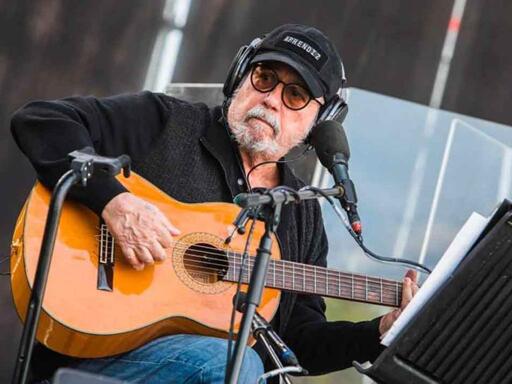
Beneath the acoustic guitar and poetic imagery of Silvio Rodríguez lies the story of a young Cuban literacy volunteer who helped build one of Latin America’s most resilient cultural weapons.
When Western commercial pop dominated the global airwaves, Rodríguez co-founded the New Trova (Nueva Trova) movement, transforming popular song into a counter-hegemonic instrument that gave voice to anti-imperialist movements across the continent and beyond.
Beyond Rodríguez’s timeless tracks like “I Wish” (Ojalá) and “The Fool” (El Necio), this article explores his frontline solidarity missions in Angola, his internal critiques of state bureaucracy, his technical support for non-commercial musicians, and his ongoing resonance with new generations of artists fighting modern austerity.
From San Antonio de los Baños to the sound of New Trova
Silvio Rodríguez, born on November 29, 1946, in San Antonio de los Baños, Cuba, stands as one of the most significant musical and political figures in Latin America.
Rodríguez’s father, Víctor Rodríguez, was a farmer and worker who wrote poetry and supported socialist ideas. His mother, Argelia Domínguez, introduced him to traditional Cuban songs.
Following the 1959 Cuban Revolution, the government launched the National Literacy Campaign in 1961 to eradicate illiteracy across the country. At age fourteen, Rodríguez joined the campaign as a volunteer literacy teacher, traveling to rural areas to teach farmers.
In 1964, Rodríguez began three years of military service in the Cuban Revolutionary Armed Forces. During his deployment at the Managua military camp near Havana, he learned guitar techniques from fellow soldier Esteban Baños and composed his first songs, including early boleros and compositions like Atavism (Ativismo) and Stay (Quédate).
During this period, Rodríguez worked as an illustrator and writer for military publications like Mella and Olive Green, where he collaborated with poets and writers such as Víctor Casaus and Luis Rogelio Nogueras.
Iconic Cuban revolutionary folk singer Silvio Rodríguez given AKM combat rifle.
Rodríguez’s gift followed his social media comments expressing readiness to defend Cuba in the event of foreign aggression, particularly involving the United States, even at the age of 79 years old. https://t.co/vPT27CLvAL
— Antifa_Ultras (@ultras_antifaa) March 21, 2026
Following his military discharge in 1967, Rodríguez made his television debut on the program Music and Stars. Rodríguez joined the group alongside Pablo Milanés, Noel Nicola, Sara González, and Sergio Vitier.
This institution provided the formal foundation for New Trova, a musical movement officially organized in Manzanillo in 1972 and placed social commentary, poetry, and technical innovation at the center of Cuban song.
Lyrical materialism and signature anthems
Silvio Rodríguez transformed Latin American songwriting. Rather than relying on simple political slogans or conventional socialist realism, his compositions explored the connection between individual emotions and collective political processes.
From September 1969 to January 1970, Rodríguez worked aboard the motor vessel Playa Girón, a fishing ship operating in the Atlantic Ocean off the coast of West Africa. During these four months at sea, he wrote 62 songs that formed a central foundation of his catalog.
Among these songs was Ojalá (“I Wish”), composed in 1969. While structured as a poem about a lost love, Emilia Sánchez, the song uses vivid imagery to convey a desire to erase an overwhelming presence. Its broad metaphorical scope allowed listeners across Latin America to interpret the piece both as an intense personal ballad and as a reflection on political disillusionment or resistance against authoritarian power.
The same maritime expedition produced Playa Girón (Girón Beach”), a song that directly addressed artistic creation and working-class identity. Written for his fellow crew members on the ship, the composition poses a direct question about who has the authority to write history and create culture. Rodríguez asked whether the story should be written by official historians or by the workers who perform daily labor under harsh conditions. The track highlighted his stance on democratic art, asserting that cultural expression belongs to the working class.
In 1991, following the collapse of the Soviet Union and the start of the Special Period in Cuba, Rodríguez recorded El Necio (“The Fool”) for his album Silvio. The song served as a firm statement of political conviction during a period of global ideological shifts and severe economic hardship in Cuba.
In the lyrics, Rodríguez rejected calls to abandon his socialist principles or adopt neoliberal market values. By declaring himself “foolish” for remaining loyal to his ideals, he created an anthem for individuals and movements resisting global political pressures and economic sanctions.
Another key composition from this period is La Maza (“The Mace”), featured on the 1982 album Unicornio. The song presents a series of hypothetical questions about the purpose of human existence, art, and intellectual work if they are disconnected from moral purpose and social solidarity.
Socio-political impact and anti-imperialist struggles
Beyond his recorded work, Rodríguez used his music in direct connection with international solidarity movements and political struggles.
In 1976, during the Angolan Civil War, he joined Cuban internationalist civilian and military personnel in Africa as part of Operation Carlota. Traveling alongside military units and cultural groups like Manguaré, he performed for soldiers and medical personnel on the front lines in towns such as Luanda, Cabinda, and Sumbe.
Rodríguez’s experiences in Angola inspired songs like Canción para mi soldado (“Song for My Soldier”) and Preludio de Girón (“Prelude to Girón”), which documented the human dimension of military conflict and internationalist solidarity.
Throughout the 1970s and 1980s, military dictatorships in the Southern Cone, including Chile, Argentina, and Uruguay, banned Rodríguez’s records and radio broadcasts under state censorship policies. Despite prohibitions, his songs were distributed clandestinely on cassette tapes among student unions, trade unions, and underground political organizations.
Following the transition to civilian rule in Chile, Rodríguez returned to Santiago in March 1990 to perform a historic concert at the National Stadium before eighty thousand people, marking a symbolic moment for the Chilean left after seventeen years of dictatorship under Augusto Pinochet.
Legendary Cuban musician, Silvio Rodríguez, expresses his support for the Revolution in the face of recent attacks. https://t.co/Wofdt6YdzA
— Kawsachun News (@KawsachunNews) July 26, 2021
While supporting the defense of Cuban sovereignty against external political and economic pressure from the United States, Rodríguez also maintained an active voice on domestic social issues within Cuba.
In 2010, Rodríguez launched the Gira por los Barrios (Neighborhood Tour), a cultural initiative designed to bring free, high-quality live concerts directly to working-class communities, housing developments, and prisons across Cuba. Accompanied by prominent classical and popular musicians, he performed over one hundred free neighborhood concerts.
Musical alliances and collective creation
Silvio Rodríguez’s career features collaborative efforts across geographical boundaries, musical genres, and generations. In the 1970s and 1980s, he built creative partnerships with artists who shared his interest in fusing poetry with popular song.
Rodríguez’s joint recordings and live performances with Spanish singer-songwriter Luis Eduardo Aute, Argentinian vocalist Mercedes Sosa, and Brazilian composer Chico Buarque established a shared catalog for progressive movements across the Spanish and Portuguese-speaking worlds.
Silvio Rodríguez’s long-standing collaboration with Pablo Milanés produced landmark recordings like El breve espacio en que no estás (“The brief space where you are not”) and Acta de fe (“Declaration of faith”), defining the acoustic identity of the New Trova movement.
Beyond acoustic folk music, Rodríguez explored diverse musical genres through large-scale collaborations. In the late 1980s, he joined forces with the Afro-Cuban jazz ensemble Afrocuba, led by woodwind player Oriente López. This collaboration combined complex horn arrangements, polyrhythms, and jazz harmonies with his acoustic guitar work, producing albums such as Causas y Azares (1987) and ¡Oh, melancolía! (1988).
Rodríguez also worked to build cultural infrastructure within Cuba to support non-commercial music production. In the 1990s, he founded Estudios Ojalá in Havana, a recording facility created to provide technical resources for Latin American musicians, classical performers, and independent artists who faced barriers within the commercial recording industry.
At the start of his Latin America concert tour with the first show in Havana, Cuba, the great Silvio Rodríguez drapes himself in a kafiya, and stands fully for Palestinian liberation.
¡Viva Palestina! https://t.co/vJ0NNO8Opc— Vijay Prashad (@vijayprashad) September 20, 2025
Rodríguez’s creative work extends into contemporary urban genres through collaborations with younger generations of Latin American artists. In 2014, he recorded Ojos Color Sol (“Sun-Colored Eyes”) with Puerto Rican hip-hop group Calle 13, combining poetic storytelling with urban rhythms.
In 2025, Rodríguez collaborated with Argentinian urban artist Milo J on the track Luciérnagas (“Fireflies”) for the album La vida era más corta (“Life was shorter”), directing the song’s streaming royalties to the human rights organization Abuelas de Plaza de Mayo. In May 2026, Rodríguez re-recorded Sueño con serpientes (“I dream of snakes”) alongside Chico Buarque in Havana, reaffirming his artistic solidarity across Latin America.
Legacy, heritage, and new generations
Silvio Rodríguez’s artistic production remains a foundational body of work in Latin American music. Across six decades, his compositions provided an alternative model to commercialized pop music, proving that popular art can achieve widespread success while retaining high literary standards, structural complexity, and political commitment.
For younger generations of musicians, activists, and listeners, Rodríguez’s work offers a framework for understanding the role of the artist in society. His songs continue to be performed at community assemblies, social protests, and cultural centers throughout Latin America.
Rather than functioning solely as historic artifacts, compositions like El Necio, Ojalá, and Playa Girón remain active tools for social expression, used by new movements advocating for social justice, anti-imperialist sovereignty, and cultural independence.
Ultimately, Silvio Rodríguez’s legacy demonstrates that non-commercial art can shape collective identity across national borders.
(Telesur)
From Orinoco Tribune via This RSS Feed.