

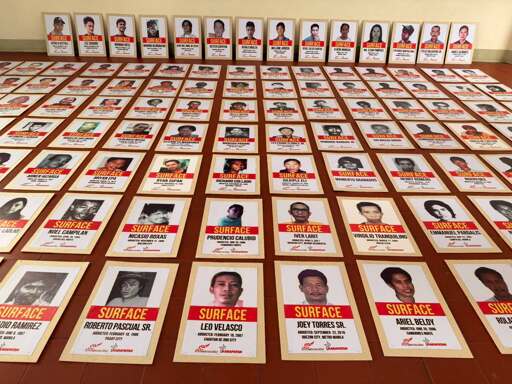
MANILA – All human rights violation victims should receive reparation consistent with domestic laws and international obligations.
“From a victim-oriented perspective, the State must recognize that different human rights violations may require various kinds of reparations based on the demands of the victims, their families, and communities which they belong to, to correct the wrongs and achieve healing,” the 2026 Commission on Human Rights (CHR) position paper stated. “Essentially, reparation should be proportional to the gravity of the violations committed and the extent of harm suffered.”
“When my daughter was killed, we received no single assistance nor investigation from the authorities. Not the barangay, not the police. Not one from the government offered help,” Sally Ramos told Bulatlat. Her daughter was killed in 2017 by four unidentified men at the height of the anti-drug campaign.
She said, “We are poor, I do not have a job. My daughter who was killed had a job before she was killed. She supported us for our daily needs and in taking care of my two grandchildren. That is why it was hard for me to accept her passing.”
Read: Ten years on, Duterte’s kill order strikes deep
While it supports the passage of Human Rights Violations Victims Compensations Act (House Bill No. 580), CHR recommends a harmonized definition of victims of human rights violations as persons whose human rights were violated by persons acting in an official capacity and by agents of the State, as well as due to the State’s failure to perform its obligations to prevent, investigate, punish, and redress the private actors’ abuse.
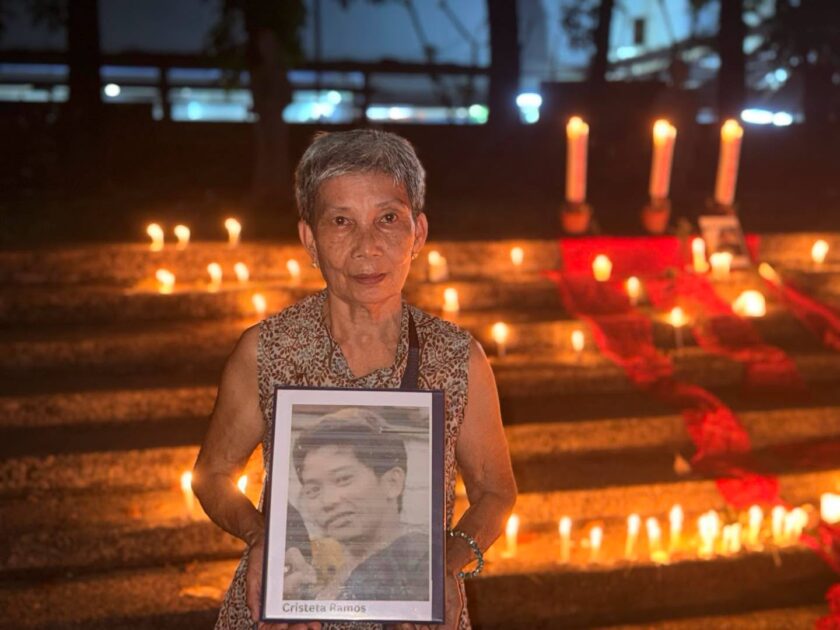
Sally Ramos had to cover her daughter’s head with a cloth because her skull had been shattered. (Photo by Dominic Gutoman/Bulatlat)
However, human rights group Karapatan disagreed with the bill’s definition that human rights violations are committed by “State or Non-State actors.”
“States are duty-bearers of rights and as such have obligations under international human rights law far greater than non-State actors, and thus the term ‘human rights violations’ should pertain to those committed by State actors. Meanwhile, those allegedly committed by Non-State actors are considered offenses against persons and as such are covered by provisions under criminal and civil laws,” Karapatan Secretary-General Cristina Palabay said.
The existing Victims Compensation Program under Republic Act 7309 provides reparation for martial law victims-survivors. The proposed bill complements this, covering cases and victims that fall outside the scope of RA 7309, particularly those involving indirect State responsibility, non-state actors, or failures of State protection.
“Acknowledging the HRVs committed against the victims is an essential step toward healing, community reconciliation, and justice. This measure will not only affirm the rights of the victims, but will also ensure that acts of grave injustice and abuse will be legally penalized and no victims, regardless of the nature of the violation, will be left disregarded,” the CHR said.
“Compensation could be a big help for the victims’ families, especially if those killed or disappeared were the breadwinners of their families” Cora Jazmines said. Her husband James, a labor rights defender, was forcibly disappeared on August 23, 2024 around 10 p.m., after celebrating the birthday of his friend, Felix Salaveria, Jr. It was Salaveria who reported James’ disappearance. Five days later, Salaveria was also abducted. Both of them remain missing.
Jazmines was among the signatories of a letter to the Supreme Court, urging them to review the writs of amparo and habeas data this August 2026. The court granted the petition for writ of amparo but it has not yielded positive results for their search.
Read: Not one surfaced despite court orders, families demand review of legal remedies
“The majority of Filipino families struggle to make ends meet. As a result, many of the issues raised by HRV victims center on advancing and protecting the basic rights of citizens, including access to adequate food, decent wages and livelihoods, quality education, housing, and healthcare services,” Jazmines said, stressing that if the primary breadwinner of the family was subjected to state violence, the family left behind can be pushed even deeper into poverty.
The bill has been pending with the House Committee on Human Rights since July 29, 2025. The State’s duty to provide reparation is also stated in the International Covenant on Civil and Political Rights, which the Philippine government ratified in October 1986.
“For far too long, human rights violation victims across regimes have been bereft of their loved ones and justice. This measure should help remedy this dire situation,” Palabay said, adding that the bill should be given due course by the House of Representatives and the Senate as it is long overdue. (RTS, DAA)
The post ‘Human rights reparation starts with justice’ appeared first on Bulatlat.
From Bulatlat via This RSS Feed.