

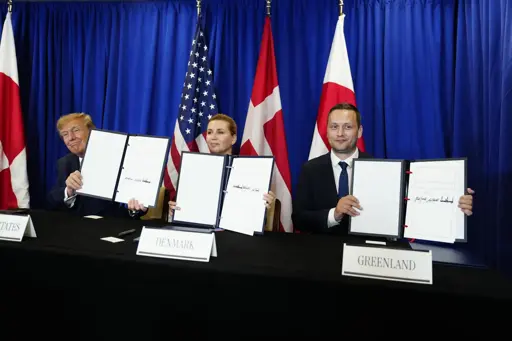
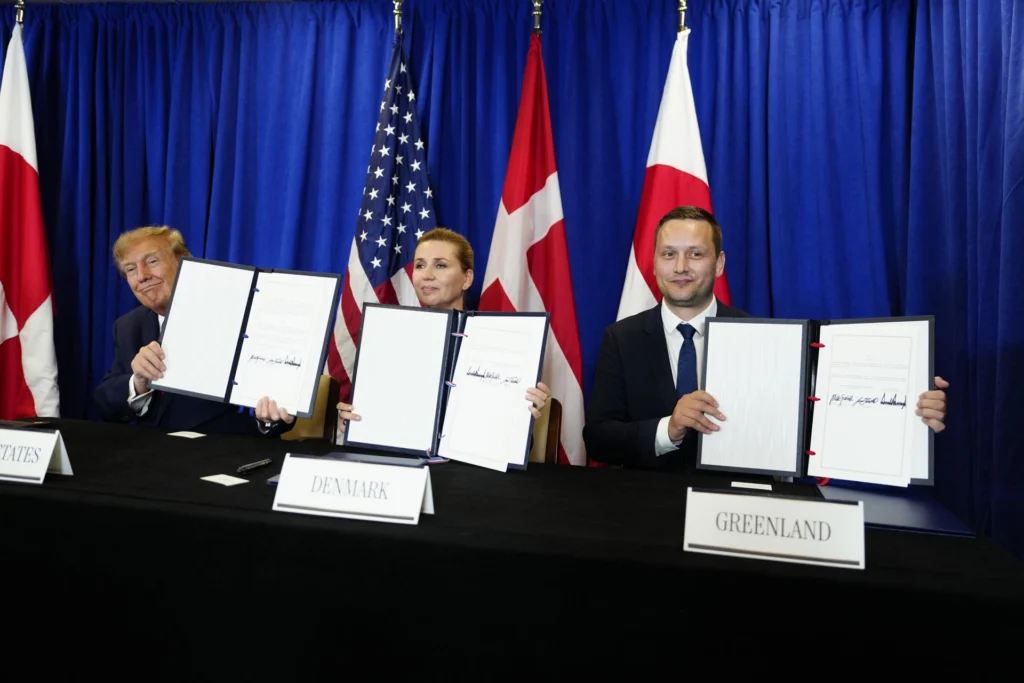
U.S., Denmark and Greenland signed a legally binding security pact Tuesday granting Washington permanent control over the Arctic island’s defense.
The trilateral pact was signed following months of intense pressure from the White House, which at points included threats to use military force to secure control over the territory.
Greenlandic Prime Minister Jens-Frederik Nielsen, Danish Prime Minister Mette Frederiksen and U.S. President Donald Trump led the signing ceremony at U.N. headquarters, formalizing what officials on all sides described as a historic shift in the island’s security architecture.
RELATED: U.S. To Have Permanent Control Over Greenland Security: Trump
Under the terms of the agreement, Washington is granted what the text describes as “permanent control over security and all other needs” on Greenland. It further stipulates that no U.S. adversary will ever be permitted to establish a base, maintain a military presence, or make sensitive investments in Greenland without the “express written approval” of the U.S. government.
Speaking at the signing ceremony, U.S. President Trump called the agreement a landmark achievement. “This is something extraordinary for Europe and for the United States, for the whole world and for Greenland… It’s going to be a fantastic long-term relationship,” he said.
President Donald J. Trump officially signs the landmark Greenland security deal alongside Prime Minister Mette Frederiksen of Denmark and Prime Minister Jens-Frederik Nielsen of Greenland.
This HISTORIC deal is critical for American national security and defense in the Arctic… pic.twitter.com/OGoSWfjEhf
— The White House (@WhiteHouse) September 22, 2026
Officials in Copenhagen and Nuuk said the agreement upholds their core conditions regarding the island’s political status. “The agreement makes very clear in its preamble that there is absolute respect for the sovereignty of the Kingdom of Denmark, the territorial integrity of Greenland, and its right to self-determination,” Danish PM Frederiksen said at a joint press conference.
For his part, Greenlandic PM Nielsen acknowledged the difficulty of the negotiating period, saying it had brought both worry and fear among Greenlanders, while cautioning that rebuilding trust with Washington would still “take time,” even as the immediate threat of confrontation had eased.
Agreement’s Key Points
The security pact spans several core areas that redefine the U.S. military and strategic presence on the Arctic island.
- New Military Bases: The agreement allows United States to build two new military bases, located in Narsarsuaq, in the south, and Mestersvig, in the east, while also expanding the existing Pituffik Space Base.
- Rights of Movement: The pact grants U.S. aircraft and vessels overflight rights, along with landing and submarine access throughout Greenlandic territory.
- Restrictions on Foreign Powers: Under the agreement, non-NATO countries are barred from establishing military installations or maintaining a persistent presence on the island. The deal also blocks sensitive investments originating from outside NATO and the European Union.
- Sovereignty: The agreement reaffirms Denmark’s sovereignty over the autonomous territory and upholds Greenland’s right to self-determination. Notably, it does not involve the sale or annexation of the territory, a demand President Donald Trump had previously raised.
BREAKING NEWS: I am pleased to announce that the United States of America has entered into an Agreement with The Kingdom of Denmark, and Greenland, that gives the United States permanent control over security, and all other needs, in Greenland, completely addressing ALL of our…
— Donald J. Trump (@realDonaldTrump) September 19, 2026
Ahead of the signing, during his address on the opening day of the General Assembly, Trump announced plans to expand the U.S. military footprint on the island. “We will immediately begin the process of developing a major military presence in the appropriate locations. We will build two large-scale military bases,” he confirmed.
The Pentagon currently maintains only the Pituffik Space Base, formerly Thule Air Base, on the territory, following decades of troop drawdowns. The new framework allows for the installation of early-warning radar systems and undersea tracking technology to monitor naval traffic across the North Atlantic, in addition to granting unrestricted overflight rights and allowing for expanded troop deployments.
Greenland’ Strategic Importance
Washington’s interest in Greenland intensified in early 2025, when the Trump administration formally classified the island as critical to U.S. national security in the Arctic. Trump, who first expressed territorial ambitions toward Greenland during his first term, reignited tensions earlier this year by suggesting the U.S. could seek to take control of the island by military force.
The island’s strategic value has grown alongside the opening of new commercial and military shipping routes caused by accelerating Arctic ice melt, positioning Greenland as a key location for ballistic detection and naval control.
The interest of the White House in this insular territory deepened in early 2025, when the Trump’s Administration classified Greenland as a critical point for its national security in the Arctic. Trump, who during his first term (2017-2021) showed ambitions over Greenland, reignited geopolitical tensions at the beginning of this year by suggesting the possibility of taking control via military means. This move highlighted the strategic value of Greenland, which has become a pivotal point due to the opening of new commercial and military maritime routes caused by the accelerated melting of the Arctic ice.
The strategic value of Greenland extends beyond its immediate geopolitical significance. The island holds some of the world’s largest unexplored reserves of rare earth minerals, uranium, and hydrocarbons, all of which are crucial for technological transition and energy security, making it a critical player in the global energy and technology landscape.
As the world transitions towards more sustainable and technologically advanced systems, the control and exploitation of these resources will become increasingly important. This adds another layer of complexity to the negotiations, as both Denmark and the United States seek to secure their interests in a rapidly changing global environment.
From teleSUR English via This RSS Feed.