

On Sunday, September 20, the Anti-War Action Network (AWAN) held a webinar to hear from activists who traveled to the Republic of Korea (RoK) to participate in demonstrations against the U.S. military occupation of the country.
Speakers on the webinar included Meredith Aby of the AWAN steering committee, Chrisley Carpio of Freedom Road Socialist Organization, and Sonya Chung of Nodutdol, the organization of Korean American activists who organized the trip. The event was moderated by Maria Sohn Hasman of the AWAN-aligned Tucson Anti-War Committee.
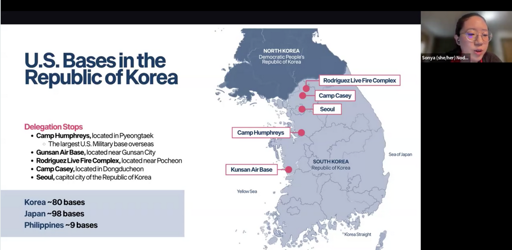
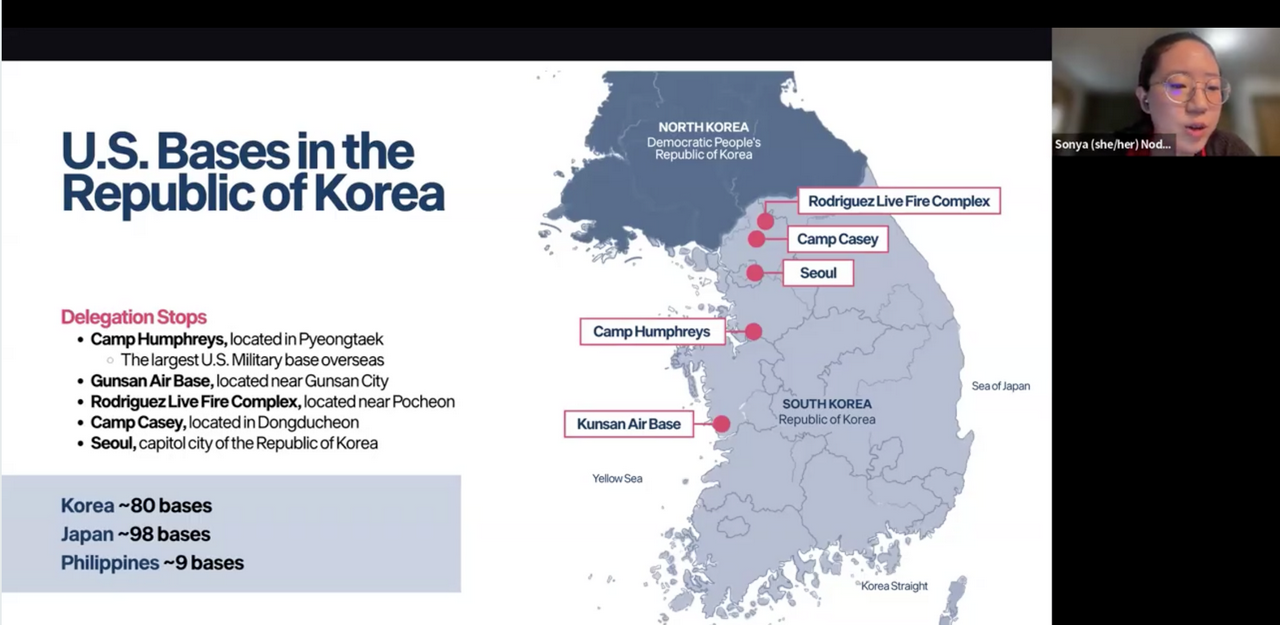
In mid-August, Nodutdol brought activists from over 20 different groups around the U.S. together to form the Jaju Solidarity Brigade, the first-ever international delegation to participate in the RoK’s long-standing August 15 protests. In addition to joining the 10,000-strong march on Seoul, members of this delegation spent a week traveling the country to visit occupation bases and learn from local activists about the history of Korea’s struggle for independence.
“It’s important to know the relationship between the U.S. and South Korea is one defined by imperialism,” said Carpio, commenting on the historical context which the present movement has emerged from. “The U.S. went ahead and carved up Korea in 1945 and divided the Korean people.” Carpio went on to characterize the 1950 war as an attempt to reunite Korea, which the U.S. violently put down with the help of the same corrupt politicians who had supported the Japanese occupation during World War II.
Chung spoke to the current memory of this history, saying, “Many people still have really raw wounds, and I think that that was something we really experienced going through all the site visits.” As Chung explained, it is estimated that the RoK hosts around 80 U.S. military bases, though the exact number is kept intentionally obscured. Chung further characterized the U.S.-RoK relationship by quoting a top U.S. commander, who called South Korea “a dagger in the heart of Asia aimed at China.”
One major issue relating to U.S. bases which the delegation heard about is that of land disputes. On their trip to Camp Humphreys, the largest overseas military base in the world, the delegation learned about the 2004-2006 struggle of Daechuri village, a community forcibly relocated to create space for the foreign base to expand. A similar struggle is being waged today in the vicinity of the Gunsan Air Base, where a proposed expansion would devastate the local ecology, disrupting both nearby communities as well as endangered species.
Later on in the webinar, Aby reflected on her 2002 trip to Palestine, noting how “a lot of the messages that I heard from people in South Korea really reminded me of the messages I heard from Palestinians. About how they’ve been pushed off their lands, that everything that Israel wanted they got to just take in terms of land. Similarly, everything that the U.S. military wanted [in South Korea] they got to just take in terms of land.”
Another major issue which Aby spoke about is the sexual violence which the U.S. occupation continues to perpetrate against Korean women. “Not only did the U.S. take military control of the peninsula, they also took control of women’s bodies,” said Aby, as she described how the U.S. and RoK governments collaborated to establish “camptowns,” where Korean women were coerced into prostitution for the pleasure of U.S. soldiers. Emphasizing the scale of this project, Aby remarked that at one point this prostitution “got to be 5% of the South Korean gross domestic product.”
While in the vicinity of Camp Casey, the delegation visited an abandoned STD management center, where the women who worked in these camp towns faced further medical abuse. Here women were forcibly tested, “and if they tested positive, they got a dose of penicillin that was ten times the amount of penicillin that people would normally get,” said Aby. This treatment often left women unable to stand, at which point they “were then imprisoned in that STD management center for a week.” The particular facility visited by the delegation remained in operation until 1993.
As regards the protests which the delegation participated in, Chung commented on how impressive it was to see so many organizations and demographics gathered to protest with the same core message: “There is truly a unity of messaging, and there’s clarity in the political message of wanting the U.S. out.”
Carpio likewise spoke about how inspired she was by the strength of Korean protest culture, which she described as achieving a high degree of organization, while balancing a celebratory tone alongside a militant focus. Carpio put it, the prevailing mood was “We’re not going to obey. We’re going to get done what we need to get done.”
#AntiWarMovement #Korea #AWAN #AntiWarActionNetwork #Nodutdol #International #JajuSolidarityBrigade
From Fight Back! News via This RSS Feed.
You must log in or # to comment.