

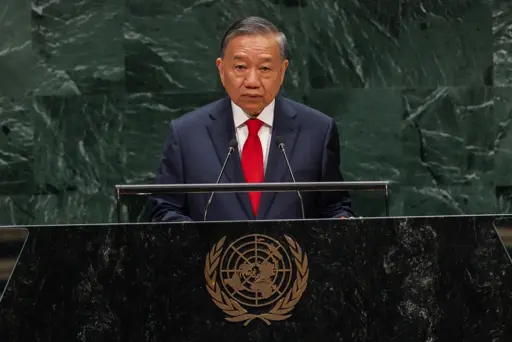
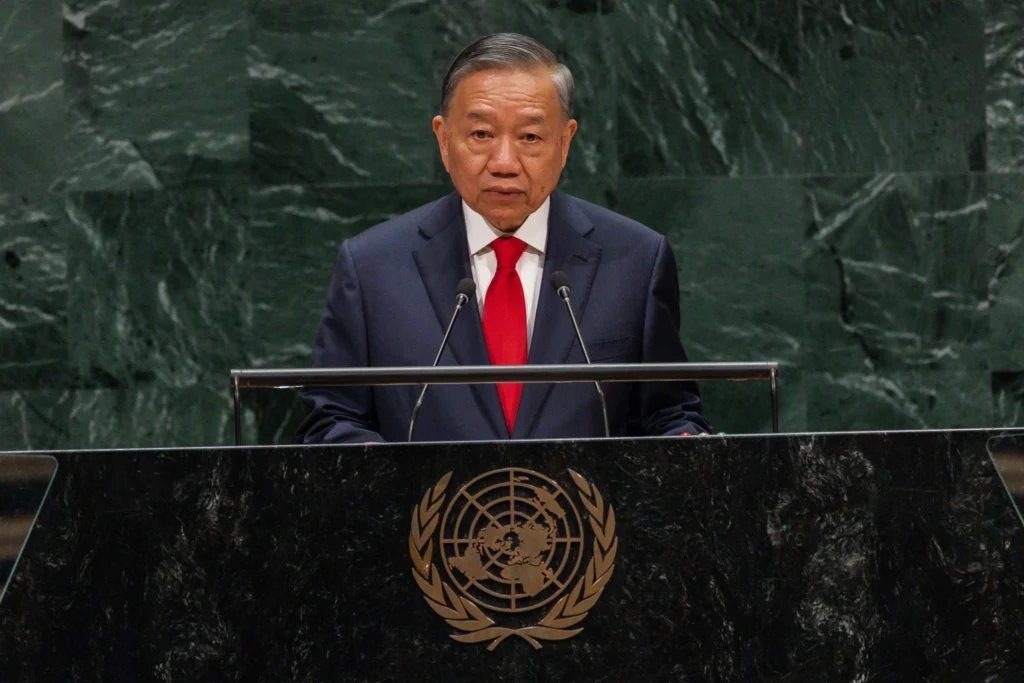
Vietnam’s President Tô Lâm called on U.S. to lift its economic, commercial, and financial blockade against Cuba during his speech at the 81st session of the United Nations General Assembly, emphasizing the need for global governance and multilateralism.
Vietnamese President Tô Lâm delivered a powerful message at the 81st session of the United Nations General Assembly (UNGA), focusing on the urgent need to strengthen global governance and multilateralism.
During his speech, Lâm highlighted the profound changes and uncertainties facing the world, including the risks posed by armamentism, the use of force, and the development of new technologies.
RELATED: Cuba Denounces Growing U.S. Military Buildup in Caribbean
President Tô Lâm demanded an end to the U.S. blockade against Cuba, describing it as a collective punishment that includes an energy siege, secondary sanctions, and a constant threat of military aggression.
In this sense, he emphasized the importance of protecting civilians and upholding humanitarian rights, and reiterated Vietnam’s support for the Palestinian people’s right to self-determination and the establishment of an independent Palestinian state.
Ver esta publicación en Instagram
Una publicación compartida de teleSUR English (@telesurenglish)
Called For Global Governance
President Lâm underscored that while change is inevitable, conflict and confrontation are not, and he advocated for consolidating trust and managing the United Nations in a way that delivers tangible results for all nations. The UN, he noted, has been a fundamental pillar for supporting dialogue since its inception after World War II.
To contribute to effective global governance, Vietnam proposed three key axes. The first is to restore trust among nations based on the UN Charter and international law, ensuring that all countries have a voice and real opportunities for development. The second axis is to promote equitable, human, and inclusive development, translating commitments from the Future Pact, the 2030 Agenda, and international financing into concrete actions that expand long-term access to resources, reduce debt burdens, and prioritize climate action and a just energy transition.
The third axis involves proactively shaping technological governance to ensure that science, artificial intelligence, and digital transformation serve humanity and reduce gaps rather than creating new dependencies. Vietnam, which hosted the signing of the UN Convention against Cybercrime in 2025, is committed to global digital cooperation.
Lâm also stressed the need for states to respect sovereignty, territorial integrity, and the right of each nation to choose its own development path, abstaining from interfering in internal affairs or threatening the use of force to prevent crises. He called for a UN that can effectively address global challenges and ensure that technological advancements do not exacerbate divisions.
Vietnam’s proposals reflect a commitment to a more just and equitable world order, where all nations have the opportunity to develop and thrive, underscoring the importance of international solidarity and the need for a rules-based global system.
“Vietnam chooses peace, cooperation, and development. We will work tirelessly with all nations to strengthen the United Nations, uphold international law, and turn our shared commitments into tangible benefits for our people,” Lâm asserted, underscoring Vietnam’s commitment to global peace and cooperation.
🇵🇸🇻🇳 “In every conflict, civilians must be protected. International humanitarian law must be respected, and humanitarian access must be ensured. Vietnam supports the right of the Palestinian people to self-determination and the two-state solution with an independent state of… pic.twitter.com/1nLQNibJsn
— State of Palestine (@Palestine_UN) September 22, 2026
Support for UN Reforms
The Vietnamese leader’s call for UN reforms comes at a critical juncture, as the organization faces numerous challenges, including geopolitical tensions, climate change, and humanitarian crises. Strengthening the UN’s institutional framework is essential for addressing these global issues effectively. Lam’s proposal to reform the General Assembly, Security Council, and Secretariat aims to create a more efficient and responsive organization capable of tackling complex challenges.
Lam’s emphasis on institutional reforms is particularly relevant given the evolving global landscape. The UN must adapt to new realities, such as the rise of emerging economies and the increasing interconnectedness of the world. By streamlining its operations and enhancing its decision-making processes, the UN can better address the diverse needs of its member states, particularly those in the developing world.
Vietnam’s experience serves as a testament to the transformative power of international cooperation. From receiving assistance to becoming a significant contributor to global peace and development, Vietnam’s journey illustrates the potential for positive change when nations work together. Lam’s call for strengthening multilateralism and the UN’s role reflects Vietnam’s commitment to global peace, cooperation, and development.
Lam’s speech at the UN General Assembly underscored the importance of strengthening multilateralism and the UN’s role in addressing global challenges. By advocating for institutional reforms, Vietnam aims to create a more effective and responsive organization capable of tackling complex issues and promoting global peace, cooperation, and development.
The Vietnamese leader’s speech at the UNGA highlighted the critical role of multilateralism and global governance in addressing the world’s most pressing challenges. His calls for an end to the Cuba blockade and support for the Palestinian people’s right to self-determination resonated with many nations, underscoring the need for a more just and equitable international order.
From teleSUR English via This RSS Feed.