

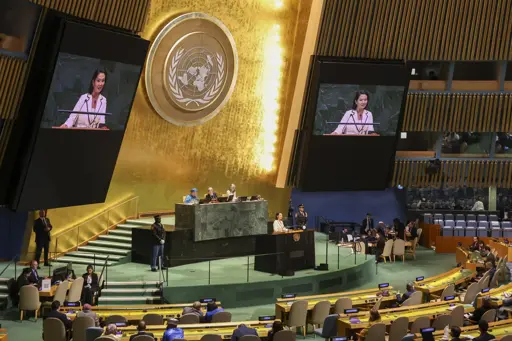
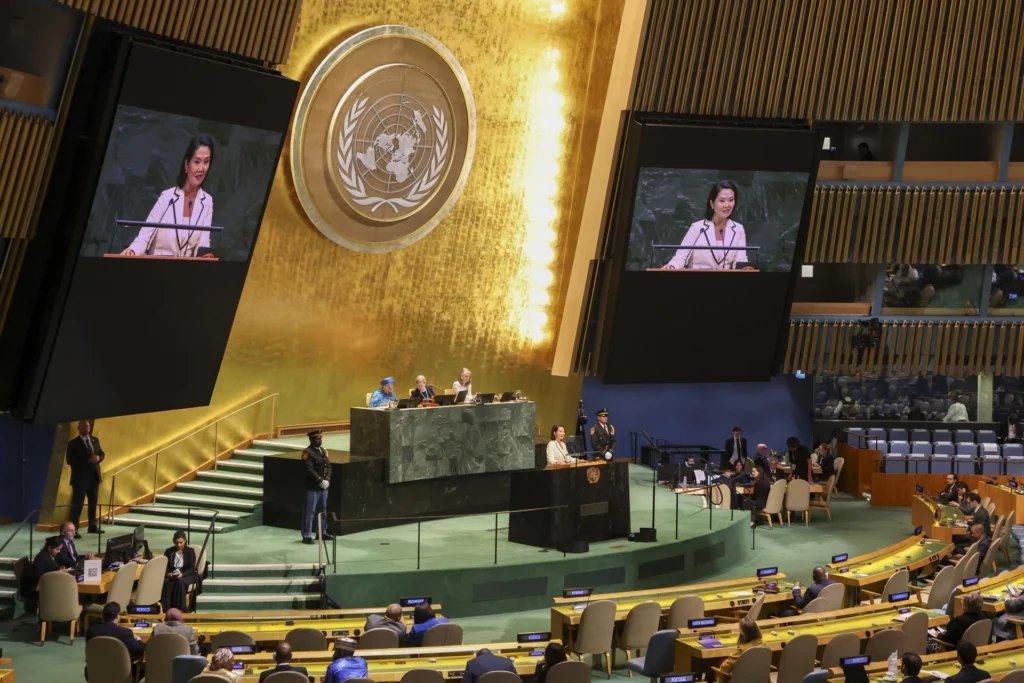
Peruvian President Keiko Fujimori, in her first international address since taking office, announced Peru’s adherence to the U.S.-led Shield of the Americas initiative during the UN General Assembly, emphasizing a strong stance against transnational crime and terrorism.
During the 81st United Nations General Assembly (UNGA), Peruvian far-right President Keiko Fujimori used her address to align her government with the U.S.-led Shield of the Americas initiative.
She framed criminal organizations as terrorist groups, asserting that Peru faces a unique war against transnational criminal entities.
RELATED: Peru Joins U.S.-Backed Shield of the Americas Pact and Space Catalyst Initiative
“These criminal organizations are terrorist groups and must be confronted as enemies of the democratic state and of law-abiding citizens,” Fujimori asserted. She argued that once these groups are legally designated as terrorists, nations will have a robust legal framework to maintain internal order.
Fujimori’s speech focused on crimes such as drug trafficking, extortion, human trafficking, and illegal mining, but it did not specify the safeguards that would govern military intervention against these groups. Nor did it clarify how the label of “terrorism” would be applied to avoid overreach. Fujimori described a scenario “without battlefronts or defined borders and no possibility of surrender or signing peace treaties,” a definition that leaves broad margins for security forces to act against civilian populations.
H.E. Keiko Sofia Fujimori Higuchi, President of the Republic of Peru @UN #GeneralDebate
🔗Access the recording and transcript of the statement here: https://t.co/ZtNoPhxwxP#UNJournal #UNGA81
© UN Photo/Loey Felipe pic.twitter.com/i4HiPooYwp— Journal of the United Nations (@Journal_UN_ONU) September 22, 2026
Fujimori also drew on her country’s history of combating alleged subversive organizations, noting that Peru has paid a high price for peace. She criticized the ongoing trials of military and police personnel for human rights violations during the internal armed conflict, stating that “the defense of human rights should not end up converting victims into defendants and perpetrators into protected individuals.”
In addition to her remarks on security, Fujimori reaffirmed Peru’s commitment to multilateralism and the principles of the United Nations. “Peru comes to this assembly ratifying its absolute commitment to the Charter of the United Nations and its main pillars: peace, security, development, and human rights,” she declared. She called on the UN to provide an independent, impartial, and dialog-driven response to conflicts, demonstrating its ability to find solutions even when understanding seems impossible.
This rhetoric echoes dark precedents from Peru’s history, notably the dictatorship of Alberto Fujimori (1990-2000), during which thousands suffered severe human rights violations, including disappearances, extrajudicial executions, and forced sterilizations.
Rejection of U.S. Alignment
The Shield of the Americas, initiated by the Trump’s administration, aims to coordinate efforts against alleged transnational organized crime across the Americas. Fujimori framed Peru’s adherence to this initiative as a commitment to “not retreat from those who seek to impose terror over the law.”
The initiative lacks clear public frameworks outlining its scope, operational command, or accountability mechanisms for U.S. forces or advisors operating in the region.
Keiko Fujimori’s announcement comes amid Peru’s participation in the far-right Santiago Group, a mechanism led by Chile and including Argentina, Bolivia, Ecuador, Paraguay, and Uruguay. Fujimori also criticized previous regional approaches to organized crime as “isolated and ineffective,” without specifying whether the solution lies in greater Latin American cooperation or operational subordination to Washington.
Experts, however, view this initiative as a means for the U.S. to align regional countries with its strategic interests, aiming to expel non-hemispheric competitors like China and secure strategic resources. Following this, Peruvian organizations have strongly rejected this alignment with U.S. policies, citing concerns over potential human rights abuses and the erosion of national sovereignty.
Fujimori’s visit to the U.S. also included a meeting with Dominican President Luis Abinader, where she reaffirmed Peru’s commitment to strengthening bilateral relations. She is also scheduled to attend a reception hosted by U.S. President Donald Trump and participate in the Regional Commitment of Santiago against Transnational Organized Crime, a meeting agreed upon by ministers in Chile.
Fujimori’s speech and actions underscore Peru’s alignment with U.S. security initiatives, which analysts view as a means to consolidate U.S. influence in the region.
From teleSUR English via This RSS Feed.