

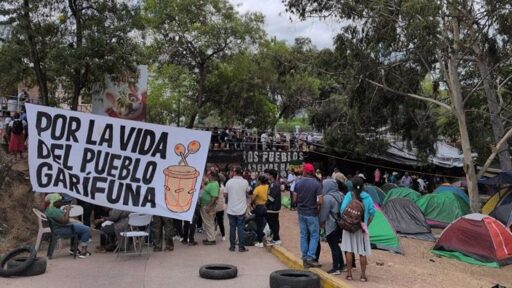

Spanish reality show “Survivor” (Supervivientes) has been filming on the land of the Afro-Indigenous Garífuna peoples in Honduras since 2006. The filming of “Supervivientes,” as well as other versions of the “Survivor” show, have sparked intense local protests over land, human rights, restrictions to fishing access, and forced evictions.
In 2025, the Inter-American Court of Human Rights (IACHR) found that the filming of the reality show violated several rights of the members of the Garífuna community. But it wasn’t the first time the Honduran government has been found in violation for its treatment of the Afro-Indigenous people of Central America. In total, the Inter-American Court has issued warnings four times regarding the mistreatment suffered by this community.
This story, though not entirely recent, has resurfaced in recent weeks when, on July 6, nearly two hundred police officers arrived in San Juan to evict several community members, claiming they were on property that did not belong to them.
However, the Garífuna assert that these lands belong to the community, and therefore an eviction order cannot be issued for communal lands that, in essence, are being targeted for privatization in favor of private interests (particularly those of the Rosenthal family, one of the wealthiest and most powerful families in Honduras). The dispute led to the arrest and prosecution of five community members by the Honduran judicial system. Those detained are Deinor Mejía, Irbin López, Carlos Fernández, Onil Hernández, and Sara Acosta.
Protests against evictions
Following this, several members of the Honduran Black Fraternal Organization (OFRANEH) arrived in the capital, Tegucigalpa, to protest in front of the Supreme Court against what they consider to be unfair treatment. They set up the “Viva Berta” Camp and plan to remain there until the proceedings against the five defendants are concluded and the court stops treating the matter as if it were a criminal case.
Furthermore, OFRANEH has rejected the intentions of Supreme Court President Wagner Vallecillo to establish dialogue forums to resolve the conflict, as the organization defending the rights of Black Hondurans asserts that this would imply recognizing that these territories do not belong to the peoples settled there – a fact already established several years ago by international courts and specifically recognized in 2023 by the Inter-American Court of Human Rights, which ruled that the territories of San Juan belonged to the communities settled there.
Thus, while the government promotes negotiations, the Garifuna people continue to resist what they see as an onslaught by private interests that are using the Honduran government to their advantage in order to strip them of something that – despite the racist rhetoric of certain media outlets – is rightfully theirs by virtue of hard-won rights.
Isolated incident or state policy?
However, in the Honduras of right-wing President Nasry Asfura, a law known as the Agroindustrial Law, the Employment and Economic Development Zones (ZEDE), was recently passed. This law authorizes law enforcement to act as they did on the day of the eviction, even though it contradicts the rulings of the IACHR, which could lead to another case against the Honduran state.
OFRANEH asserts that this is part of a long-standing pattern of the Honduran state’s actions against Indigenous peoples. For two decades, various institutions have promoted the dispossession of lands in favor of private interests, they stated. In one such example, the National Agrarian Institute reportedly failed to recognize more than 172 hectares for the Garifuna people but did recognize them for the company Promotur, a firm linked to Jaime Rosenthal Oliva, a prominent Honduran banker and politician who died in 2019.
This organization has also denounced the clear ties between the Rosenthals and the Supreme Court of Justice, which could jeopardize fair treatment and recognition of the territories in favor of Indigenous peoples.
For their part, several United Nations special rapporteurs have called on the Honduran government not to carry out more than 1,000 eviction orders that would affect tens of thousands of peasant, Indigenous, and Afro-descendant families. These orders would jeopardize not only territorial rights but also the food security of thousands of people, as these families rely primarily on working the land for their livelihoods.
From BT News via This RSS Feed.