

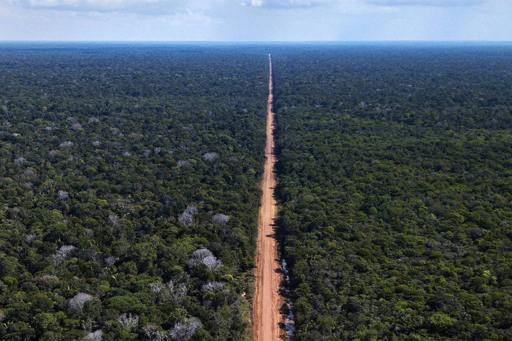
The Brazilian government has created four new sustainable development reserves in the Amazon as part of an effort to mitigate environmental damage from the controversial plan to fully pave the BR-319 highway. The road will pass through one of the most intact parts of the rainforest, which conservationists warn will lead to increased deforestation. President Luiz Inácio Lula da Silva signed on Sept. 8 the decrees that would protect more than 668,000 hectares (1.65 million acres) of Amazon rainforest under a sustainable-use model, which allows existing residents to remain on the land and extract forest products. “The federal government is working … to build a solution capable of enabling the highway’s paving, while ensuring environmental protection and encouraging sustainable economic development in the region,” João Paulo Capobianco, the minister of environment and climate change, said at an event announcing the new conservation areas. Map by Andrés Alegria/Mongabay. The four reserves will be managed by Brazil’s Chico Mendes Institute for Biodiversity Conservation, a federal agency under the environment ministry. The decrees also establish buffer zones around three of the four largest reserves, putting another 109,718 hectares (271,119 acres) of land under some level of protection, though mining could be permitted in those areas. The BR-319 highway, which connects the cities of Manaus and Porto Velho in Brazil’s northern Amazon, was built during Brazil’s military dictatorship in the 1970s and later fell into disrepair. The highway’s 339-kilometer (211-mile) middle section is largely impassable in the rainy season, though many still try to…This article was originally published on Mongabay
From Conservation news via This RSS Feed.