

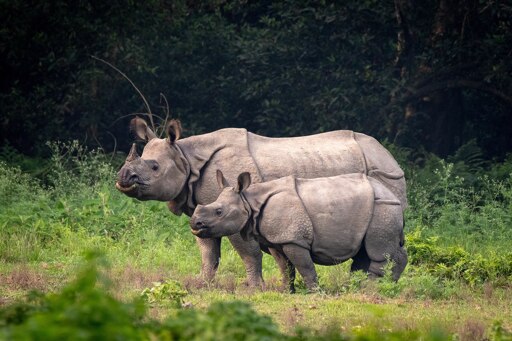
In honor of World Rhino Day, on Sept. 22, here’s a snapshot of Mongabay’s reporting from the past year on the actions being taken to save rhinos from extinction: Reintroduction in Uganda In 1983, the last wild northern white rhino (Ceratotherium simum cottoni) living in Uganda was killed for its horn. But now rhinos are back in the country, contributor Benjamin Jumbe reported in March. In the last year, at least four southern white rhinos (Ceratotherium simum simum) were brought to northern Uganda’s Kidepo Valley National Park and another four to Ajai Wildlife Reserve. The reintroduced rhinos are a different subspecies, because just two northern white rhinos are alive today; both are females. “The translocation helps us not keep all eggs in one basket and create opportunities to mitigate … risks,” Robert Aruho, a veterinary specialist with the Uganda Wildlife Authority told Mongabay. Mozambique’s ‘silent park’ receives rhinos Zinave National Park in Mozambique, the site of a decades-long civil war, came to be known as a “silent park,” because the war nearly decimated its wildlife. Since 2022, 64 white rhinos (Ceratotherium simum) and black rhinos (Diceros bicornis) have been reintroduced to the park, Mongabay’s Shanna Hanbury reported in June. As grazers, rhinos help maintain the grassland ecosystem, creating habitat for other wildlife and mitigating fire risk. “You can imagine if you don’t have rhinos in the park, [there are] very high grass levels, which is a very large fire hazard,” said Antony Alexander, with the Peace Parks Foundation. At least five…This article was originally published on Mongabay
From Conservation news via This RSS Feed.