

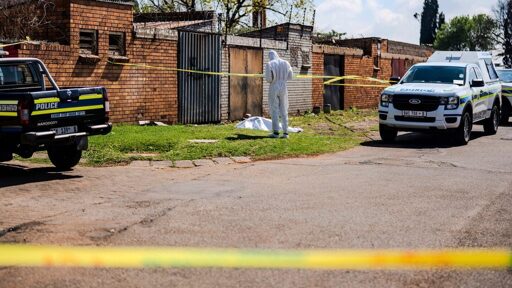

Fear and anger are growing in South Africa after the bodies of nine women were discovered across the Ekurhuleni municipality, east of Johannesburg, over the past two months, with police investigating whether the deaths are connected, a 10th body was confirmed this week. Three suspects have been arrested, and police have acknowledged a possible connection between some of the killings. What is not in dispute is the scale of the crisis the discovery has exposed, and the outrage it has provoked, protests against femicide have been held in the country in the weeks since.
Four of the nine women have so far been publicly identified, Elizabeth “Tsontso” Moselakgomo, 38, a mother who vanished during her regular afternoon run and was found days later behind a hotel in Rhodesfield; Itumeleng Kekana, 32, missing since July and found in August with multiple stab wounds; Dineo Evelyn Motapane, 38, found in KwaThema; and Gracious Nkomo, 28, a lodge worker in Kempton Park missing for more than two weeks before she was found.
Anger over the response
The deaths have triggered protests and renewed criticism of the country’s response to gender-based violence. Residents and women’s rights campaigners have questioned why women are repeatedly advised to change their behavior, avoid isolated areas, walking alone or running alone, rather than placing greater emphasis on preventing perpetrators from committing violence.
The National Union of Metalworkers of South Africa (NUMSA) has been among the sharpest voices responding to the killings. In a statement condemning the deaths, the union insisted the killings should not be treated as a “crime wave” or a mystery, describing them instead as femicide and, more precisely, a war being waged against women. NUMSA’s argument is that this is not an aberration but the visible edge of something structural. The union points to police figures showing at least 569 women murdered nationally between April and June 2026 alone, by the verified count, with an unverified estimate closer to 892, roughly six women killed every day. Against this, nine deaths in one metro over two months is, in the union’s words, closer to the ordinary condition of the country, made visible only because the fear of a serial killer has made it a story the wider public can imagine touching them.
The statement also pushes back on the instinct to treat this primarily as a street-level danger. Of thousands of rape cases registered by police in the same quarter, the majority occurred in a residence, not a public place. The killings that draw headlines, a body beside a highway, represent a fraction of a type of violence whose center of gravity is the home.
The economics underneath the violence
NUMSA also refuses to treat gender-based violence as an individual pathology alone. It traces a line from the colonial and apartheid-era migrant labor system, which depended on women’s unpaid domestic and reproductive labor to keep wages artificially low through to the present, where South African women remain disproportionately unemployed (an official rate near 37.5%, against 44.9% for men) and disproportionately head of household. Over four in ten nationally, and closer to half in rural areas. Close to two million employed women work informally, without pensions, medical aid, or written contracts. When a woman who is also a breadwinner is killed, the union argues, it is not only a life lost but a household’s income and caregiving capacity lost with her.
Gender-based violence and femicide were declared a national disaster in South Africa in November 2025. Nearly a year on, the killings in Ekurhuleni are evidence, in the union’s reading, that the declaration has not translated into protection.
What’s being demanded
NUMSA has rejected the idea of policing alone and the state’s response so far has leaned on a security “lockdown” of Kempton Park to answer a crisis this size. Its demands include full funding of the national plan on gender-based violence and femicide, functioning forensic and mortuary capacity so victims can be identified quickly, safe transport for workers on early and late shifts, and the implementation of the ILO Convention 190 on violence and harassment in the workplace, which South Africa has ratified but not fully enforced. Alongside state accountability, the union is calling for community-based structures, street and area committees, explicitly modeled on the civic organizing of the anti-apartheid period to accompany women, support survivors, and track cases through the courts.
Investigations continue, but the fear, concern and anger surrounding the killings remain. The deaths of the women in Ekurhuleni have already forced a public reckoning with the scale of violence against women in South Africa and the urgent need for stronger action to protect women and hold perpetrators accountable.
From BT News via This RSS Feed.