

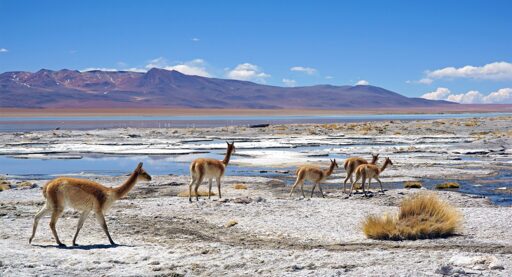
In the high Andes of Peru, Bolivia, Chile and Argentina, you can still find the vicuña, a shy, elusive camelid, revered by Indigenous people. It has reasons to be cautious of humans. Long-prized for its fine wool, European colonists hunted it relentlessly. Flocks in the millions were reduced to 6,000 individuals by the 1960s. Indigenous-driven conservation efforts helped bring the species back from the brink, but the vicuña (Vicugna vicugna) still walks a knife-edge. “Its survival remains precarious due to a complex interplay of threats to its habitat,” James Murray wrote for the U.S. Institute for Environmental Research and Education. The vicuña today is a victim of a Latin America biodiversity crisis that has seen a 95% decline in wildlife between 1970 and 2020, according to the WWF’s 2024 Living Planet Report. A key driver of that decline is mineral extraction. During the Inca empire, an estimated two million vicuñas roamed the Andes. The population fell to 6,000 by 1974 primarily due to intensive hunting for wool. Today’s numbers have risen to about 350,000 due to legal protections, community-based conservation, and bans on international trade. The species’ namesake, the proposed Vicuña mining district, if not managed properly, could reverse that recovery. Image by Renzo Tirado via Wikipedia Commons (CC BY-SA 4.0). Vicuña is also the name given to a vast $18 billion metallurgical planning district that could devastate and transform endangered vicuña habitat. Straddling the border of Argentina’s San Juan province and Chile’s Atacama region, this high-altitude Andes region represents…This article was originally published on Mongabay
From Conservation news via This RSS Feed.