

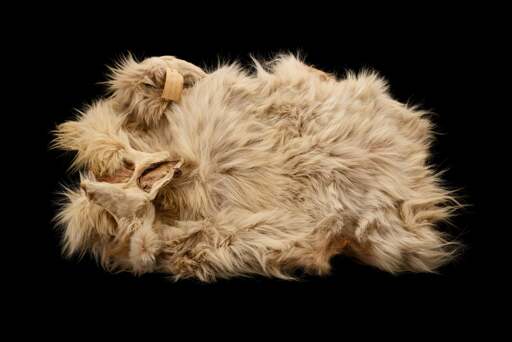

Only known pelt of the extinct woolly dog. Photo by Brittany M. Hance, courtesy of Division of Mammals, Smithsonian
Institution
This story is co-published with the Narwhal as part of their 2026 Indigenous journalism fellowship
Coming face to face with the pelt of a now-extinct Salish woolly dog was an emotional experience for Jordan Wilson.
The curator from xʷməθkʷəy̓əm (Musqueam Indian Band) attended an unveiling at the Museum of Anthropology in “Vancouver” as the ancestor was welcomed back to its home territories earlier this month.
The pelt is on loan from the Smithsonian institution, where it was in storage for more than a century — it was sent to the “American” museum in 1859. It will be at MOA until August of 2027.
Belonging to a dog from Stó:lō territories known as Mutton, it’s the only known Salish woolly dog pelt in existence.
As the pelt was unveiled to its Salish relatives on Sept. 4, Wilson attended along with other Salish community members from “Vancouver Island” and the “Fraser Valley.”
“For me personally, I was caught off guard at the emotional quality of it,” Wilson said.
“Seeing this pelt in person, seeing its little paws and seeing its little nose, realizing that this was a living being that was alive 160 years ago.”

A reconstruction of the Coast Salish dog with sketches of Arctic dogs and spitz breeds in the background for comparison. Illustration by Karen Carr
Renowned Musqueam weaver Debra Sparrow was there with her daughter and grandson.
“You watch as they unveil it, pieces of the wood come off, and then the containers open, and there he is. There’s a sense of welcome you feel instinctively,” she said.
“It’s historical that the woolly dog arrived back home.”
Once ubiquitous among Indigenous communities in the Pacific Northwest, Salish woolly dogs went extinct during the late 1800s, as settlers arrived on the coast. Through storytelling, oral history, literature and artwork, woolly dogs have remained a sacred part of Coast and Interior Salish culture.
The pelt came to “B.C.” from Seattle, where it was on loan from the Smithsonian and temporarily exhibited for the first time.
Indigenous people travelled from up and down the Salish Sea to spend time with the woolly dog pelt at MOA before it became open to be viewed by the public.
“They were very important to every village, all through the territory of Salish people,” Sparrow said about the dogs. Their traditional territory spans from southwestern “B.C.,” into “Washington State” and “Oregon.”
“People will come to feel connected to it. It’s amazing how one little pelt can bring all the people back together.”
Dog’s genetic makeup confirms Salish oral history
This specific dog, with Stó:lō roots from the Chilliwack area, belonged to an American naturalist George Gibbs, who named the dog “Mutton.”
Because of specific storage requirements, the pelt is being hosted at MOA, on Musqueam territory, at the request of Stó:lō leaders.
It’s a caretaking responsibility that museum curator Wilson takes seriously. He began working on the Pacific Northwest and contemporary Indigenous art exhibit, where the pelt is being shown, last year.
“This is the highlight of the work that I do … being able to help facilitate things like this,” he said.
“This specific breed dates back thousands of years,” he added. “That goes to show how important this breed was to our ancestors.”
Sparrow recalled that, as settlers arrived in “British Columbia,” “the first thing many of the European sailors said was that the people have these little dogs with them in their canoes.”
Combined with mountain goat wool, Salish woolly dog fur was spun into a weaving fibre, used to make clothes, blankets, regalia and other textiles.
The woolly relatives were fed a rich salmon and elk diet to keep their coats soft and shiny, and in exchange providing Salish communities with safety, companionship and fluffy white hair.
But the deep connection between Salish people and the woolly dog was severed as the important animal went extinct.
Kwulasultun, Eliot White-Hill, an artist from Snuneymuxw First Nation, said he never heard about the Salish woolly dog while he was growing up.
Once he became an artist and started asking Elders in his community questions, knowledge and stories about them began resurfacing.
“It’s profoundly meaningful to have that woolly dog come back to this part of the world, to be able to reconnect with the communities that it came from,” he said.
“These blankets are almost like currency to us. They’d be given away at potlaches and they were robes of nobility and protection, and there’s a very important spiritual aspect to them.”
He curated his own exhibit about Salish woolly dogs at the Field Museum in “Chicago.” They have one of the largest collections of Coast Salish materials outside of the Pacific Northwest.
“Woolly dogs are so important to Coast Salish culture. They were at the centre of so many different artistic, cultural and economic systems that our ancestors had in place,” White-Hill said.

Two girls possibly holding a Salish woolly dog. Photo taken in Chilliwack by James Booen, 1895-97. Photo courtesy of the Chilliwack Museum and Archives
“Where I come from on Vancouver Island, we didn’t have sheep prior to contact. Mountain goats, another major source for fibre, were only on the mainland. It was expensive and hard to trade for that, so instead we had the woolly dogs.”
The dogs were often raised on small islands to avoid interbreeding with other dog breeds, and passed down through the matrilineal line in families.
These woolly dogs were genetically distinct from the European dog breeds settlers were familiar with. According to the book The Teachings of Mutton: A Coast Salish Woolly Dog, “very few dog breeds have any precolonial [ancient DNA]. An exception is the Chihuahua, which has two to three per cent precolonial DNA.”
Mutton’s genetic ancestry has been analyzed by numerous specialists in “Canada” and the “United States.” Though he died more than a century ago, techniques exist to analyze ancient DNA, or aDNA, which is drawn from sources that lived long ago.
“Mutton himself has 16 per cent European ancestry. This means he had one great-grandparent that was a European dog … The rest, or 84 per cent of his [ancient DNA], points to precolonial ancestors from thousands of years ago,” the book reads.
“That little being is not a canine, it’s its own entity,” Sparrow said. “It doesn’t belong to the canine world. People always want to compare European philosophies with ours, and it’s not.”
How Mutton was found
The woolly relative’s journey home has been decades in the making. In 2002, historian Candace Wellman was undertaking archival research that would eventually lead her into asking a question with lasting impact for Indigenous nations situated along the Salish Sea.
“I was researching the life of Dr. Caleb Kennerly, who married an important Semiahmoo woman,” Wellman said, whose first book was about inter-marriages in the region.
She went to the Smithsonian Museum, where Kennerly had been a naturalist, and obtained photocopies of all his letters back to the museum
“One night at 3 o’clock in the morning I woke up and realized that one of the things he had sent in was a woolly dog pelt specimen,” she said.
Aware of how important woolly dogs are to Coast Salish culture, and women in particular, Wellman wrote to the Smithsonian curator of mammals, who later confirmed the pelt was there, intact and in a drawer.
“I wrote and said, this is really important because the Coast Salish women alive today have never been able to see the hair that their great-great-grandmothers used to weave the beautiful white blankets,” she said.

A Salish blanket, woven from woolly dog hair and mountain goat wool (maker
unrecorded). Photo by Donald E. Hurlbert, courtesy of Department of Anthropology, Smithsonian
Institution
Wellman asked for a hair sample to show Coast Salish women on the West Coast. The museum took it to a committee and they agreed.
Now, that sample is housed at the Whatcom Museum in “Bellingham, WA” where Wellman has resided for most of her life.
Wellman explains the dog hair has never been displayed to the public, but has been used to authenticate items, such as a Coast Salish blanket woven with woolly dog fibre that is on display.
The woolly dog’s return to its home territories for the first time in more than a century is historic but bittersweet.
“I have really complicated feelings about the pelt, the name Mutton, and the whole story behind that dog,” White-Hill shared.
“It’s really sad to me.”
It’s a sentiment shared by Sparrow. Reflecting on the woolly dog pelt, she said, “It makes me sad — happy that he’s here, but sad they’re non-existent now.”.
While the woolly dog pelt is set to return to the Smithsonian next year, White-Hill hopes that it can eventually make its way back to its homelands permanently.
“We need to return this ancestor to its home so it can rest.”
The post After more than a century, this Salish woolly dog pelt has returned to ‘B.C.’ appeared first on Indiginews.
From Indiginews via This RSS Feed.