

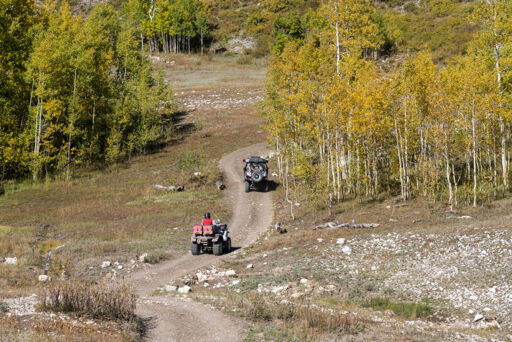
There are many ways to enjoy the outdoors, but thrill-seekers visiting the nation’s national forests often turn to motorized recreation. They might ride ATVs along dirt trails, snowmobile down winding tracks, or go off-roading in 4x4s. The United States Forest Service’s approach to all such forms of recreation on trails can be summed up in four words: closed unless designated open.
Unless a trail is explicitly designated as open to off-highway vehicles, such as side-by-sides and dirt bikes, it can only be used for non-motorized recreation. Most national forests have “travel management plans” that outline when a trail is open for non-motorized use like mountain biking, horseback riding, or hiking, and when it’s open to off-highway vehicles. These plans tend to be exhaustive and list which types of motorized or nonmotorized access are allowed on every trail, two-track, and road. The strict guidelines are a result of a Forest Service policy called the Travel Management Rule.
But the Trump administration wants to turn the current rule on its head. In late August, the Forest Service announced its plan to revise the rule so that trails are open unless designated closed. It would mean forest managers would be expected to prioritize motorized access on service roads, trails, and even backcountry airfields.
The U.S. Department of Agriculture, of which the Forest Service is a part, has said that the move will increase recreation access and “simplify regulatory requirements.” The change is being opposed by sportsmen, backcountry horsemen, conservation organizations, and non-motorized recreation groups. They say opening up all Forest Service trails to motorized access could have devastating consequences for the ecosystems and wildlife that rely on these lands. Healthy, intact forest ecosystems are also critical for sequestering carbon in a warming world.
Hillary Eisen, the federal policy director for Wild Montana, a public lands advocacy organization, said everyone who uses forest lands, from recreationists to ranchers with grazing leases to those in the timber industry, relies on the clarity provided by travel management plans. The Forest Service’s formal announcement to revise the rule is “vague,” “somewhat poorly written,” and “difficult to follow,” Eisen said. Without clear guidelines in place, she fears motorized users could end up anywhere on the landscape.
“Any sort of feature that you could interpret to be a trail or a road would be open to every type of use, unless closed,” she said. “That could mean, if you can get your side-by-side on there, have at it.”
Read Next
Trump administration advances plan to open national forests to development
Chris Edgington, a watershed project manager with Montana Trout Unlimited, witnessed firsthand the environmental damage that can happen from off-highway vehicle use on the Middle Fork of the Judith River, which runs through the Little Belt Mountains of central Montana.
Prior to 2023, there were more than 80 entrances and 27 shallow spots along a 6-mile stretch of the river, where various types of vehicles, including cars and side-by-sides, crossed. As these vehicles cut across, they caused erosion and an influx of sediment that coats rocks along the riverbed, suppressing insect life and the ability for fish to successfully spawn. By 2020, the sediment runoff had gotten so bad it was choking out nearly all the fish, Edgington said.
“The fish population was estimated to be less than 10 percent of what we’d expect of a river that size and character,” Edgington said. “The river had become over-widened and shallow, creating unusual riffles, and the river couldn’t manage its sediment load.”
So Edgington brought together a diverse coalition of groups, including the off-highway vehicle community and the Great Falls Trail Bike Riders Association, environmental groups, and federal and local government agencies to address the issue. They rebuilt 1,000 feet of riverbank, reduced the number of crossings by 80 percent, and built a new section of the off-highway vehicle and jeep trail so the area could still be used for recreation, without harming the river. It’s been a huge success, Edgington says, and the work is already paying off.
“Fish numbers are up,” he explained. “The work we did to remove the sediment is restoring water quality and the fish population in that incredible backcountry setting.”
The vehicles crossing the river weren’t breaking any rules; the Forest Service had designated the area open for motorized recreation, but the number of stream crossings degraded the health of the river and the threatened species that lived there, including the cutthroat trout. “I’m totally OK with appropriate machine use in the forest,” Edgington said. “But there are just places where the ecosystem is too sensitive to use this equipment.”
The travel management plan, written by the Helena-Lewis and Clark National Forest, recognized this impact to the river and the need to reroute the road out of the river corridor. Parts of the Middle Fork are protected as a Wilderness Study Area and an Inventoried Roadless Area. Edgington said that because of those protections and the travel management plan, it was worth investing in this restoration; he knew the conservation work would last.
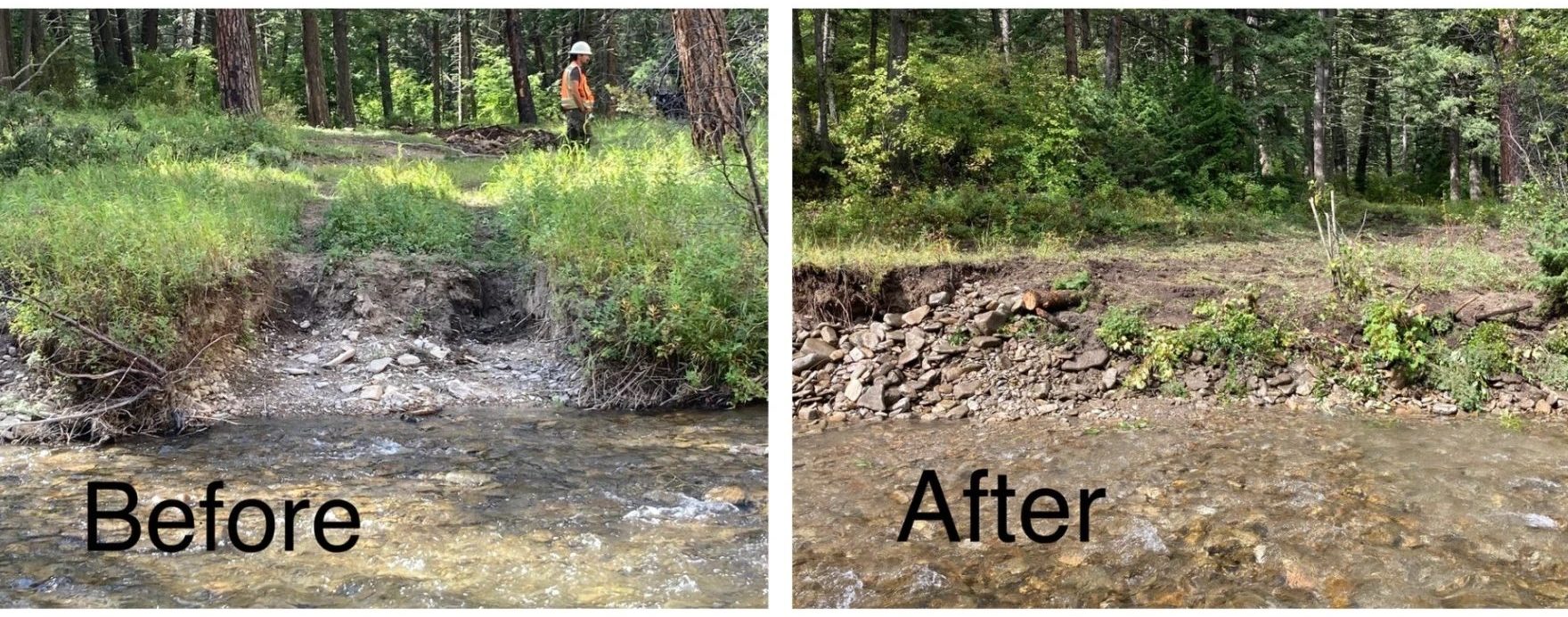
Before and after photos of restoration work on the Middle Fork of the Judith River. Courtesy of Montana Trout Unlimited
He said a full repeal of the travel management rule would create more problems than it intends to solve. A change of this magnitude, he said, could be a devastating blow to river health and restoration projects like the Middle Fork Judith.
“Whether that’s off-highway vehicles in the river or motorcycles on horse trails, it’s going to create a lot of conflict and confusion and animosity between different user groups.”
The process to change a federal rule is a long one. The Forest Service is accepting public comments on the plan to revise the rule, which is the first step in the process, through September 23.
These proposed revisions to travel management aren’t occurring in a vacuum. They are one of several widespread policy changes that could take effect across the 193 million acres of land the Forest Service manages, including more than 19 million acres in Montana alone. Last month, just before the travel management revision, Agriculture Secretary Brooke Rollins announced the USDA was moving forward with rescinding the Roadless Rule, a policy that prevents road building and commercial logging on 45 million acres of Forest Service land. The Forest Service and other scientists have conducted extensive research showing how roads fragment habitat, disturb wildlife, introduce noxious weeds, and increase human-caused wildfires. In the first round of public comment, 99 percent of commenters opposed removing roadless protections.
The short public comment periods have received public backlash. On September 11, the Forest Service announced it was adding an additional 15 days to the comment period; it is now open until October 6.
In a statement about the decision, the agency wrote the extension was “to provide interested persons additional time to review the proposed rule and supporting materials.”
Read Next
The Trump administration wants to take an ax to the East’s last great forests
Eisen, the federal policy director for Wild Montana, said the roadless rule and travel management rule help uphold the purpose of public lands.
“The intent in Congress is that they support current generations,” she said. “That they are also available for future generations, that’s the sustained yield, conservation piece of it. And the regulations we have that connect to public lands all tie into that in one way or another.”
The roadless rule, she said, ensures intact habitat remains for clean water and wildlife, but the travel management rule affects far more people every time they visit a national forest.
“Anytime you go anywhere on national forest land outside of wilderness, the travel management rule is part of your experience,” she said. “And your experience is not an accident.”
Supporters of these changes, like Kerry White, who runs the Bozeman-based nonprofit Citizens for Balanced Use, say making trails open unless designated closed would create more opportunities for recreation. Citizens for Balanced Use is an organization that advocates for motorized access on public lands.
“Without roads and trails, people can’t get out in the woods,” said White, who represented a section of Bozeman in the state legislature from 2013 to 2021. This is public land, and people with disabilities, the elderly, need some sort of transportation to get out there.”
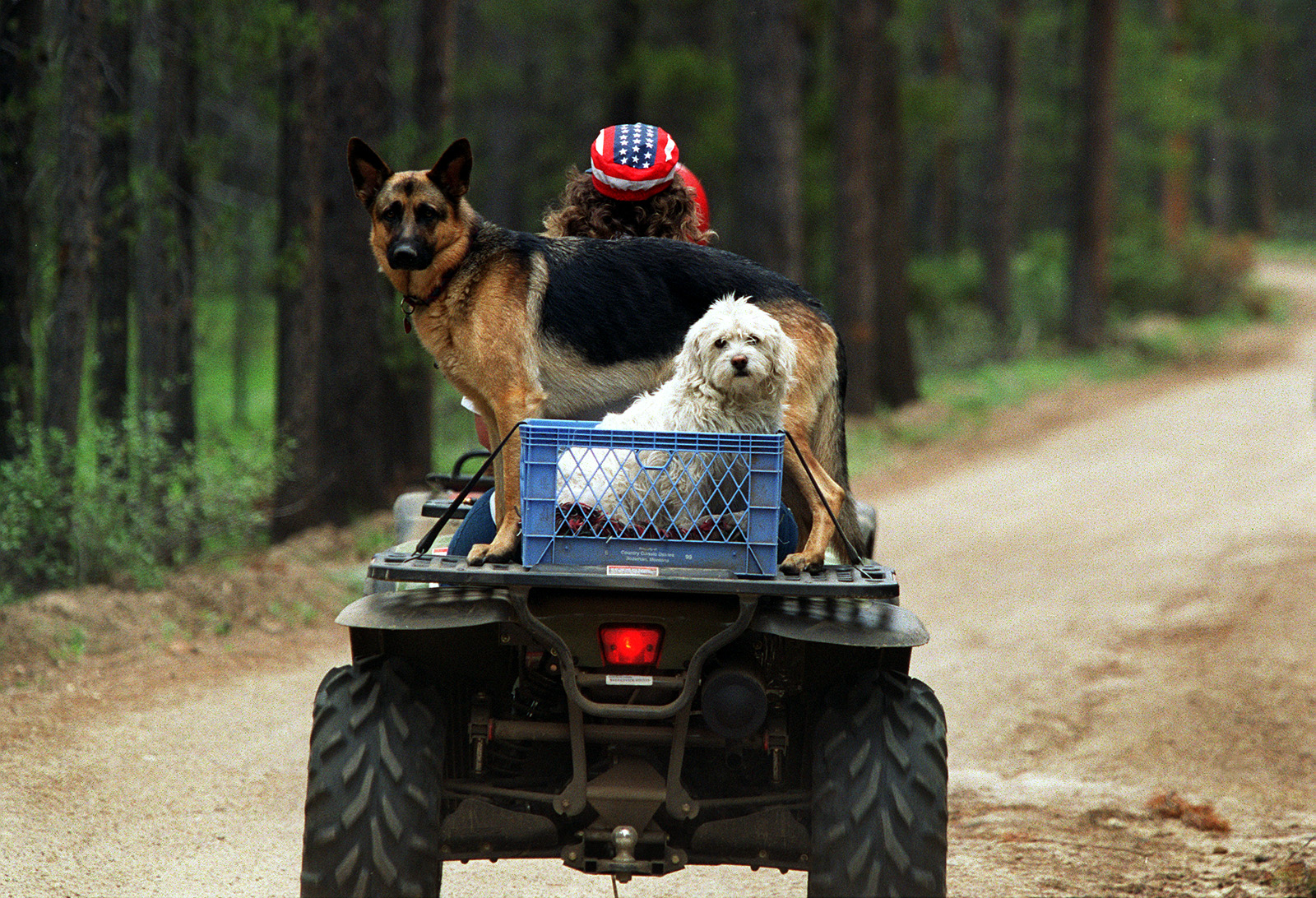
Karla Gagby, 40, can’t hike because of a lung injury and is seen here riding on the Fourth of July in the Beaverhead–-Deerlodge National Forest in southwestern Montana. Gary Friedman / Getty Images
White said these new changes will allow for better access and clarity for visitors on ATVs, e-bikes, and other motorized vehicles. “By making everything open unless posted closed,” he said, “it puts a bit more onus on the Forest Service to do due diligence and, if a trail is closed, make sure those signs are posted and maintained and kept in place.”
White also believes these changes won’t have negative environmental impacts. “People are freaking out [that] we’ll have strip malls and open-pit mining in these areas, and that’s simply not the case,” he said. “There’s a lot of regulation that has to be done to do any kind of projects in these areas.”
But Eisen with Wild Montana says these changes are occurring alongside the Trump administration’s rollback of a myriad of the nation’s bedrock environmental protections, including changes to the Endangered Species Act and the National Environmental Policy Act.
“This administration does not appear to value what our public-land system is rooted in,” she said. “It’s more about ‘How can I make a quick buck off of this for my benefit?’ I think it gets back into that interest in privatizing.”
To Edgington, these changes are a concerning pile on. “Many of these rules were created with a thoughtful balance of forest use,” he said. “And there are probably areas where we could improve these rules, but a full repeal would be devastating to fish and wildlife resources beyond our comprehension”.
He spent years overseeing restoration work and conservation for some of Montana’s most beloved trout fisheries. “Cold clean water is a finite resource,” he said, “and we need to do whatever we can to protect it.”
While Edgington is proud of the work he and partners did to restore the Middle Fork of the Judith River, he doesn’t know how work like that happens without policies like the roadless and travel management rules.
“This project was funded by three federal sources,” Edgington said. “If protections are possibly lifted and those investments are diminished? It is pretty counterintuitive to the responsible use of taxpayer dollars.”
This story was originally published by Grist with the headline Trump wants to open nearly all national forest trails to dirt bikes and ATVs on Sep 22, 2026.
From Grist via This RSS Feed.
“By making everything open unless posted closed,” he said, “it puts a bit more onus on the Forest Service to do due diligence and, if a trail is closed, make sure those signs are posted and maintained and kept in place.”
Conveniently for motorized vehicle riders, the forest service has been largely defunded, so this won’t happen.
