

Bullets:
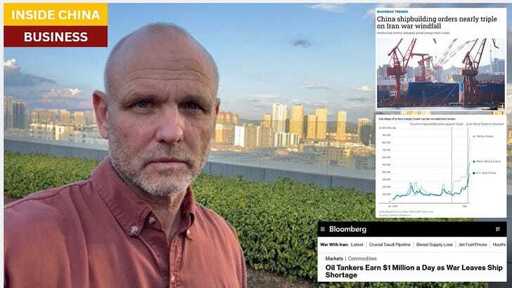
Tanker companies are booking record profits, as a result of the re-routing of the global energy trade.
Inside China / Business is a reader-supported publication. To receive new posts and support my work, consider becoming a free or paid subscriber.
The chaos after the closures of Hormuz and the Red Sea, and severe weather problems at the Panama Canal, are a boon to shipping companies who earn $1 million per day making longer transits.
Shipping firms are scrambling to find ships, and used vessels are selling at tens of millions of dollars above new builds, delivered under old contracts.
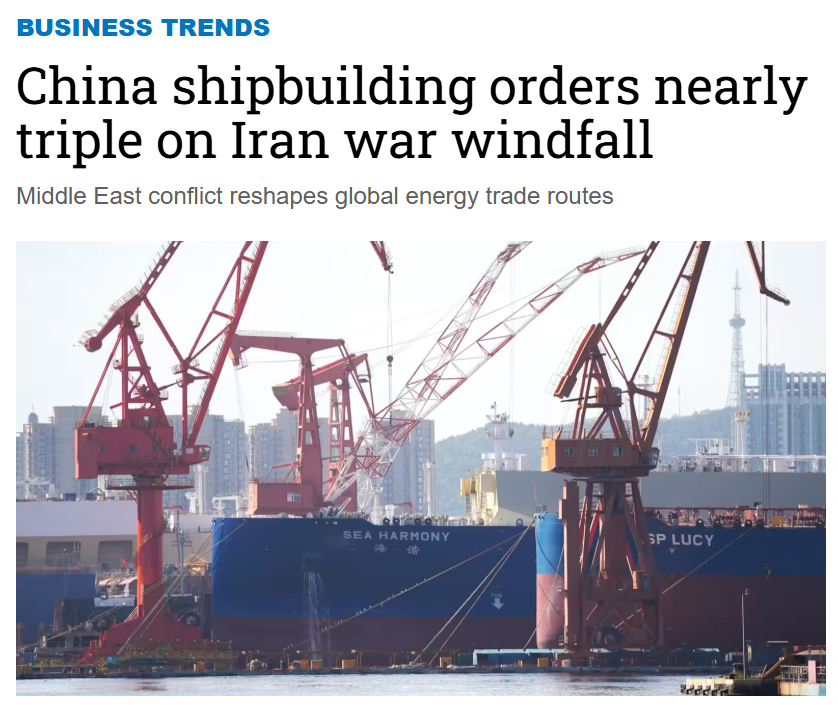
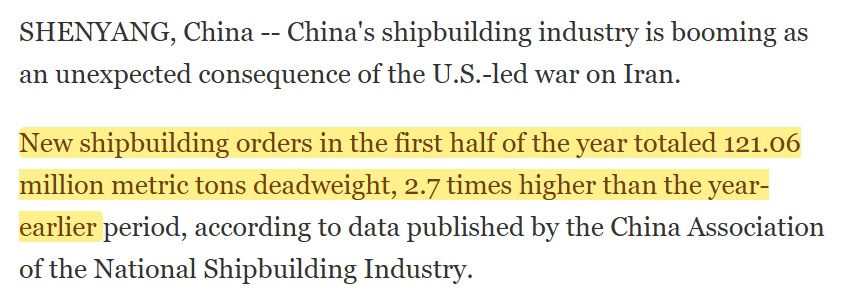
Orders at Chinese shipyards are booming, up 2.7 times over last year, as China is the sole shipbuilder with sufficient capacity.
Skyrocketing transport costs are fueling inflation, as $26 per barrel is spent just to move crude to refineries.
Report:
Good morning.
Shipping routes across the world are wrecked, as a result of wars in the Persian Gulf, the Red Sea, and the Black Sea. Ships are bypassing those warzones, and sailing longer routes, which results in less frequent loading and unloading.
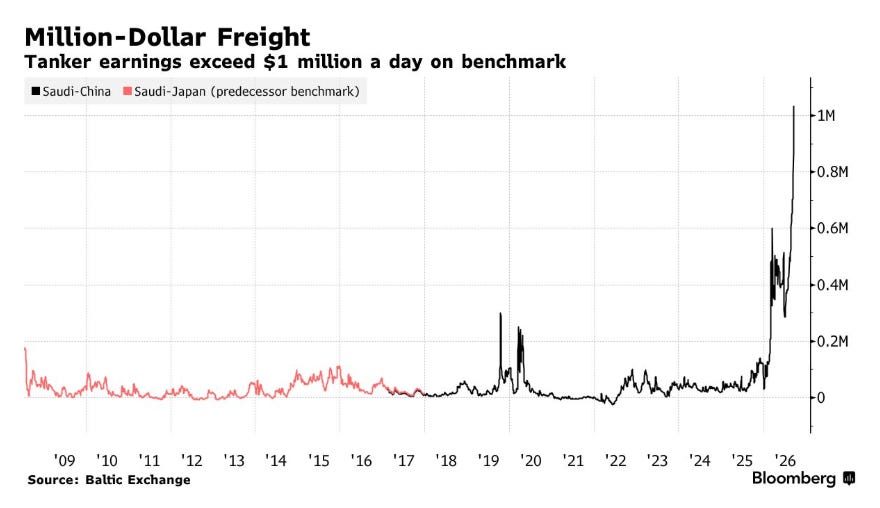
So costs are shooting higher. [Oil tanker rates are now over $1 million, per day](http://tanker/ companies are booking record profits, as a result of the re-routing of the global energy trade. The chaos after the closures of Hormuz and the Red Sea, and severe weather problems at the Panama Canal, are a boon to shipping companies who earn $1 million per day making longer transits. Shipping firms are scrambling to find ships, and used vessels are selling at tens of millions of dollars above new builds, delivered under old contracts. Orders at Chinese shipyards are booming, up 2.7 times over last year, as China is the sole shipbuilder with sufficient capacity. Skyrocketing transport costs are fueling inflation, as $26 per barrel is spent just to move crude to refineries.)—a record high. Everything costs more, and that translates to higher prices paid for crude oil at refineries, which are passed along to everybody who buys gasoline or airline tickets or bunker fuel for those same ships.
The Persian Gulf-to-China benchmark route went vertical immediately after this year’s War on Iran kicked off. But that measure has lost meaning, anyway, because there are so few ships now going that way, via the Hormuz. The Saudis shifted their exports the other direction, and relied on their East-West Pipeline until two weeks ago, when the Houthis blew that up. And for the oil outbound the Gulf of Oman to China, tankers are billing $644,000 a day. Before the war, the shipping companies handling that route were running just over break-even.
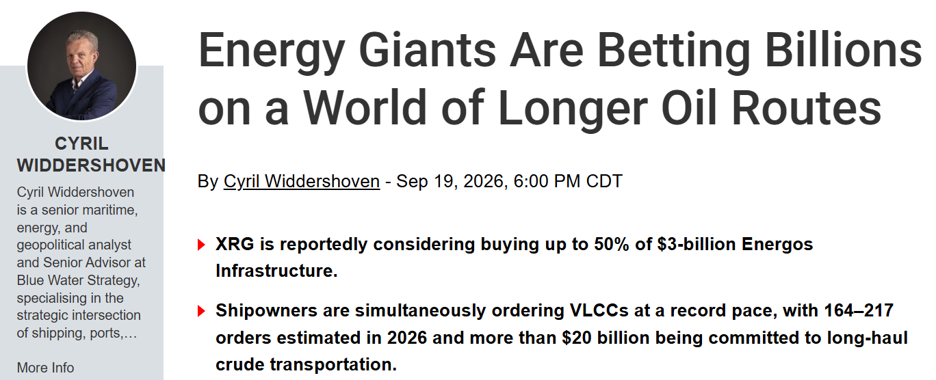
Energy companies, ship operators, and shipbuilders are all arriving at the same conclusion, at the same time: the disruption is structural and long-lasting. The energy trade has become less efficient, more chaotic, and anyone who can load and move a tanker now enjoys unprecedented market power. “Energy sovereignty” isn’t just oil and gas coming out of the ground—Saudi has plenty of that, after all. But it’s moved down chain to logistics companies who have tanker capacity and safe places to load them.
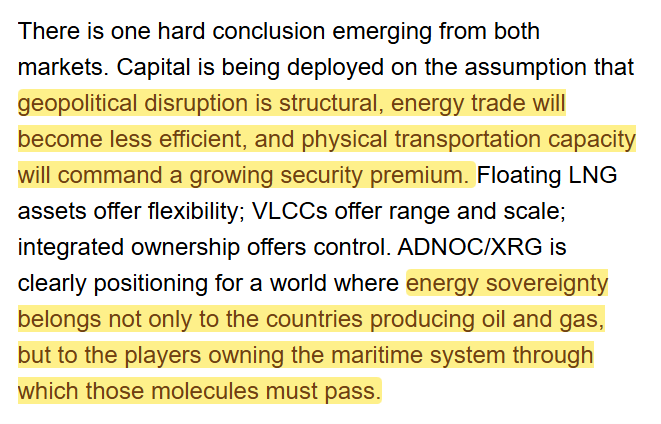
Longer transit times are a hit to shipping supply; how many ships are available. And the oil industry now understands that longer oil routes are a long-term feature of global logistics. Energy companies are spending tens of billions of dollars on new ships that can carry larger loads longer distances.
The industry is pricing in a “permanent era” of longer transits, with chokepoints like the Hormuz and the Red Sea and the Bosporus at constant risk of closure.
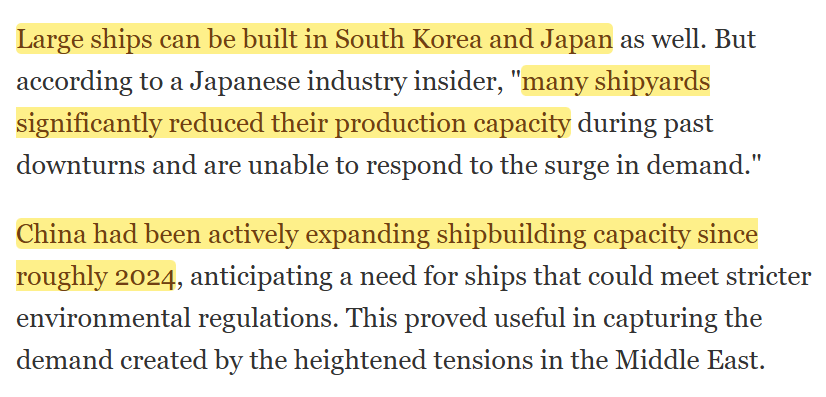
This is all great news for shipbuilders, particularly in China, who are uniquely able to ramp up production at their shipyards to meet the new demand. Maritime suppliers are already seeing backlogs for motors and other equipment, which will only worsen—or get better, depending on if you’re buying or selling.
But building new ships takes time, and the industry doesn’t have time. So they’re prowling the world for used ships, and taking on never-before-seen levels of risk to get existing ships out, that are trapped behind blockades. Operators switch off their transponders and satnav, and transfer cargoes to other ships on the open ocean, which is very hard to do safely, and costs a lot of money.
So “control of tanker capacity” is a strategic priority, and money is no object. Tanker companies are making the highest profits ever, and they naturally want to buy more ships. Very Large Crude Carriers are in especially high demand, because they are optimized for those long-haul routes that are the reality of the oil markets today.
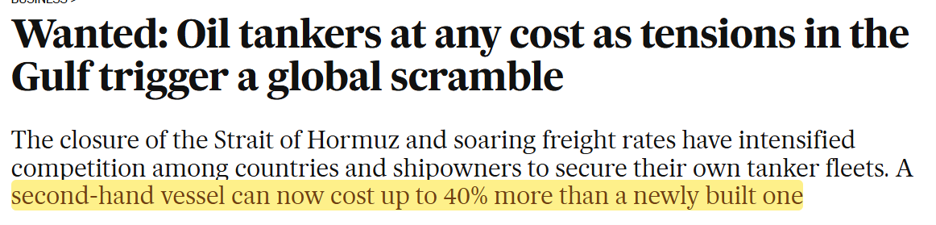
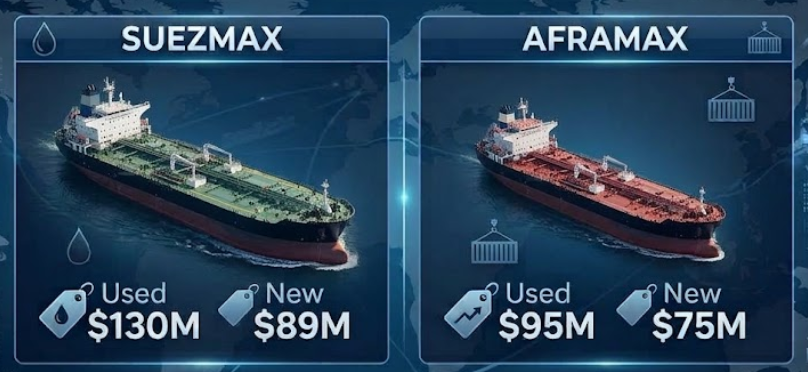
A secondhand VLCC commands a $52 million premium, compared to a new one. Suezmax and Aframax tankers are smaller and are used for shorter routes, but they too are trading hands at millions of dollars above new builds. A used Suezmax tanker costs $41 million more than a new one coming out of the yard today, for a customer who signed a contract just three years ago. Used Aframax tankers come with a $20 million premium, over new.
The math is simple—waiting two years or more for a new ship to get built, costs a shipping company a million dollars a day in lost revenues. VLCC rates from the routes that are open between the Middle East and Asia went from $5.4 million, to over $36 million. So as desperate as buyers are to find more ships, shipowners who have them are just as desperate to hold on to the ones they’ve got.
So this market still is nowhere close to equilibrium; the point at which prices stabilize. At least 140 new tankers were ordered just in the first six months of 2026, but those will be delivered in three years’ time. Prices are moving, violently, while very limited supply is stretched to satisfy booming demand.
We are also seeing steep price moves in places not directly impacted by the wars. Fees to transit the Panama Canal are blowing out, and we see here again that “shipping on ALL global” routes are “skyrocketing”. Trade is less efficient with the re-routing, with longer sailing times, and lack of ships. The Panama Canal is struggling to keep up with transit demand as it is, because of low rainfall there. Ships are stacking up outside the canal entrance. Wait times to sail through are at 17 days, and shipping companies are paying record-high prices to jump to the front of the line. A South Korean ship paid $4.6 million in early September, and another Korean operator just paid $5.3 million.
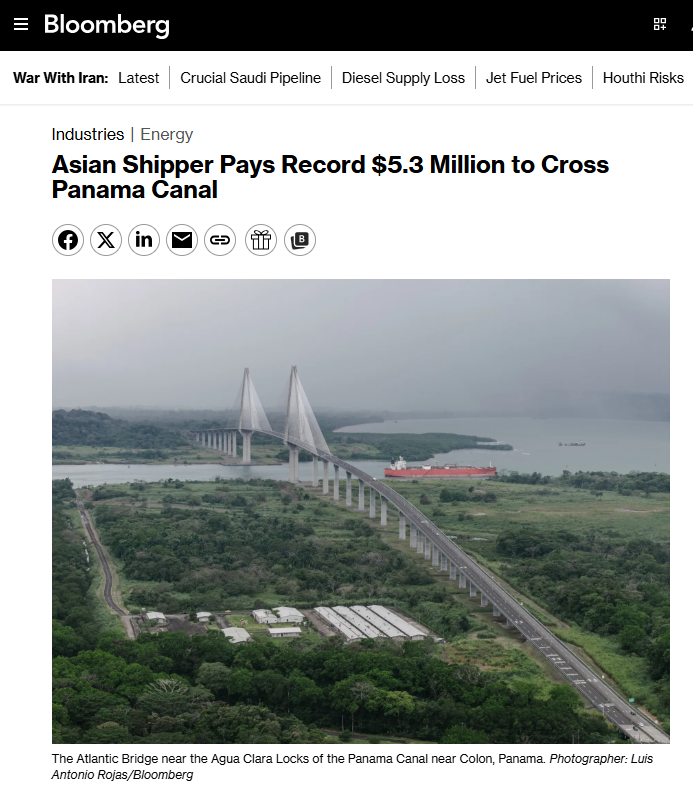
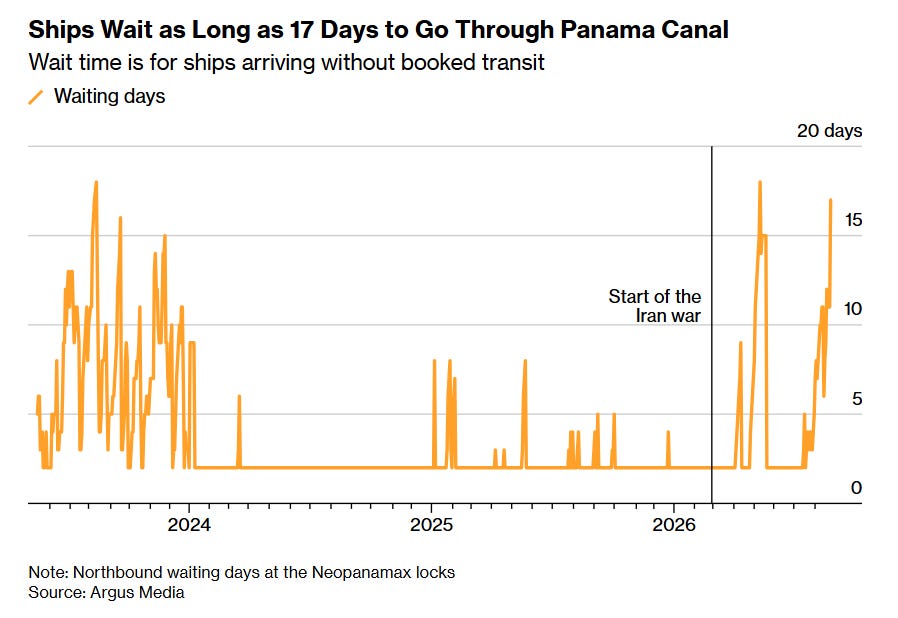
Before the war on Iran, in February, the median price paid was just $55,000. So ships today are paying nearly 100 times historical rates, and that’s again a function of how much money the ships are making on a daily basis. It’s logical for a ship to pay $5 million to skip the line, in the case of an oil tanker that is making hundreds of thousands of dollars a day, if they can squeeze through early and find new customers at new, even higher contract prices.
Goes without saying that all of this is inflationary; $26 per barrel is now just freight cost, to get energy out of the Persian Gulf and to global markets. Here’s a helpful timeline: daily oil tanker rates clustered around $100,000 a day at the beginning of the year. Then in February-March they more than doubled, to over $250,000 a day. Costs normalized, somewhat—markets found equilibrium again, as ships went through the Red Sea instead of the Strait of Hormuz:
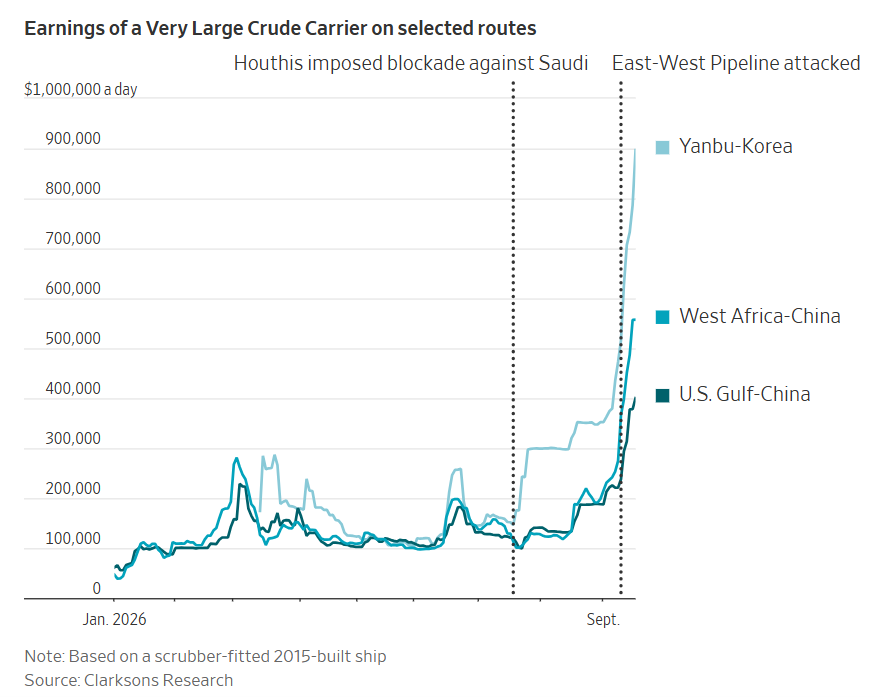
But then the Houthis closed that way, and prices stepped up to their highest levels in years. There was still an outlet, though, through the Suez, but then the East-West pipeline was taken down, and nobody really knows what that price is anymore, for new oil shipments.
And it’s happening everywhere at once. Yanbu port is in Saudi Arabia, and it’s little wonder that the costs there are blowing out. But the price action for tankers loading in West Africa and the Gulf of Mexico ports are also heading straight up, and all those costs fall on consumers.
Be Good.
Resources and links:
Tanker Rates Smash $1 Million a Day as Oil Shipping Crisis Deepens
https://oilprice.com/Energy/Crude-Oil/Tanker-Rates-Smash-1-Million-a-Day-as-Oil-Shipping-Crisis-Deepens.html
Oil Tankers Earn $1 Million a Day as War Leaves Ship Shortage
https://www.bloomberg.com/news/articles/2026-09-14/oil-tankers-earn-1-million-a-day-as-war-leaves-ship-shortage
Global Shipping Costs Explode as Hormuz Disruptions Hit Key Trade Routes
https://oilprice.com/Energy/Crude-Oil/Global-Shipping-Costs-Explode-as-Hormuz-Disruptions-Hit-Key-Trade-Routes.html
Energy Giants Are Betting Billions on a World of Longer Oil Routes
https://oilprice.com/Energy/Energy-General/Energy-Giants-Are-Betting-Billions-on-a-World-of-Longer-Oil-Routes.html
Wanted: Oil tankers at any cost as tensions in the Gulf trigger a global scramble
https://english.elpais.com/economy-and-business/2026-09-13/wanted-oil-tankers-at-any-cost-as-tensions-in-the-gulf-trigger-a-global-scramble.html
Panama Canal fees hit record high as El Niño and Iran war choke shipping
https://www.ft.com/content/38083cb5-3892-40a1-b90f-102109f96b17?syn-25a6b1a6=1
Panama Canal To Maintain 32 Daily Ship Transits Despite El Niño Drought Risks
https://www.marineinsight.com/panama-canal-to-cut-ship-transits-again-due-to-severe-drought-linked-to-el-nino/
A Shortage of Oil Tankers Is Threatening to Keep Gas Prices High
https://www.wsj.com/business/energy-oil/a-shortage-of-oil-tankers-is-threatening-to-keep-gas-prices-high-66b2675a
China shipbuilding orders nearly triple on Iran war windfall
https://asia.nikkei.com/business/business-trends/china-shipbuilding-orders-nearly-triple-on-iran-war-windfall
Asian Shipper Pays Record $5.3 Million to Cross Panama Canal
https://www.bloomberg.com/news/articles/2026-08-25/asian-shipper-pays-record-5-3-million-for-panama-canal-access
Inside China / Business is a reader-supported publication. To receive new posts and support my work, consider becoming a free or paid subscriber.
From Inside China / Business via This RSS Feed.