

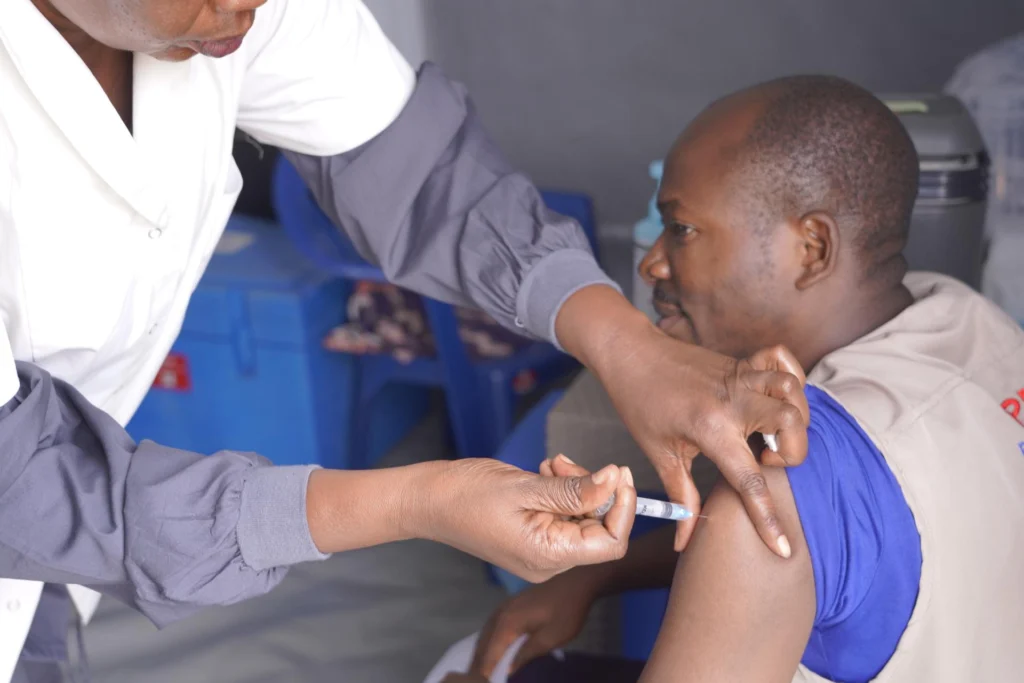
Health authorities in the Democratic Republic of Congo launched a new vaccination campaign this week to contain what has become the country’s deadliest Ebola outbreak on record, as the death toll from the epidemic continues to climb across the country’s eastern provinces.
The campaign, coordinated by the World Health Organization (W.H.O) alongside Doctors Without Borders, began between September 18 and 19 in the provinces of Ituri and North Kivu, the latter serving as the epicenter of the outbreak.
The rollout forms part of a broader study to test a new vaccine, known as Ervebo, and is expected to run for between nine and twelve months.
RELATED: Doctors Without Borders Warns of Ebola Spreading to New Areas
According to the latest report from the Congolese National Public Health Institute, the ebola outbreak, which has been active since May, has already claimed 3,699 lives and infected more than 7,541 people.
Those figures surpass the previous Ebola epidemic, which ran from 2018 to 2020 and killed roughly 2,300 people out of about 3,500 confirmed cases, making the current crisis the most severe the country has ever confronted.
Daily Ebola update:
– Cases: 7,693 (+58)
– Recovered: 1,898 (+15)
– Deaths: 3,701 (+23) pic.twitter.com/KRaIf8VhkU— WBC24 | BNO News (@BNOFeed) September 21, 2026
Frontline Workers First
The vaccination effort is initially targeting frontline health workers, with roughly 20,000 expected to be immunized in an effort to reduce infection risk among those treating patients and suspected cases. Notably, Ervebo does not specifically target the Bundibugyo strain responsible for the current outbreak, though officials believe it may still offer meaningful benefits.
Dr. Jean-Jacques Muyembe, director general of the National Institute of Biomedical Research, announced on September 15 in Bunia, in Ituri province, that a significant number of vaccine doses were now available to combat the epidemic in the region. International media reports indicate health officials expect Ervebo to provide cross-protection against both the Zaire and Bundibugyo strains of the virus, even though it was not originally developed for the strain currently circulating.
Dr. Muyembe cautioned, however, that treatments specifically developed for the Bundibugyo strain remain in the research phase. While some medications are already available at treatment centers in Bunia, their overall effectiveness has yet to be fully confirmed. He emphasized the continued importance of primary care in managing the outbreak, noting that researchers have developed molecules designed to directly target the virus, though their full efficacy is still being studied.
À Lita, près de #Bunia 🇨🇩, les représentants de @WHO, @UNICEFDRC et @WFPDRC ont, mardi, constaté aux côtés des autorités sanitaires les progrès réalisés dans la lutte contre le virus #Bundibugyo & intensifié les efforts pour améliorer la prise en charge des patients dans la zone. pic.twitter.com/fcjiTXulyj
— OMS RDC (@OMSRDCONGO) September 16, 2026
Describing the results seen so far at treatment centers in Bunia, Muyembe said early outcomes among patients receiving care have been encouraging. He pointed in particular to observations from the town of Mongwalu, where unvaccinated residents went on to develop severe forms of the disease, a pattern health officials say underscores the urgency of expanding immunization.
Vaccination efforts have already begun in the central-northern province of Tshopo, and officials say the arrival of a substantial new supply of doses now allows the campaign to expand into Ituri as well. Muyembe stressed that frontline personnel remain the top priority, saying that anyone who has been in contact with confirmed cases needs to be protected as quickly as possible to prevent further spread of the virus.
The outbreak continues to strain the country’s health infrastructure, and officials have not indicated when case numbers are expected to peak.
From teleSUR English via This RSS Feed.