

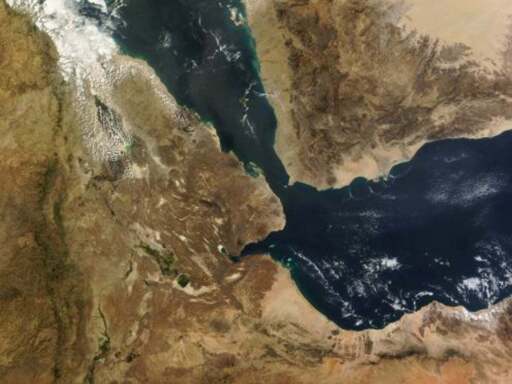

The US-Israeli war on Iran has underlined the importance of key waterways for global trade. And the Red Sea’s Bab al-Mandeb Strait is now attracting more and more attention for the same reason, but not just because of Yemen’s Houthis. Disruption could also be about to come from a regional war involving African power Ethiopia.
Conflict in Ethiopia has already caused massive human suffering, amid national and international struggles for power. But some experts say the currently escalating tensions there could soon explode into another ‘African world war’. And the world should absolutely pay attention.
Introduction: The Bab al-Mandeb Strait’s increasing global visibility
Ethiopian leader Abiy Ahmed got Western praise when he took power in 2018. But he soon oversaw rising instability and an alleged genocide in the northern Tigray region. Despite a fragile pause in fighting since 2022, people’s suffering has continued. And the lack of a lasting resolution to the conflict means it’s starting up again.
The Bab al-Mandeb Strait comes into the story because of the role Red Sea nation Eritrea plays in Ethiopian politics, and because of Ethiopia’s insistent interest in sea access via Eritrean ports. Eritrea’s resistance, along with tensions between Ethiopia and other nations in the Horn of Africa, risk sparking “Africa’s second world war”.
On the other side of the Bab al-Mandeb Strait, meanwhile, the Houthis have just stepped up their challenge to US-Israeli interests in the Middle East by taking over Yemen’s Red Sea coastline. Their resistance against ships primarily with links to Israel since the apartheid state’s genocide in Gaza has already hit trade in the sea hard.
By essentially controlling the strait, the Houthis have now made the Horn of Africa’s affairs of even greater concern to regional and global powers. In particular, the state of Ethiopian-Eritrean relations could very much determine how stable the African side of the Bab al-Mandeb Strait will be in the coming months and years.
Below, we’ll look at the historical and current Ethiopian and international dynamics behind the devastating power struggles that have caused so much suffering. By understanding this, we can put pressure in the right places to help oppose further pain and destruction.
Index
As background to the current situation in Ethiopia, we’ll look at three key periods in its history:
1) Pre-1974: Feudal monarchy and US influence-Pre-1974:-Feudal-monarchy-and-US-influence)
2) 1974-1991: The Derg and Cold War intervention-1974-1991:-The-Derg-and-Cold-War-intervention)
3) 1991-2018: TPLF rule, ethnic federalism, and the lean towards China-1991-2018:-TPLF-rule,-ethnic-federalism,-and-the-lean-towards-China)
For context regarding Ethiopia’s current government, we’ll look at the following points:
4) Abiy Ahmed’s privatisation drive-Abiy-Ahmed’s-privatisation-drive)
5) Abiy’s international power plays-Abiy’s-international-power-plays)
6) Abiy’s ethnic conflicts-Abiy’s-ethnic-conflicts)
7) Starvation, ethnic cleansing, and genocide in Tigray-Starvation,-ethnic cleansing,-and-genocide-in-Tigray)
To look at the possible involvement of regional and global actors in an international conflict in the Horn of Africa, we’ll look at five key points:
8) Eritrea: a former Ethiopian region under a nervously insular nationalist regime-Eritrea:-a-former-Ethiopian-region-under-a-nervously-insular-nationalist-regime)
9) Global power plays in the Horn of Africa-Global-power-plays-in-the-Horn-of-Africa)
10) A new Tigray war, and external involvement-A-new-Tigray-war,-and-external-involvement)
11) Will self-serving international powers push for inclusion and reconciliation to prevent ‘Africa’s second world war’?-Will-self-serving-international-powers-push-for-inclusion-and-reconciliation-to-prevent-‘Africa’s-second-world-war’?)
(You can click on the points above to go directly to each section.)
- Pre-1974: Feudal monarchy and US influence
Ethiopia has Africa’s second-biggest population, and hosts over 80 different ethnic groups. The largest are the Oromo (35%) and Amhara (24%) peoples. The biggest minority groups are Somalis (7%) and Tigrayans (6%).
Amhara figures dominated the monarchy and ruling class for centuries, and expanded their territorial control from the late nineteenth century onwards. Whether this was a ‘nation-building‘ process or imperial expansion at a time of European efforts to control Africa, it generated feelings of injustice and distrust in other ethnic groups.
Ethiopia’s Orthodox Tewahedo Church was very much part of the state apparatus. And Ethiopia was one of the closest US allies in Africa until the fall of the monarchy.
Eritrea, which was briefly part of Ethiopia between 1952 and 1993, suffered attempts by the monarchy to ‘Amharise’ the population. Young Tigrinya-speaking Eritreans in particular, who share cultural links to Tigrayans in Ethiopia, began to mobilise via a secular, communist resistance.
- 1974-1991: The Derg and Cold War intervention
The poverty and repression under the feudal monarchy led to the 1974 revolution. The new ‘Derg’ regime soon went all out against capitalism, launching broad land reform and nationalisation campaigns.
The Derg faced Western destabilisation efforts, along with resistance from dissidents in several Ethiopian regions. By 1977, dictator Mengistu Haile Mariam had taken charge, and brutally crushed his opponents. He decided the USSR would be more useful than the US, opportunistically turning Ethiopia into a key Cold War battleground.
The US and its allies in Saudi Arabia then used Somalia (formerly a Soviet ally) as a proxy to attack Ethiopia. The Soviet Union and Cuba helped the Derg to defeat Somalia.
Just like the monarchy, Amhara figures were central to the Derg regime, intensifying hostility towards Amhara people among other ethnic groups. That was particularly true in Tigray, the region next to the Amhara heartland.
The Tigray People’s Liberation Front (TPLF) emerged as one of the key forces resisting Derg rule. Claiming to seek the end of historic repression of the Tigrayan people, it took some inspiration from Albanian dictator Enver Hoxha and received some training from Eritreans also opposing the Derg.
The Derg’s bunker mentality and Mengistu’s hunger for power saw the brutal regime attack civilians, profile people by ethnicity, and manipulate famine against dissidents in the TPLF and elsewhere. In 1990, Mengistu tried to appease the West and cling onto his privileges by promising to adopt capitalist policies. But it was too late.
- 1991-2018: TPLF rule, ethnic federalism, and the lean towards China
An alliance with the Tigrayan TPLF at the forefront defeated the Derg in 1991. But the TPLF regime wasn’t so different. While it increased cultural recognition and ethnic representation nationally, it was also authoritarian and allowed Tigrayan figures to dominate. This made being in the TPLF economically beneficial.
Despite Marxist rhetoric, the TPLF was pragmatic in its search to get and keep power. It had received support from Western forces seeking to defeat the Derg (to weaken the USSR), it didn’t embrace Western neoliberal economics. Instead, it indebted itself with China to industrialise and build infrastructure under state control.
The TPLF government nonetheless maintained strong ties with Western nations.
Ethiopia gained strength regionally and globally as its economy performed well. And there were some benefits for the population. But corruption and debt eventually caught up with the TPLF, contributing to increasing economic difficulties. A policy of leasing land to foreign corporations, meanwhile, sparked mass displacement.
Eritrea’s independence from Ethiopia in 1993 left territorial disputes simmering. The two countries also competed to show the US they were reliable strategic allies. But it was Eritrea that would soon face Western sanctions while Ethiopia got massive amounts of international aid (and the task of occupying Somalia to help the West).
Ethiopia’s heavy-handed response to border skirmishes with Eritrea in 1998 led to a devastating war that lasted until 2000 and caused immense human suffering and economic damage for both countries.
Under the TPLF and beyond, Amhara groups have sought to get back some of the privilege they lost following the fall of the monarchy (and the Derg), starting numerous territorial conflicts with other ethnic groups.
- Abiy Ahmed’s privatisation drive
Abiy Ahmed rose to power in 2018, and he sought to weaken the TPLF’s role in government. An ambitious and power-hungry Pentecostal Christian from the Oromo community, Abiy has tried to exploit Ethiopian people’s faith to cement his power. Some Pentecostal churches even said God had sent him.
Abiy’s ‘Prosperity Party’ has reportedly pursued an anti-intellectual approach. Alongside promises to boost Ethiopia’s economy and secure its place as an African superpower, image seems to be central for him. And his quest to increase presidential power has raised concerns about him trying to consolidate his own position.
He has overseen new mega-projects and an increase in mining of gold (which global elites care a lot about), tantalum (largely for microelectronics and aviation), and other metallic minerals. Mega-projects include an international airport, an oil refinery, and a plant for fertiliser production.
The development agenda seems to benefit powerful interests more than it does ordinary people, though.
For example, Abiy used state funds to build luxury homes for himself and other officials, displacing local people in the process. He apparently wants to emulate the ‘modernity’ of Dubai. And while a pledge to build 1.5 million homes sounds good, the role of the private sector raises concerns about affordability.
Abiy’s neoliberal plan has involved ‘special economic zones‘ – complex, dystopian and anti-democratic areas where extreme corporate lawlessness usually reigns. And he has imposed austerity on the Ethiopian population, cutting public spending while squeezing the poorest people even further. This has led to increasing levels of hunger, worse public services, and a lower quality of life.
- Abiy’s international power plays
Abiy built an image of himself as a pro-Western privatiser and China-sceptic, sparking Western praise and excitement early on. But he hasn’t shunned China (partly because cutting ties after decades of cooperation is a challenge). And China has reciprocated, supporting him regardless of his actions, in the interests of ‘stability‘.
Abiy waged war on the TPLF from 2020 to 2022. Western sanctions and criticisms followed, but served only to push him closer to China and other non-Western powers. Wary of this, and despite ongoing conflicts in Ethiopia, Western governments have increasingly sought to court Abiy again.
Ethiopia entered into BRICS in 2023 (the group of major non-Western economies pushing for global stability and respect for state sovereignty). This showed a level of self-interest, possibly pre-empting future Western sanctions.
Abiy seems willing to listen to anyone supportive of his quest to make Ethiopia a regional power. That includes keeping good relations with Israel and its regional allies (like Somaliland and South Sudan), although other partners like China and Middle Eastern regimes have more sway.
Regional criticism of Abiy came after a 2024 port deal with Somaliland (possibly in exchange for recognising its independence from Somalia in the future). Egypt, meanwhile, has said the “illegal” Grand Ethiopian Renaissance Dam (GERD) is limiting its access to water. Past Ethiopian talks about the dam with both Egypt and Sudan failed.
- Abiy’s ethnic conflicts
Ethiopia already had a displacement crisis, but Abiy’s decisions made this worse. Riding to power in an internal regime coup against the TPLF, he essentially tried to cut the group out of government completely, centralise state power, and weaken ethnic rights. But he apparently underestimated the tension and risk of conflict this would create.
Abiy also temporarily settled tensions with neighbouring Eritrea, apparently to help squeeze the TPLF between two hostile forces. And arms from the West and the United Arab Emirates (UAE) allowed him and Eritrea to try and crush the TPLF by force.
Abiy’s stubborn insistence and the TPLF’s resistance sparked the catastrophic 2020-22 war, which we’ll look at in more detail in section 7. The fragile peace of 2022 didn’t deal with the roots of the conflict. And Abiy’s neoliberal centralisation efforts sparked ethnic struggles beyond Tigray too.
Between 2022 and May 2026, for example, Ethiopians experienced over 7,400 attacks (around half by government forces). These mostly took place in Amhara (3,719) and Oromia (2,735). But Tigray also registered 262 attacks, despite the TPLF’s official ceasefire deal with the government.
The war on the TPLF and the Tigrayan people was not just Abiy’s most devastating conflict, though. It also became one of the deadliest so far in the 21st century, helping to bring international conflict deaths to their highest level since the 1970s.
- Starvation, ethnic cleansing, and genocide in Tigray
The Ethiopian-Eritrean assault on Tigray from 2020 to 2022 allegedly involved ethnic cleansing, sexual violence, and the use of starvation as a weapon in a region where most people’s livelihoods depend on agriculture. As famine expert Alex de Waal has noted, an army doesn’t starve people by accident – it’s a calculated decision.
There have been numerous allegations of genocide against the Tigrayan people. A key factor behind this is that, far from understanding and addressing Tigrayan concerns (mainly the right to self-governance), Abiy’s party sought to demonise the TPLF by calling it a terrorist group.
While the West criticised Abiy, support from the UAE continued. And Ethiopia allegedly became an intermediary helping to funnel UAE arms into Sudan to fuel its genocidal civil war.
The Tigray conflict was devastating, killing at least 600,000 people. It also resulted in the mass displacement of at least a million people in Tigray. This added to the millions of ordinary people already displaced in Ethiopia. And the occupation of Tigray continued after the war despite the ceasefire deal.
Over two million people in Tigray were left to rely on international humanitarian aid in order to eat. And in one Tigrayan refugee camp that has hosted over 20,000 people, the 2025 cuts to US aid led one inhabitant to say:
we will just die in silence
The World Food Programme and other international agencies continue to experience a severe underfunding crisis due to US and other Western cuts. And this has come at the worst time for Tigrayans and others around the world, whose need for support is “at an all-time high“, according to Al Jazeera.
This desperate situation has almost certainly contributed to making the renewal of war more likely.
- Eritrea: a former region of Ethiopia under a nervously insular nationalist regime
A highly repressive military regime turned Eritrea into “Africa’s North Korea” after its 1993 independence from Ethiopia. It also courted Israel, becoming one of the only African countries not to recognise Palestinian statehood. And it has hosted bases for Western allies Saudi Arabia and the UAE, helping to fuel their assaults on Yemen and Libya.
The insular regime zealously protects its own power, shunning the ‘international order’ and keeping few long-term allies. Western sanctions and criticism didn’t weaken the regime. They just boosted its narrative of isolation and links with China, Russia, and Iran.
Isaias has criticised Donald Trump and the US for fostering global instability and extreme levels of debt. But on 18 September, the US confirmed it was lifting sanctions on Eritrea due to “regional interests” (following Houthi advances on Yemen’s coast).
As with the early TPLF, Eritrean leader Isaias Afwerki apparently took inspiration from brutal Albanian dictator Enver Hoxha. Isaias stresses ideological conformity and centralised governance, with the military essentially controlling the economy.
Despite some health and literacy achievements, Eritrea has high poverty rates (among Africa’s highest, along with other nearby nations). It also forces people into the army for indefinite periods – contributing to hundreds of thousands of people fleeing the country.
Eritrea is rich in natural resources (gold and other metallic minerals, along with oil and gas). It just has poor infrastructure, though China has been helping to develop its resources.
Eritrea’s biggest asset, however, is probably its strategic location on the Red Sea. Its ports were busy with Ethiopian trade before the Eritrean-Ethiopian war (1998-2000), for example. But since 2000, Ethiopia has sent cargo via the neoliberal dictatorship in Djibouti (home to many Western military bases).
With the US-Israeli war on Iran highlighting the importance of key waterways like the Bab al-Mandeb Strait, Eritrea’s fate may be about to change again.
- Global power plays in the Horn of Africa
Ethiopia’s instability has regional and global attention largely because of the disruption it could cause to trade via the Red Sea. Europe and pro-Western Gulf dictatorships rely a lot on Egypt’s Suez Canal, for example, which remains the most efficient sea trade route between Europe and Asia (including for oil and natural gas).
The US has long secured preferential passage through the Suez Canal for US warships via massive funding for Egypt’s dictators. But Egypt’s economy has suffered badly as Israel’s rampage through the Middle East has affected regional stability. So the Egyptian regime has started to grow closer to China.
Israel, meanwhile, has sought influence in the Horn of Africa by supporting Somaliland and becoming the only nation to recognise its self-declared independence. Africa has long opposed Israel’s occupation of Palestine, though. And amid the Gaza genocide, Israel’s Somaliland recognition has backfired. Israel would like its allies to back the recognition, but none have dared so far.
The Houthis in Yemen have caused big headaches for US allies regionally with their response to Israeli military aggression. The apartheid state, for example, stepped up its interest in the Horn of Africa after a 2024 report showed Houthis were getting arms there. The Houthis are also fully willing and able to bring traffic in the Bab al-Mandeb Strait to an effective halt in retaliation for US-Israeli warmongering in the region.
The Houthis also present a challenge to pro-US regimes in Saudi Arabia and the UAE, which have been competing for influence in the Horn of Africa for decades, helping to fuel instability, conflict, and a refugee crisis that few regions in the world can match.
Because of the big regional stakes at play, an escalation of conflict in Ethiopia could quickly turn international.
- A new Tigray war, and external involvement
The 2022 peace deal between Abiy and the TPLF failed because it resolved little and implementation was weak. Criminals didn’t face accountability. Refugees couldn’t return home. And government repression continued. So escalating tensions since 2025 have been unsurprising.
Abiy has allegedly mobilised his military while blocking the entry of aid, fuel, and basic goods into Tigray. And he has painted Tigray’s discontent as an effort by external powers (i.e. Eritrea and Sudan) to ‘derail’ Ethiopia.
Eritrea’s peace deal with Abiy in 2018, along with longstanding Eritrea-TPLF tensions, may have convinced it to join the war on the TPLF. But border tensions between Ethiopia and Eritrea have continued. And Abiy’s desire to annex Eritrean ports to access the Red Sea (something nearby Egypt opposes) has torpedoed the neighbours’ military alliance.
Ultimately, Eritrea sees the Ethiopian government as its biggest challenge, especially when it’s being too demanding. So right now, whatever weakens Ethiopia (even a strategic alliance with the TPLF) seems good to Eritrea.
The Fano militia in Amhara had previously backed Abiy’s war on the TPLF too. But like Eritrea, its own conflict with Abiy since 2023 has shifted its alliance toward the TPLF.
The TPLF has said it will work with anyone to resist Abiy’s oppression. And on 20 September, the TPLF and six other militant groups finally announced a “survival” alliance to defeat the “dictatorial” Abiy regime.
Elsewhere, Sudan’s military rulers have reportedly developed close ties with the TPLF, Eritrea, and Egypt just as Ethiopia has apparently backed Sudan’s RSF paramilitaries. And there’s been an increasing military build-up on the Sudanese-Ethiopian border, with Sudan’s own fighting getting closer and closer to Ethiopia.
People have already died since hostilities escalated further at the start of August 2026, and many people have already fled the area.
- Will self-serving international powers push for inclusion and reconciliation to prevent Africa’s second world war?
Academic Kjetil Tronvoll has warned that:
if there is a new conflict, it will likely pull in neighbouring states like Sudan and Eritrea… It will be Africa’s second world war
The first African world war (the 1998-2003 Congo conflict) involved nine countries, killed hundreds of thousands of people, and led indirectly to the deaths of over five million. The resource-rich Congo had faced horrific repression under Belgian colonialism and then a Western-backed dictator. And it continues to suffer today, with ongoing concerns about genocide.
Abiy’s power games in Ethiopia demonstrate yet again that one group trying to rule over another by force is never the path to lasting peace. This is despite the fact that, as academic Richard Reid has explained:
Ethiopian history demonstrates the dangers – and indeed the futilities – of attempting to crush local dissent utterly and to suppress ethnic identities; of seeking to marginalize and demonize particular communities to the advantage of others.
The sensible solution, Reid said, is reconciliation, an inclusive political system, and a refusal to let other nations exploit d