

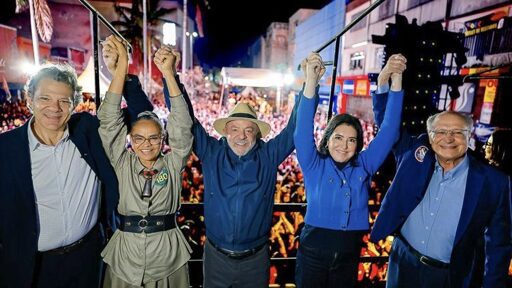

On October 4, nearly 160 million Brazilians will go to the polls to elect their next president, vice president, members of Congress, governors, and state legislators from the country’s various states. If no presidential candidate receives more than 50% of the valid votes, a runoff election will be held on October 25.
At this time, 13 presidential candidates are vying for the presidency in Brasília, although polls clearly point to two candidates vying for the presidency of Latin America’s most economically powerful country.
On one side is Brazil’s current president, the former union leader and progressive Luis Inácio Lula da Silva. Lula served as president from 2003 to 2011 with very high approval ratings, although following corruption allegations, he was imprisoned and sentenced to nine years.
However, after over 500 days in detention, a judge ordered his release, ruling that the proceedings were flawed. The Supreme Court of Justice called the incident a “historic error.” Following that, Lula faced off against then-far-right President Jair Bolsonaro and defeated him in the 2022 election. Now Lula hopes to be re-elected once again.
At the forefront is none other than Jair Bolsonaro’s son, Flávio Bolsonaro, who has leveraged his father’s reputation to boost his own. This is because Jair Bolsonaro was found guilty of several crimes that, according to the Brazilian justice system, were intended to prevent Lula’s inauguration and promote a coup d’état. Jair Bolsonaro is currently in house arrest for those crimes.
Consequently, a significant portion of Brazilian society, as well as international politicians such as Donald Trump, consider Bolsonaro’s imprisonment to be unjust. This explains how his son Flávio – a lawyer and businessman who currently serves as a senator – has managed to garner significant support in his bid to win the presidency on October 4.
Thus, two clearly distinct political and economic models are pitted against one another. Lula belongs to a political tradition that seeks to strengthen the state, reduce extreme poverty, invest in social programs, and diversify trade partners (such as China and India), all in line with a clearly pro-sovereignty discourse.
For his part, Flávio Bolsonaro promises to continue on his father’s path: economic neoliberalism, reducing the size of the state, building closer ties with the private sector, and – perhaps most importantly – placing Brazil once again under the influence of the Trump administration, which supports the far-right candidate.
Read more: Lula and Flávio Bolsonaro all set to face off this October in Brazil’s presidential election
Clearly, a victory for the far right – which is close to Washington – would represent a sharp shift in the region’s current economic and political course. Brazil accounts for nearly 50% of the region’s total GDP, so a victory for a Trump ally would drastically alter not only the political landscape but also the economic one. On the other hand, a victory for Lula would signal a “halt” (probably the most significant of all possible outcomes) to the wave of victories by the Latin American right and far right – allies and supporters of US hemispheric and military policy – that have swept the electoral landscape in recent years.
What do the polls say?
Since the start of the presidential race, Lula has maintained a lead over his political opponent. However, that lead has been narrowing as the weeks have gone by, raising the possibility that the runoff election, scheduled for October 25, will be a very close race. This is because, it appears, neither candidate will manage to secure more than 50% of the vote to win in a single round.
According to a poll by the MDA Pesquisa Institute, Lula holds a solid lead over Bolsonaro: 40.06% to 30.4%. Augusto Cury comes in third with 6% of the vote, while the remaining candidates trail behind this mark. According to this poll, in the event of a runoff, Lula would win with 47.3% against Bolsonaro’s likely 40%.
However, other polls paint a different picture, in which Lula remains in the lead but by a very narrow margin. This is according to an AtlasIntel poll, which shows Lula with 46% of the vote, while Bolsonaro would receive 44% in the first round. In the runoff, the gap would disappear, and both candidates would receive nearly 47% of the vote (a technical tie).
A corruption scandal that is shaking up the political landscape
However, everything could change in the wake of a scandal that has rocked Brazilian politics. In late 2025, the former owner of Banco Máster SA, Daniel Vorcaro, allegedly committed a serious case of bank fraud. Since his arrest in March 2026, his conversations, friendships, and connections have all been under close investigation.
One of the people who has come under scrutiny is Flávio Bolsonaro, who confirmed that he had asked the banker for money to make a film about his father called “Dark Horse”. The Federal Police are investigating this case to determine whether Bolsonaro participated in any illegal activity.
Meanwhile, Lula’s inner circle has also been affected. The judge who ordered Jair Bolsonaro’s arrest, Alexandre de Moraes, is alleged to have exchanged messages with Vorcaro. Moraes has been portrayed as a judge close to Lula and thus Bolsonaro and his supporters have seized on the revelation of the messages to call for Moraes’s removal and indirectly accuse the government of suspicious activities.
The debate has led to a serious crisis within the Brazilian judiciary because a decision to investigate Moraes was postponed, prompting accusations of political bias among the judges.
From BT News via This RSS Feed.