

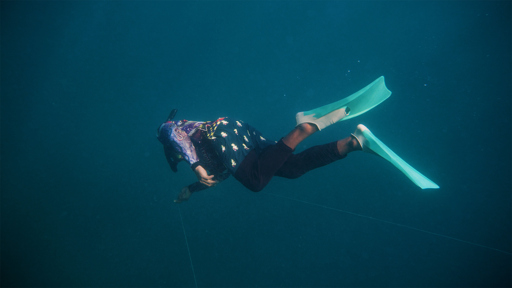
POTO TANO, Indonesia — Mahari sits at the front of the boat, cigarette in hand, surveying the conditions of the waters off Poto Tano, a small fishing community on the island of Sumbawa, Indonesia. As ketua, the leader of this group of Bajau octopus fishers, Mahari decides which tool they will use today. He silently surveys the waters while the rest of the group sits back and waits for his cue. The Bajau people are an Indigenous ethnic group spanning Indonesia, Malaysia and the Philippines. Traditionally living mostly on boats, Bajau people have harvested from the sea through traditional freediving for generations. In Sumbawa, a recent ban on dives assisted by an air compressor, a dangerous diving technique that provides the diver with continuous air, means these traditional methods have become more valuable than ever. With the right skills, freediving can be gentler on both the environment and the body than more destructive modern practices. Through expeditions like this one, Mahari and the other fishermen in his community work in cooperation with local NGOs to ensure this knowledge is passed to new generations. Day octopus (Octopus cyanea). Image by © Stergios Vasilis via iNaturalist (CC BY-NC-ND 4.0). ‘Pocong time’ Depending on current and water visibility, Bajau fishers typically use one of two methods to catch octopus. If there is low visibility or a strong current, they will use a “shell” tool adorned with hooks, which they let go in the water and trail behind their boat. If there is better…This article was originally published on Mongabay
From Conservation news via This RSS Feed.