

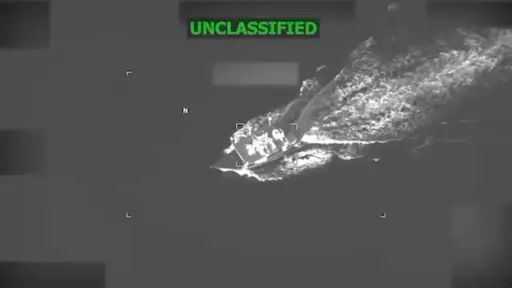
Caracas (OrinocoTribune.com)—On Saturday, September 19, the US Southern Command (SOUTHCOM) killed four people aboard a small boat in the Caribbean, continuing its campaign of extrajudicial executions just days after another US operation involving the destruction of a vessel and the transfer of its crew to Ecuador.
In its announcement, SOUTHCOM said Joint Task Force Western Hemisphere attacked a speedboat traveling along an alleged drug-trafficking route. It labeled the victims “narco-terrorists,” but supplied no names, nationalities, or verifiable evidence of drugs aboard. The statement identified no imminent threat to human life.
On September 19, under the direction of #SOUTHCOM, Joint Task Force Western Hemisphere executed a lethal, kinetic strike on a go-fast vessel operating along established narco-trafficking routes in the Caribbean. Confirmed intelligence revealed the vessel’s active involvement in… pic.twitter.com/LPNJ5ec3GU
— U.S. Southern Command (@Southcom) September 19, 2026
The attack came less than a month after the resumption of the killings on August 23. SOUTHCOM also announced attacks killing four people on August 25 and three on September 9, both in the Caribbean. Saturday’s strike followed the latter by just 10 days.
Nearly two-thirds of the death toll in the PacificAn updated tally drawing on Orinoco Tribune’s database and US strike announcements puts the campaign’s toll at 234 people killed or presumed dead since September 2025. Of these, 149—63.7%, or nearly two-thirds—were in the Eastern Pacific, and 85 in the Caribbean.
The total includes 23 people who survived the initial attacks or jumped overboard, subsequently remained missing, and are presumed dead. People reported rescued alive are counted separately. Announcing that someone survived an explosion does not establish that they survived the ensuing ordeal at sea.
The Pacific concentration stands in sharp contrast to the campaign’s initial emphasis on alleged Venezuelan “narco-terrorist” organizations. Venezuela has no Pacific coastline, yet Washington has extended its lethal military operations far beyond the country it initially placed at the center of its justification.
Another interception involving EcuadorJust three days before the latest killings, SOUTHCOM announced another questionable operation in the Eastern Pacific. On September 16, US forces intercepted a vessel allegedly serving as a floating refueling station for the Los Choneros gang, removed its crew, transferred them to Ecuadorian authorities, and sank the craft.
SOUTHCOM’s statement offered no publicly verifiable evidence establishing the alleged criminal connection. Its own account nevertheless demonstrates that interception and removal of crews are possible. The decision to destroy the vessel after taking control of it also raises questions surrounding the motive for the sinking and the preservation of evidence.
Washington changes Venezuela’s designationCoincidentally, Washington changed its assessment of Venezuela’s counterdrug cooperation last week. A presidential determination released on September 16 omitted Venezuela from the countries deemed to have “failed demonstrably” to fulfill their drug-control obligations.
US controversy and UN condemnationWithin the United States, the campaign has provoked controversy over congressional war powers, the absence of publicly presented evidence, and the killing of survivors. On September 2, senior House Democrats Gregory Meeks, Adam Smith, Jim Himes, and Bennie Thompson introduced a War Powers Resolution seeking to stop the attacks, which they described as executions without due process or congressional authorization.
Smith also highlighted the follow-up strike that killed survivors clinging to their boat’s wreckage, challenging the administration’s justification for using lethal force instead of interception and arrest. However, the congressional move has not had any demonstrable effects in stopping the atrocious US campaign.
UN human rights experts have explicitly characterized the killings as “extrajudicial and unlawful”. They rejected Washington’s assertion that it is fighting an armed conflict with drug-trafficking groups, stressing that suspected traffickers are not combatants and that lethal force requires an imminent threat to life.
US SOUTHCOM Resumes Extrajudicial Killings After 63-Day Pause, Death Toll Reaches 211
“Calling it war does not make it one,” they stated. The experts also emphasized the duty to rescue survivors and demanded investigations, accountability throughout the military and civilian chains of command, and reparations for victims’ families.
Special for Orinoco Tribune by staff
OT/JRE/SF
From Orinoco Tribune via This RSS Feed.