

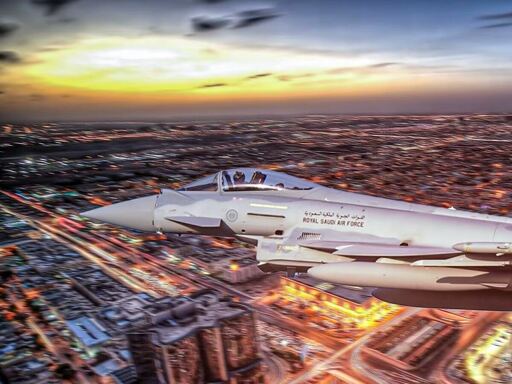

As Andy Burnham reportedly considers Saudi requests for military support in the Yemen war, new data shows that the UK government approved £464.8m of weapons exports to Saudi Arabia in the first quarter of this year.
This is one of the largest quarterly UK-Saudi arms sales on record. The vast majority of this figure is made up of air-to-surface weapons, raising concerns over their use in Saudi airstrikes.
Campaign Against Arms Trade and Transition Security Project have issued a new report. It calculates that BAE Systems and Rolls Royce made £3.9bn in profit from arming the 2015-22 Saudi-led intervention in Yemen.
The report sets out a funded proposal for the UK government, and UK arms companies, to pay reparations to Yemen for the war crimes they enabled the Saudi-led coalition to perpetrate. The report also calls for a full arms embargo on Saudi Arabia.
Yemen remains devastated by years of war. The Saudi-led coalition’s indiscriminate bombing of civilian infrastructure, coupled with a punishing air-and-sea blockade, are among the leading causes of what became the world’s worst humanitarian crisis in the late 2010s.
Hundreds of thousands died from violence, hunger and preventable disease. And over half the population of Yemen remains in need of humanitarian assistance. The richest states in the Middle East imposed an avoidable humanitarian disaster on the poorest state in the region. And they did this in collaboration with some of the richest countries in the world, including the US and UK.
Tax the warmongers’ Yemen windfalls
Calculations set out in the report recommend a windfall tax on the profits made by two leading arms companies, BAE Systems and Rolls Royce, on the weapons and military services they sold to Saudi Arabia. Initial calculations suggest this could raise a combined £3.9bn.
The report proposes that the UK state matches this figure, funded from a UK aid budget restored to 0.7% of GNI. The report recommends that this reparations payment funds urgent humanitarian relief. And any remainder should go into an appropriate Yemeni fund for long-term reconstruction.
Dr Sam Perlo-Freeman, research coordinator at Campaign Against Arms Trade, was an author of the report. He said:
The humanitarian crisis caused by the Saudi-led coalition in Yemen was only possible because of the UK arms trade, and the complicity of the UK state.
Many of the air-raids were conducted with UK-built aircraft and bombs. 6,000 government and contractor personnel were deployed to Saudi Arabia to maintain its fighter jets.
BAE Systems made an estimated £3.56bn profit from its role in this devastation, and this windfall tax would be a start in alleviating the suffering the Yemeni people are facing as a result of these sales.
Report author Dr David Wearing, assistant professor of International Relations at the University of Sussex, said:
This report sets out a model for ensuring that those who facilitate war crimes take responsibility for their actions, and for ensuring that the victims of those crimes secure restitution and justice.
Reparations are no less than we would demand if the devastation the UK helped Saudi Arabia cause in Yemen had been imposed on our own country instead.
We hope that this model can be taken up and applied by campaigners and civil society organisations in other countries to challenge a global arms trade that continues to fuel conflict around the world.
Khem Rogaly, co-director of Transition Security Project and another of the report’s authors, said:
The government must refuse any requests for military involvement in the Yemen war. Over the last eleven years, the UK state and its arms industry have collaborated in Saudi-led war crimes in Yemen, devastating the country.
If the UK is to account for its role in one of the world’s worst humanitarian crises, it must stop arming Saudi Arabia and reckon with the impact of its own bombing campaigns in Yemen which have killed scores of civilians in the last two years.
As the brutal consequences of its interventions in Yemen, Iraq, Afghanistan and Libya show, the UK’s pursuit of global military power has left destruction and instability across large parts of the world.
Rather than pursuing its plan to double the military budget over the next decade while maintaining its capacity to project military force across the world, the UK should end its destructive policy of military intervention, use its existing military capabilities for defensive purposes and direct government resources towards making life more affordable.
Featured image via the Canary
By The Canary
From Canary via This RSS Feed.