

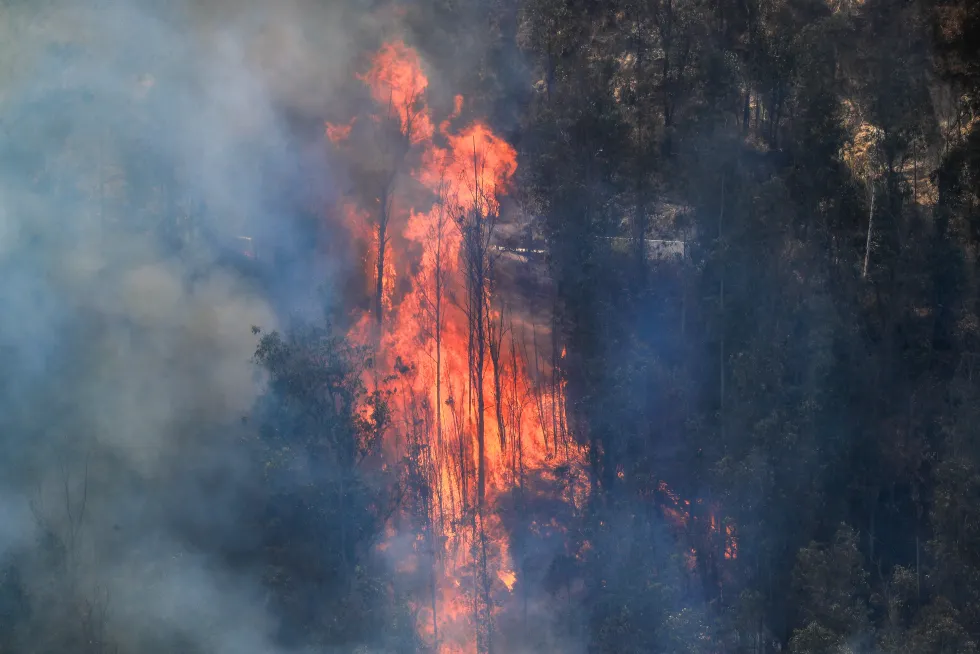
Ecuador’s National Secretariat for Risk Management (SNGR) reported Sunday, Sept. 20, 2026, that seven forest fires remain active across four provinces.
The Andean and southern provinces are the most affected. In Pichincha, the active hotspots are in Alóag (Mejía canton) and on Casitagua hill (Quito). In Carchi, the fires are affecting Maldonado (Tulcán canton) and Goaltal (Espejo canton). In El Oro, the hotspots are in Chilla (Chilla canton) and Guanazán (Zaruma canton). In Loja, the active fire is in El Airo (Espíndola canton).
RELATED: Ecuador Boat Strikes: 11 Controversial Attacks Deepen Legal Crisis
Adverse weather conditions—a severe summer drought accentuated by El Niño, high temperatures and strong wind gusts—have hindered suppression work in the national territory.
Six sectors have contained the advance of the flames: Itchimbía, Yaruquí, Puéllaro and the area between Puéllaro and San José de Minas (Pichincha), as well as San Pablo (Imbabura) and Nieves (Azuay). Authorities maintain ash guards in these places to prevent reactivations.
Detrás de cada incendio hay comunidades, fauna y bosques en riesgo. 🔥
Si ves una columna de humo o ves algo sospechoso, llama al 911, denuncia ante la Fiscalía y colabora con la investigación. pic.twitter.com/OD0zIzkn1f
— Riesgos Ecuador (@Riesgos_Ec) September 21, 2026
In the north of the capital, firefighting efforts were intensified after winds reactivated the fire on Casitagua hill. More than 120 Quito Fire Department personnel, along with National Police, Armed Forces and FONAG forest ranger brigades, are operating on steep terrain with the support of institutional helicopters carrying out continuous water drops.
The Metropolitan Air Quality Monitoring Network maintains acceptable indices in surrounding sectors such as Pomasqui, San José and Santa Clara. Authorities advise wearing masks, closing windows and staying hydrated due to the presence of smoke columns, which adds to citizens’ concerns about air quality.
From teleSUR English via This RSS Feed.