

By Atilio A. Boron – Sep 16, 2026
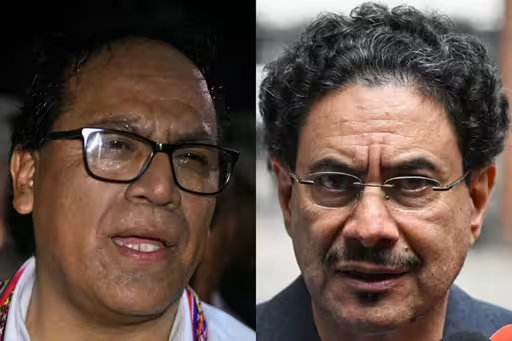
Roberto Sánchez and Ivan Cepeda, AFP
Recently, the empire has already stolen four elections in Latin America—one under the Biden administration and three under Trump. But this is not unusual in the history of relations between the United States and our countries. The most notorious cases in the past were those of the 1988 Mexican presidential election, when Cuauhtémoc Cárdenas was stripped of his victory to favor the candidate of the United States and the ruling classes, Carlos Salinas de Gortari. This election ushered in the era of electoral fraud in the region, which was still very primitive compared to what Palantir can do today with great sophistication. At that time, they resorted to a staged “computer blackout”; then, when the National Electoral Institute’s computers were restarted, a “miracle” occurred that radically altered the figures assigned to the leading contenders up until the moment of the blackout.
But there’s more: in 2000, Alberto Fujimori won the election through a blatant manipulation of votes and election records. The maneuver was so brazen that even the OAS withdrew its observation mission to make its protest clear. Months later, Fujimori would be removed from office. Another even more scandalous case was the 2017 presidential election in Honduras, which allowed for the reelection of Juan Orlando Hernández thanks to a “computer blackout” similar to the one that had enabled Salinas de Gortari’s victory in Mexico. It is worth noting that years later, JOH was arrested by US authorities, tried in US courts, and, in 2024, sentenced to 45 years in prison after being found guilty of smuggling several hundred metric tons of cocaine into the United States while serving as president of Honduras and simultaneously acting as a drug lord. Confirming once again the “seriousness” of the US government’s fight against drug trafficking, JOH was granted a pardon by Donald Trump in November 2025 and now enjoys complete freedom to continue his criminal activities.
A quick return to the present day demonstrates the renewed prevalence of this practice of stealing elections in our countries.
• Ecuador, April 2025. The empire and the Ecuadorian right wing erected all manner of obstacles to prevent the election of Luisa González, the candidate of Revolución Ciudadana. A climate of violence was instigated, and a fierce media campaign was unleashed to discredit González, in addition to the unpunished manipulation of the vote count with the open complicity of the National Electoral Council. Thus, the billionaire Daniel Noboa—a US citizen born in Miami, who is said to be the largest cocaine exporter on this continent with his fleet of banana boats—emerged victorious. As far as the Organization of American States (OAS) is concerned, everything is fine.
• Honduras, 2025. Candidate Rixi Moncada, of the ruling Libre Party, saw her electoral chances dashed when Washington made it known that it was considering revising the policy allowing unrestricted remittances to Honduras should Moncada win the election. These remittances are a vital resource for Honduran families: the country receives some $12 billion a year, providing essential relief for those most in need. The mere dissemination of the news triggered a massive exodus of votes, reducing the electoral landscape to a battle between two right-wing candidates: Salvador Nasralla of the Liberal Party and Nasry Asfura, the candidate of Juan O. Hernández’s National Party. Trump stated on several occasions that his candidate was Asfura, who ultimately won the election with just over 40 percent of the vote.
• Peru, June 2026, runoff election. The candidate chosen by the empire was Keiko Fujimori, against whom Mario Vargas Llosa himself had not spared any insults due to her proven immorality and complicity in numerous acts of corruption. Roberto Sánchez, representative of a broad sector of the left and the progressive movement, was defeated by Fujimori in a shameless vote count during the runoff election. Fujimori won by a narrow margin of 49,641 votes out of a total of just over 18 million voters. In light of serious allegations of irregularities during the voting process and in the corresponding records, the law allows for the contesting of suspicious polling stations. Of course, to challenge the 1,751 polling stations that showed serious irregularities, one had to pay 1,375 soles per station—a total of 715,000 dollars—which had to be deposited within 72 hours of the election’s conclusion. Mission impossible: no recount, and yet another theft by the empire.
• Colombia, 2026. The recent Colombian election declared a nefarious figure like Abelardo De la Espriella the winner. To achieve this, a master-class cyberfraud was employed, introducing a troubling innovation in the realm of electoral crimes. President Gustavo Petro denounced the existence of a clandestine data center, hosted in the US, from which the vote count was monitored and altered. It is said that this center focused its intervention on just over 5,000 polling stations, set up exclusively for the runoff election. At these stations, De la Espriella received a disproportionately higher total number of votes than at the others. This striking anomaly—which systematically awarded an overwhelming majority to the “empire’s” candidate (who, like his neighbor Noboa, is a US citizen)—allowed him to prevail in the final tally with a lead of some 250,000 votes over Iván Cepeda, out of a total electorate of nearly 25 million voters. Despite President Petro’s allegations, the entire Colombian judicial system—not just the electoral courts, which are dominated by Uribism—completely dismissed the presidential accusation.
• Brazil, 2026. Now, now they’re going after Lula. It is of the utmost importance to exercise the highest level of vigilance to prevent all kinds of fraud, whether electronic or more traditional. Keep in mind that if the election is snatched away from Lula, Trump will have a free hand to—using a chess metaphor—attempt to checkmate the queen, Claudia Sheinbaum, who is relentlessly hounded by the raving orange man. And next in line is Argentina’s presidential election in 2027.
From Orinoco Tribune via This RSS Feed.
You must log in or # to comment.