

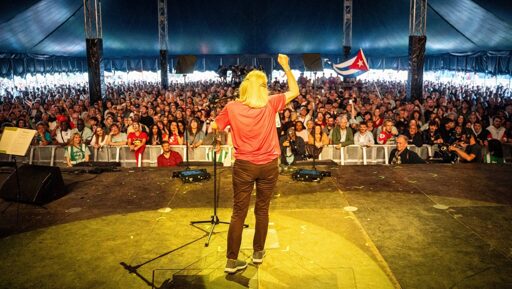

Health is always a prominent topic at Belgium’s ManiFiesta, a two-day festival organized by the Workers’ Party of Belgium (PTB) in the beginning of September. Discussions range from the organization of health services or workshops led by progressive health organizations like Medics for the People (MPLP-GVHV) and Viva Salud. This September, the program covered local priorities such as health coverage and hospital reform – along with Israel’s ongoing assault on Gaza’s healthcare system and the threat of militarization across Europe.
Health workers should oppose rearmament
Addressing the question of why health workers should be concerned by Europe’s armament drive, Juliette Mattijsen of the People’s Health Movement (PHM), Nadja Rakowitz of the Association of Democratic Doctors (vdää*) in Germany, and Tim Joye of Medics for the People emphasized the different ways hospitals, health centers, and medical studies are being reshaped.
Not only are governments imposing cuts on health budgets to enable increased defense spending, as Mattijsen illustrated – some are structurally changing what the health system is supposed to be about.
Read more: Militarization is spreading through Germany’s health sector
As the Merz administration in Germany rushes to build Europe’s mightiest army, Rakowitz explained, it is tabling plans for underground hospitals and an overhaul of triage systems. The goal of these reforms is supposedly to ensure wounded soldiers – from a battlefield that still only exists in the imagination of regional politicians – are cared for swiftly and returned to combat as soon as possible. In Belgium, Joye added, plans are being circulated to introduce war medicine into medical school curricula, and professional congresses have made this their topic of choice.
If European governments have their way, the speakers warned, health systems in the region will increasingly lose their focus on patients and add further strain on service provision. To prevent this, the panel suggested, health workers themselves – nurses, doctors, dentists, and others – must mobilize and actively oppose this dangerous trend.
In Palestine, medics provide more than health care
At another panel hosted by Viva Salud, the focus shifted to Palestine. Gaza’s health services have been militarized by the Israeli occupation, which has turned health infrastructure and workers into direct targets.
Sama Jaber of the Awda Association and Hanne Bosselaers, a Medics for the People general practitioner who participated in the 2025 solidarity flotillas to Gaza, focused their interventions on the relevance of organizing and providing healthcare under occupation.
In Palestine, Jaber pointed out, the formation of medical practitioners is a collective feat. By persevering in their work during a genocide, health workers in Gaza are now giving back to the communities who accompanied them along the way. “Being a health worker in Palestine today means sharing genocide conditions, but also upholding the right to health,” she said.
Read more: In Palestine, healthcare is also a form of resistance
For Bosselaers, the steadfastness of Palestinian comrades has been an inspiration since her first visits to Gaza approximately 15 years ago and the twinning process she supported with a health center in Beit Hanoun. Today, she emphasized, Israeli attacks have leveled Beit Hanoun to the ground – yet health workers have not given up their work.
Doctors and other health workers in Europe need to recognize this unbreakable spirit, Bosselaers said, and support their peers by joining movements at home. This should mean standing by Palestinians’ demands for liberation, she added, but also joining networks struggling against other forms of attack on healthcare: opposing commercialization, austerity, and militarization.
Call to support boycott, divestment and sanctions
Health workers around the world should direct their efforts into directly supporting the health system in Palestine, the panelists pointed out. This does not mean replacing hospitals with large international NGO operations or flying in and taking over, Bosselaers insisted, as is often seen in humanitarian medicine. Instead, she and Jaber suggested, the priority should be mobilizing against the occupation and campaigning for an end to Israel’s impunity.
In this, they echoed Palestinian physician and political leader Mustafa Barghouti, who addressed the panel through a video message. Barghouti invited health workers in Europe to stand firm in their support of Gaza, particularly by supporting boycott, divestment and sanctions (BDS) campaigns. By doing so, he said, they will also recognize the efforts of their peers in Palestine, who are doing more than healthcare today, “helping people persevere in their steadfastness.”
As the genocide continues, Barghouti insisted, health workers in occupied Palestine know their efforts are directed at supporting people in remaining on their land – starting from the most common health procedures. “If you help a woman safely deliver a baby,” he said, “you’re helping her stay in Palestine.”
People’s Health Dispatch is a monthly bulletin published by the People’s Health Movement and Peoples Dispatch*. For more articles and to subscribe to People’s Health Dispatch, click* here.
From BT News via This RSS Feed.