

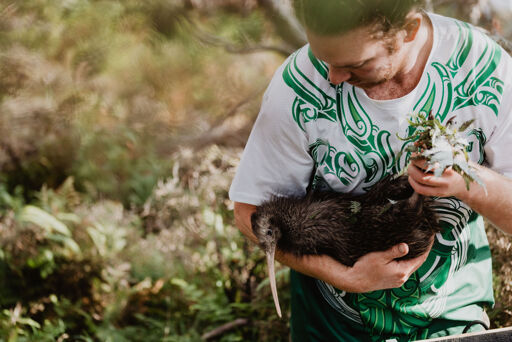

Capital Kiwi’s Paul Ward, Rāwiri Walsh (Taranaki Whānui, Ngā Rauru Kītahi), Pete Kirkman with Ngarangi, the first kiwi chick produced in Pōneke by Anahera (aged 50) and Nouveau (10). (Photo: Capital Kiwi)
A remarkable project to return kiwi to the wild in Wellington reached an important milestone recently — 250 birds have now been released to an area the size of Abel Tasman National Park, made safe enough for them thanks to the large-scale removal of stoats, the predators introduced by British settlers in the late 1800s.
It’s a shining example of what can be achieved when local communities, iwi, and private landowners work together.
Here, Paul Ward, the founder of the Capital Kiwi Project, explains why tears have been the typical response for those involved in the kiwi kaupapa.
“If there was one thing I could give everybody who’s a citizen of this country, it would be to give them this experience.”
“It’s like meeting ET and a long-lost relative at once.”
Releasing a kiwi is a privilege. Protocol requires a firm hold around the ankle and heel. Hand gripped tight around prehistoric claws, thumb pressing dirt. Wrist flexors flinching to contain the kick of a survivor.
There is a sense of homecoming. As Matua Tom Roa says, kiwi are the “manu whenua”. The originals.
Since 2022, 250 kiwi have been released to hills surrounding Wellington as part of the Capital Kiwi Project. They’ve been exiled from this corner of Aotearoa for 150 years. But what was a Pōneke pipe dream a decade ago is now a reality. A rapidly growing population of kiwi has been re-established on the southern hills of our capital city.
And with the recent removal of the last trackers from our monitored birds, they’re now truly wild. Truly free.
There are always tears when kiwi are released.
Whether it’s the Makarā farmer with the shades hiding “a bit of onion in the eye”. Or the Karori Golf Club doyen who told us it was “up there with weddings and becoming a granddad”. Or the Ngāti Hinewai kuia who wept as she farewelled a manu that four generations of whānau have been kaitiaki of. Or the Gen Z who rated it the “most amazing day of my life”. Or the Toyota mechanic who said: “I had my citizenship ceremony last week, but this was the real one.”
New Zealanders aren’t prone to overt emotion.
So why the tears?

The kiwi’s claws are powerful, and a firm grip is required. This one belongs to Kōpū, a big uwha (adult female). She and her chick were the last to have their transmitters removed. (Photo: Caleb Smith for Capital Kiwi Project)
Aotearoa is the only home of kiwi. They are all-terrain, adapted to live anywhere from sand to snow to scrub. Restoration represents the will to honour that possibility.
For Capital Kiwi, this is a decade of collective effort. There’ve been countless cuppas on marae, in halls, kitchens and woolsheds. We’ve laid 5,300 traps over 24,000 hectares, an area larger than Abel Tasman National Park that includes farms, forestry, city suburbs, mountain-bike parks, urupā, and national power infrastructure. We’ve done half a million trap checks in sun, rain, ongaonga, and gorse.
The removal of thousands of stoats — the killer of kiwi chicks — is a landscape-scale achievement. But “reward for mahi” doesn’t explain the tangi.
The kiwi is an unlikely icon. National marketers could have chosen the mischievous kea or the giant moa, but we settled on an animal that seems to have been invented by a five-year-old on a sugar bender, making a Mr Potato Head bird — the size of a rugby ball, velociraptor talons, a chopstick bill, whiskers like a cat, feathers like fur, and a mega-sized egg.

Anahera, mother of the first chick born in the wild in Wellington, is about 50 years old. (Photo: A Neil Hutton)
Kiwi are the ultimate example of Aotearoa’s unique island evolution. They’re our kangaroo, our panda. Since people came here, we’ve shared a relationship. In the pūrākau, the story goes that the kiwi was the only manu willing to head down from the tops to defend the ngahere (forest) against insects and disease. When early sports teams travelled abroad, cartoons depicted a kiwi defeating a lion. The kiwi captured scrapper aspirations and a low-key sense of humour — the wingless bird is also the ensign of our air force.
Perhaps the tears are a response to meeting kiwi in real life?
We take our name as a people from the bird, but most only know it as a symbol on a league jersey or an army sleeve. If we’ve met our namesake, it will likely be as a shadow in a zoo nocturnal house.
But fun-run costumes and emoji don’t bolster belief in the possibility of wild kiwi. To meet a big 3–4 kg uwha (female kiwi) at a release is to feel surprise and pride that this is a kiwi. This is a manu that has never skipped leg day. Claws designed by Tāne: powerful, substantial. At these encounters, the kiwi claims back some ownership of its identity: kiwiana is washed away by wairua.

The pōwhiri at Waiwhetū marae, followed by the release of kiwi at Terawhiti Station in 2025. The kauapa to return kiwi to the wild in Wellington after a 150-year absence is a community effort, involving locals, iwi, and landowners.(Photo: Capital Kiwi)

Releasing kiwi at Terawhiti Station in 2023. (Photo: Capital Kiwi)

A kiwi release in 2024. (Photo: Capital Kiwi)

(Photo: Capital Kiwi)
Locating our last monitored chick to remove its tracker involved hours of hillside hide-and-seek, with the help of a Yagi aerial and a trained dog.
The final reveal, where we pulled the kiwi from a thick mat of akatea (climbing rātā), had the awe of a magic trick. After a health check, the ankle bracelet was removed by cutting the loop of electrical tape and the baby band. There’s a mulch-sweet stench, like having a cast broken. (One writer compared clipping a kiwi transmitter to cutting her child’s umbilical cord.)
Having graduated to a stoat-proof 1 kg, odds are that this bird will live for many decades. Last year, beneath a Transpower cable, we freed Ngārangi. His mother, Anahera, the matriarch of Pōneke’s homecoming kiwi, was around 50 years old. For the team, it was humbling to reflect that Ngārangi will likely outlive all of us present on that salty Terawhiti hillside.
The snipping of the scissors is a moment filled with contradictions. The kiwi is wild but clamped in a handler’s arms, and in daylight. We rarely see images of the kiwi on its own terms. In the dark, where we’re blind and clumsy, they are masters of their nighttime takiwā (territory). Returning them to range freely has been made possible by kōhanga programmes within fenced sanctuaries. Protection of kiwi involves killing introduced predators. Releasing a kiwi is profound, but few people will experience this. They are taonga, and were once food and clothing, but right now, they’re a conduit for reconnection.
For the team, it’s a bittersweet moment. We will no longer be able to (easily) find the bird. A manu we’ve come to know, from when it was little bigger than a tennis ball, is now a rooster-sized Junior Kiwi. But the aim is for the manu to be out of our intensive care, so we can honour the mana of te manu huna a Tāne, the hidden bird of Tāne.
The hide-and-seek search in the Wellington bush for Kōpū and her chick, the last kiwi to have their trackers removed. (The Last Transmitter: Capital Kiwi)
The project’s first chicks made the front page of The New York Times: “New Zealand exalts in revival of the kiwi, a national icon.” The other stories were about Trump, conflict in Gaza and Ukraine, and AI. Amid these dire challenges is a photo of two Makarā kiwi chicks. They are antidote and agency, hope that we haven’t stuffed it all up, that the graphs can still be bent in the right direction.
The public pōwhiri are moments of shared grace: Te Papa, Pipitea, and Waiwhetū marae, the village hall, the school, the golf course, the sheep station, the urupā, the wind farm, the beehive.
For many Pākehā community members, it’s their first pōwhiri. The birds — welcomed by Taranaki Whānui and Ngāti Toa with karanga, a few chosen to be met briefly before their release — are Trojan manu for kotahitanga. Whether you’re blue, red, green, or purple, everyone can agree with Makarā identity Ted Smith, who passed away this year, when he said: “If we can’t look after the animal that gifted us its name, we deserve to be renamed idiots.”
It’s hard to think of a more visceral jolt from endless internet scrolling than holding kiwi claws. More than “touching grass”, this is touching dinosaur. The moment of release, hand open in wonder at what it briefly contained, is personal.

Rāwiri Walsh, iwi liaison for Capital Kiwi, about to release a kiwi at Terawhiti Station in 2023. (Photo: Sara Tansy for the Capital Kiwi Project)
Why the tears?
I reckon the tears are as basic as the dirt. There’s a concession that we’ve taken this relationship for granted in the past, and that we haven’t paid an appropriate koha for all the kiwi has given us.
My Pākehā settler ancestors would’ve heard kiwi in the Pōneke dusk (and ruru, weka, and kākā, too). For 150 years, that song was absent. What does a kiwi sound like? Makarā schoolkids don’t need to squeeze the stuffed toy to find out — they know because the raucous korowhio rings out from their backyards.
Kiwi can use their multi-tool matimati (claws) to excavate burrows, some metres deep into bony Wellington greywacke, filled with cave wētā. If you didn’t have a scale reference, it could look like the shaft of a Terawhiti gold mine. When a kiwi is put into a burrow, there’s the sense that something missing from the earth, but intrinsic to it, has been returned.
Might that burrow beneath a Makarā gorse bush be an altar to possibility?
Helping kiwi whakakāinga anō — remake their homes here — is a case for belonging and an investment in the future, a planting rather than a burial.
Wellingtonians grin when they see the signs of kiwi: a fresh footprint in a cow pat beneath a turbine, a kiwi hooning down a mountain bike trail or climbing stairs on a suburban security camera.
The ngutu roa (long bill) is a supreme kai detector — the kiwi is the only bird with nostrils at the end of the beak. It sniffs out the secret-recipe smells of the worms, grubs, wētā, cicada, koura, and berries. When the nostrils get clogged, a kiwi forcefully sneezes to clear the tubes. Tīhei mouri ora! Behold, the sneeze of life!

The Capital Kiwi Project team. (Photo: Caleb Smith for Capital Kiwi Project)
Paul Ward is the founder of the Capital Kiwi Project, the mission that has restored a kiwi population to the hills of Te Upoko o te Ika, surrounding our capital city. The kaupapa is a partnership between communities, iwi, and landowners.
Kiwi ora: The people of Pōneke (especially Makarā), iwi mana whenua (Taranaki Whānui, Ngāti Toa), 100-plus landowners (especially Terawhiti Station), and gifting kōhanga sites and iwi: Ōtorohanga Kiwi House (Ngāti Hinewai), Sanctuary Mountain Maungatautari (Ngāti Korokī Kahukura, Ngāti Hauā, Ngāti Raukawa), and Rotokare Scenic Reserve Trust and Taranaki Kiwi Trust (Ngāti Tupaia).
The post The return of the ‘manu whenua’ appeared first on E-Tangata.
From E-Tangata via This RSS Feed.