

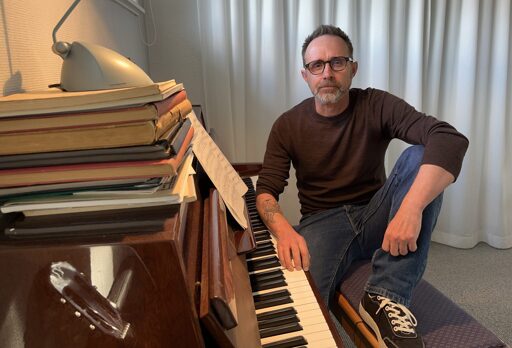

“As I leaned into the dissonance of the past, I realised that learning te reo had become a salve that smoothed away the spiky edges of my defensiveness,” writes Marcel Currin. (Photo supplied)
When Marcel Currin learns a difficult section of music, he finds it helps to “lean into the dissonance” and learn to love it. Learning te reo has been like that for him — and the payoff has been immense, as he writes here.
A single note in one of Schubert’s piano impromptus makes me feel glad to be alive.
The note is a high G. When it briefly pokes its head into the upper register, it’s the first time you hear it. It pings like light in a dewdrop.
I came to it as an amateur pianist, fumbling through the music. It appears in bar 49 of “Impromptu No. 3” in G-flat major, shortly after a dissonant passage. When I was learning the piece, I wrestled with that dissonant section. It felt like an affront to the straightforward delicacy I’d enjoyed up to that point. It took me a while to understand what was going on so I could find the melody.
My philosophy for dealing with difficult sections of music is to learn to love them. If I lean into the dissonance, I’ll eventually push through, complete the piece, and uncover its secrets. I relish the discovery. The world feels overwhelming at times, but the human project feels worth it if I can be alive to appreciate such flashes of artistry.
When my hands move over the keyboard, a tattoo of a tūī moves lightly on my forearm. The tattoo is a piece of art that, like the high G, sparks pleasure whenever I see it.
It’s my first and only tattoo. It marks a bunch of things: turning 50, a return to good health, and creativity. Mostly, it embodies a personal journey of identity over many years — and it began with learning te reo Māori.
*
I’m Pākehā. There’s no trace of Māori in my heritage that I’m aware of. I’m from the generation when our teachers smoked cigarettes in class and were legally allowed to hit us with wads of leather. My exposure to Māori culture at primary school was limited to a few basic reo phrases. Olly Ohlson spoke a Māori greeting on afternoon television. We sang “Oma Rapeti”. That was about it.
For a long time, I didn’t question the blithe assumption that “We’re all just New Zealanders.” Jandals, fish ’n’ chips, All Blacks, Footrot Flats, the six o’clock news. We were a homogeneous blend of Kiwi, the lot of us. I saw Māori culture as an optional extra, something you could tack onto your innate New Zealandness. If our national identity was a meal, it was gumboots with an optional bit of haka on the side. Sure, some people might have been Māori, but they were New Zealanders first and foremost.
Things changed a bit during my teen and university years, when I enjoyed increasingly deep and rewarding encounters with Māori culture. Yet, looking back, I still missed what was right in front of me.
In my 40s, I enrolled in a beginners’ Māori language course. I had questions about the culture and wanted to engage with it on its own terms rather than looking at it from the outside. I also imagined that after I learned the language and earned the right to broadcast my opinion, I would stroll into the Māori world and help shepherd New Zealand’s race relations towards a harmonious future. White saviour aspirations (what a dickhead).
The reality checks sorted that out soon enough. They started when we learned how to introduce ourselves. Introductions in Māori focus less on the individual and instead start with heritage. Where are your ancestors from? What is your marae?
I don’t have a marae. I tick “New Zealand European” on the ethnicity questionnaires. I’ve always defined myself by my name, my job, my skills, and my interests. Nothing in my upbringing required me to ponder questions like “Who are my people?” or “Where am I from?”
In fact, I resented being asked to prod into my ancestry. As far as I was concerned, the only history that mattered began the day I was born. I’m a New Zealander. From New Zealand. That’s it. End of story. Don’t start telling me I’m from England or some other place I have no connection with.
But I quelled my indignation because I loved learning te reo. Evening classes at the wānanga were the highlight of my week. There were people from all walks of life, from all sorts of countries. “Why are you here?” I asked some of them. “Because I’ve moved to New Zealand and I want to learn the language,” they answered. It was a positive environment, and I had great fun playing with the Māori sentences. Beginner reo is structured like Lego blocks — you can swap the pieces around. I found it easy and satisfying.
At the end of that first year, we stayed on a marae for a weekend. Those of us who arrived on the Friday were welcomed with a pōwhiri. The next morning, a small contingent of Saturday arrivals assembled outside the gate. Our tutor gathered some of us to join him for their formal welcome. “You are tangata whenua now,” he told us, so we took our places to support the home side.
He stood and addressed the visitors across the marae ātea, the stretch of lawn that lay between us and them. The sun was still low in the sky, and from where I sat, he was a silhouette directly in front of me. I observed his posture and listened to his voice. As he spoke across the marae in words I didn’t yet understand, I was struck by the responsibility he carried. This was his marae. He was representing all who had gone before him. He wasn’t just standing on a piece of grass — his feet were anchored to the land, to the marae, and to the history of his people.
It was an “aha!” moment. I’d been treating the language like a trinket, yet it was grounded in something far deeper and more vital than I could comprehend. The culture wasn’t an embellishment — it was a complete composition. The door to a wider perspective cracked open.
I pressed on with the reo over the next few years. Those simple Lego blocks of sentences got more complicated. I had to work harder as the language became more nuanced. Each year, there were fewer non-Māori in the class, while new Māori students came on board to sharpen the reo they already had. Phrases rattled over my head, and I felt like the slow kid at the back of the room. It was uncomfortable at times — I felt like an outsider. I often reflected on the irony of my complaint.
There were moments I had to get over myself. When I expressed confusion or was slow to grasp a concept, my tutors said gently: “Whakaaro Māori.” Try thinking about it from a Māori perspective. Learning te reo was a constant check on my “whakaaro Pākahā”, my default Pākehā thinking. I still flinch when I see someone sit on a kitchen bench or on a dinner table. (That’s a food surface, don’t stick your bum there!) Or when important meetings start without the acknowledgments and scene-setting common in tikanga.
Around me, Māori students were digging into the heritage that anchored them to Aotearoa. Compared with the depth of their whakapapa, it seemed I had no such anchor. The Pākehā tribal waka was starting to look like a dinghy.
Once, a tutor asked the non-Māori in the class for our thoughts about something. He addressed us as tauiwi, which refers to people who’ve come to Aotearoa from overseas. Was I not a New Zealander? Where was my homeland if not New Zealand?
These and a myriad of other questions I couldn’t easily articulate swirled uncomfortably in the background. In retrospect, they had always been there. Learning Māori shone a spotlight on those questions, but it also gave me the tools to engage with them.
Māori is a language loaded with metaphor. To compliment someone’s singing, you can say “he manu tīoriori”, which describes a bird with a beautiful song. When a person of note passes away, you might hear them described as a tōtara tree: “Kua hinga te tōtara,” the tōtara has fallen. Notice how “te taiao”, the natural world, is threaded through these phrases.
The more I explored the language, the more in tune I began to feel with the land around me. I found depth and resonance in the symbolism of te ao Māori, and in the beauty of its poetry. Instead of mountains, rivers, and birds, I began to see maunga, awa, and manu. Just changing the words activated something in me. I was viewing Aotearoa through whakaaro Māori.
I began to learn more about my ancestry, tracing it as deep into the past and as far across the world as I could. I zoomed in on my family’s arrival in New Zealand. I found a story about something that happened to my great-great-great-grandfather, John, in Motueka. His surveying party was confronted by a group of Māori who objected to their land being marked out. John was grabbed and dragged through the forest. One of the Māori raised his weapon and was about to bring it down on John’s head, but a chief stopped him and spared my ancestor’s life.
That story sent an electric charge through me when I first read it. New Zealand history was suddenly less distant and more relevant. It prompted me to consider how my family’s history related to the physical land. Suffice to say, my heritage is directly linked to the legacy of colonisation.
Ah, the C word. It can be uncomfortable to talk about. But as I leaned into the dissonance of the past, I realised that learning te reo had become a salve that smoothed away the spiky edges of my defensiveness. The habit of expanding my perspective had somehow neutralised my need to rationalise, justify, or look away from difficult things.
To my surprise, I discovered that I was passionate about Te Tiriti o Waitangi. For most of my life, I hadn’t cared about the Treaty because I hadn’t understood its relevance to me. I had ring-fenced it as something for Māori, something to think about another day.
When the day finally arrived to think about it, I realised that Te Tiriti is perhaps the most relevant document of all. It helps explain who I am as a citizen of Aotearoa. He tangata Tiriti ahau: I am a person of the Treaty, a person without Māori whakapapa who nevertheless belongs to Aotearoa under Te Tiriti. I think of my tutor on his marae, seating us alongside him at the pōwhiri because, having been formally welcomed onto the marae, we now belonged there too. Importantly, it wasn’t an entitlement. It was a responsibility.

“I chose a tūī to represent Aotearoa . . . I like that the tattoo has a Māori foundation, as does my country. As a bonus, tūī have two voice boxes — two distinct voices — which aligns nicely with what I was trying to convey.” (Artwork by tā moko artist Jordyn Hautapu.)
So here comes the tattoo. It grew out of my desire to express my deep sense of connection to Aotearoa as my homeland.
I chose a tūī to represent Aotearoa. The tūī illustration is set against a tā moko design that reflects my personal journey. It includes symbols of manu rere, flying birds, to represent the countries my ancestors travelled to Aotearoa from. This is my whakapapa as tangata Tiriti.
I felt it was important for the integrity of the piece that a tā moko artist do the artwork. I like that the tattoo has a Māori foundation, as does my country. As a bonus, tūī have two voice boxes — two distinct voices — which aligns nicely with what I was trying to convey.
I love seeing the artwork on my arm. Catching it in my reflection grounds me to te taiao, to the land, to te reo, to the story of Aotearoa, and to my family heritage. It’s a visual affirmation of where I’ve come from, where I belong, and what I’m committed to. Most people will just see a pretty picture of a bird, but for me it’s an important statement.
I can hear a friend of mine scoffing: “Good for you, but the rest of us shouldn’t have to learn Māori just to know who we are. Let alone get a tattoo!” You certainly don’t need to get a tattoo. I’m just trying to explain what I discovered when I leaned into the dissonance.
The expressiveness of te reo Māori gives me joy. A simple “Kia ora” has layers of depth in the way it wishes wellness on the other person. The name of the estuary near my home, Waikareao, describes light rippling on the water. It’s poetry.
Leaning into te reo, I’ve made discoveries about myself and about my relationship to my country. I feel more complete as a New Zealander.
I’m still prone to the myopia of my assumptions. Look at me writing this essay: I thought I was clever linking Schubert’s high G to my thoughts about te reo Māori. “Oh, how I enjoy the graceful notes of Māori language because they add colour to our cultural landscape.” But I realise now that my analogy is threaded with a familiar arrogance: it reduces Māori culture to an embellishment that’s been added to the “real” New Zealand composition. That’s a Pākehā-centric way to look at it.
The image of my tutor framed against the light returns to me as a reminder. Te reo Māori is its own music. There’s always more to learn, and what a gift that is. Kia ora.
Marcel Currin studied te reo Māori at Te Wānanga o Aotearoa in Tauranga. He works part-time as a communication advisor in local government and is a published poet and writer.
The post Leaning into te reo appeared first on E-Tangata.
From E-Tangata via This RSS Feed.