

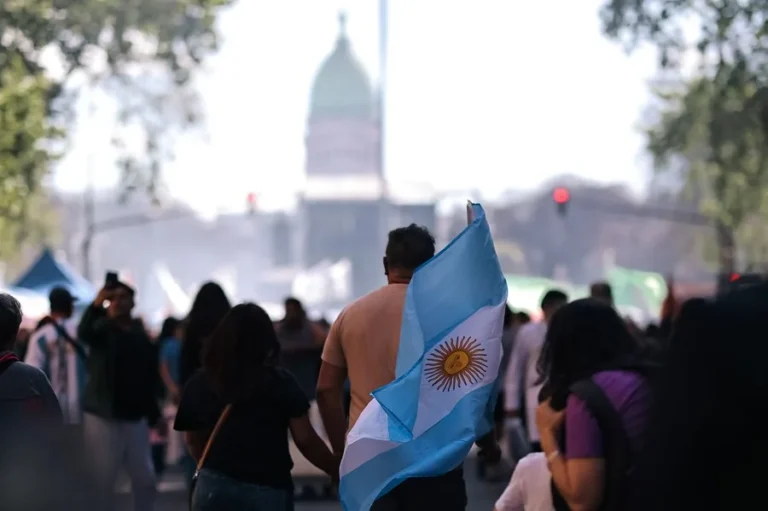
Marcha de la Bronca Argentina brings more than 350 groups into the streets against Milei’s austerity plan, demanding a general strike and social protections.
Related: Argentina Files Complaints Against Five Oil Companies Operating in the Malvinas Islands
Marcha de la Bronca Argentina Mobilizes Thousands Against Milei
The Marcha de la Bronca Argentina brought together more than 350 trade-union, student, social, cultural, environmental, and human-rights organizations on Saturday, September 19, in Buenos Aires and more than 30 cities across the country.
The protest was organized against the economic policies of President Javier Milei and called for a general strike against austerity measures, layoffs, cuts to public services, and what organizers describe as judicial persecution.
The main demonstration began at Congress Square and moved toward Plaza de Mayo, where participants read a joint document agreed upon by the organizations involved.
The mobilization was promoted by left-wing leaders including Myriam Bregman and Gabriel Solano, who called on unions and social movements to transform widespread dissatisfaction into coordinated action.
The organizers used the slogan “Organize anger to defeat Milei” and argued that public pressure should continue through protests, strikes, and neighborhood organizing rather than being postponed until the next electoral cycle.
The demonstration included left-wing parties, grassroots unions, unemployed workers’ organizations, student groups, feminist collectives, environmental assemblies, human-rights organizations, and cultural figures.
Musician Miguel Cantilo was among the artists who expressed support for the demonstrations, which were also held in Córdoba, Santa Fe, Mendoza, Salta, Neuquén, and other provinces.
The Buenos Aires march was scheduled to begin at 3:30 p.m. at Congress Square. Columns then advanced along Avenida de Mayo toward Plaza de Mayo, where organizers presented the final document and held a closing event.
The government announced that its anti-picket protocol would be applied. Security forces installed barriers and prepared an operation around the main points of concentration.
The presence of police forces and the possibility of road closures raised concerns among organizers, who said the government’s protest protocol restricts the right to demonstrate.
The Marcha de la Bronca Argentina is one of the largest mobilizations organized by the left since Milei took office. It also reflects growing pressure on trade-union leadership to call a national strike.
Organizers criticized the General Confederation of Labor, or CGT, for what they described as passivity in the face of the government’s economic program.
The protest document reportedly denounces dismissals, company closures, cuts to health and education, attacks on disability protections, and pressure on public universities. It also calls for breaking with the International Monetary Fund and rejecting what the organizations call a debt-driven austerity model.[telesurtv][c5n][ambito]
Marcha de la Bronca Argentina Demands a General Strike
Read about the Marcha de la Bronca schedule, route, and demands.
The Marcha de la Bronca Argentina was presented by its organizers as more than a one-day protest. It is intended to create a national coordination structure capable of linking social movements, unions, students, and political organizations.
Myriam Bregman said the objective was to organize anger and turn it into a sustained plan of struggle. Gabriel Solano similarly described the mobilization as a point of regrouping for sectors opposing Milei’s government.
The organizers said Argentina needs a general strike to challenge the economic program. They argue that demonstrations without workplace action will not be enough to reverse cuts or stop the government’s reforms.
The government’s economic policy is based on reducing public spending, controlling inflation, deregulating markets, and limiting the fiscal deficit. Officials say the measures are necessary to stabilize the economy after years of inflation, debt, and monetary instability.
Critics say the adjustment has transferred the burden of stabilization onto workers, retirees, students, people with disabilities, and low-income households.
The social organizations participating in the Marcha de la Bronca Argentina are demanding wage increases, protection for pensions, funding for public universities, investment in hospitals, and the restoration of employment programs.
They are also protesting changes to labor regulations and the government’s approach to collective bargaining. Unions fear that deregulation could weaken job security and reduce workers’ negotiating power.
The protest takes place as Congress debates the government’s 2027 budget proposal. Opposition groups say the draft budget would underfund public universities and repeal or weaken a law protecting disability benefits.
The government argues that the budget is part of a broader program to restore fiscal balance and reduce dependence on debt. The opposition says it prioritizes creditors and financial markets over social needs.
The Marcha de la Bronca Argentina also has a strong cultural and symbolic dimension. The name refers to anger accumulated over unemployment, declining purchasing power, insecurity, and what organizers describe as attacks on democratic and social rights.
Artists and cultural workers have joined the mobilization because they say cuts to public funding threaten theaters, museums, independent production, and cultural institutions.
Student groups have focused on the situation of public universities. They say reduced funding is affecting scholarships, salaries, research, laboratories, and access for students from working-class families.
Environmental organizations are also participating, linking austerity to the weakening of environmental protections and public oversight of mining, energy, and infrastructure projects.
The demonstration’s broad composition reflects the effort to build a multi-sector opposition rather than a protest limited to one union or political party.
However, the coalition also faces challenges. The left is divided among different parties, unions, and social organizations. Some sectors prioritize electoral work, while others insist that street mobilization and strikes should come first.
The Marcha de la Bronca Argentina is therefore being watched as a test of whether the left can convert public discontent into a sustained national movement.
The success of the mobilization will depend on its ability to maintain organization after the march, coordinate future actions, and persuade larger trade-union confederations to join a general strike.
Peronism Builds Its Own Alternative
See coverage of Axel Kicillof’s federal meeting in Avellaneda.
While left-wing organizations marched in Buenos Aires, Peronism held a major political gathering in the province of Buenos Aires.
Governor Axel Kicillof led a national event of the Movement Right to the Future in Avellaneda. The meeting was designed to reorganize the movement and develop alternatives to Milei’s federal administration.
More than 40,000 activists attended the event at the National Technological University campus in Villa Domínico, according to organizers.
The gathering included working groups and a closing plenary. Participants came from at least 10 provinces, including mayors, legislators, local officials, and political leaders.
The event had a strongly federal character. Kicillof’s supporters sought to demonstrate that the movement has structures beyond the province of Buenos Aires and can develop a national political project.
The meeting addressed public health, education, science, universities, labor, production, women’s rights, youth, security, justice, public works, housing, culture, and sport.
Organizers said approximately 7,300 people registered to participate in thematic workshops, although the overall attendance figure was much larger.
The gathering took place amid internal tensions within Peronism. Kicillof has sought to strengthen his political identity and build a national network, while former President Cristina Fernández de Kirchner remains an influential figure within the movement.
The two dynamics occurring on the same day—street protest led by the left and territorial organization led by Peronism—show the different strategies being used to challenge Milei.
The Marcha de la Bronca Argentina seeks immediate pressure through mobilization and a general strike. Kicillof’s movement is focused on institutional organization, electoral preparation, and the development of an alternative governing program.
Both approaches oppose the government’s austerity measures, but they do not necessarily share the same political timetable or organizational priorities.
The left-wing groups want unions to act before future elections. Peronist leaders are also looking toward the next electoral cycle and the possibility of building a broad coalition capable of competing nationally.
The relationship between these forces will be decisive for Argentina’s opposition. If they remain divided, Milei may be able to maintain political initiative even amid social discontent.
If they coordinate, they could create a stronger movement combining street mobilization, union action, provincial organization, and electoral competition.
Geopolitical Context: Austerity, Debt, and Regional Politics
The Marcha de la Bronca Argentina reflects a wider regional conflict over the economic model adopted by governments facing inflation, debt, fiscal pressure, and demands from international creditors.
Milei’s administration has presented Argentina as a laboratory for radical austerity and deregulation. Its policies have attracted support from international investors and right-wing leaders who see the country as an example of market-oriented transformation.
At the same time, the adjustment has generated strong social resistance. Argentina has a long tradition of union organization, student activism, neighborhood assemblies, and mass demonstrations.
The conflict therefore extends beyond domestic policy. It also involves debates over the role of the International Monetary Fund, the future of public services, the distribution of wealth, and the relationship between national sovereignty and financial markets.
Milei has criticized what he calls state intervention and political privileges. His opponents argue that the government’s economic program weakens public institutions while protecting financial and corporate interests.
The social consequences of the adjustment could affect Argentina’s relations with neighboring countries. Governments across Latin America are watching the outcome as they debate whether austerity can stabilize economies without generating greater inequality and political instability.
The Marcha de la Bronca Argentina also takes place amid debates over sovereignty. Opposition groups say the government is accepting foreign conditions related to debt, trade, energy, and investment.
The administration says international financing and private investment are necessary to restore growth and attract capital.
The mobilization’s demand for a general strike could create a major confrontation between the government and organized labor. A successful national stoppage could disrupt transportation, industry, education, and public services.
A government response based on police restrictions could intensify tensions and reinforce accusations that Milei is limiting democratic freedoms.
For now, the protest is both a social mobilization and a political warning. It shows that opposition to the government is not confined to Congress or electoral parties.
The parallel Peronist gathering in Avellaneda demonstrates that political groups are also building longer-term structures to challenge Milei nationally.
The coming months will reveal whether these forces can coordinate around a common program or remain separated by ideological and organizational differences.
From teleSUR English via This RSS Feed.