

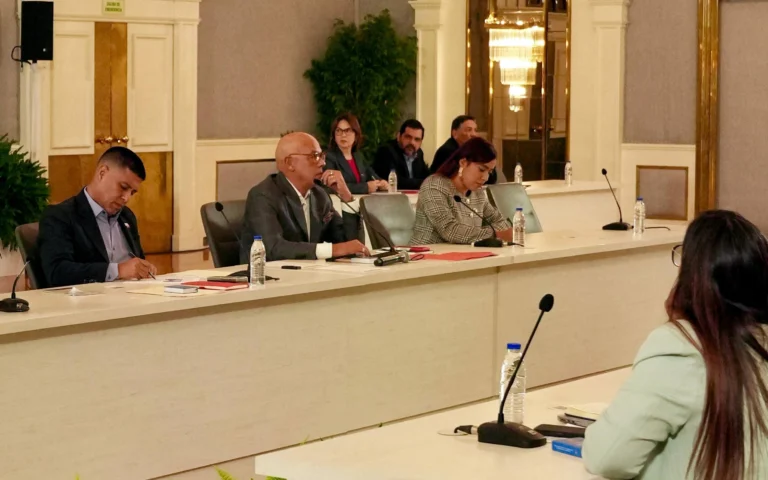
Venezuela government opposition dialogue advances with a freedom-of-expression table, portal access restored and a joint commission to monitor agreements.
Related: Venezuela Resumes Primary Aluminum Exports to U.S. After Almost a Decade
Venezuela Government Opposition Dialogue Advances in Caracas
The Venezuela government opposition dialogue concluded its second day on Friday, September 18, with the two delegations announcing new mechanisms for addressing freedom of expression, access to information, and implementation of their commitments.
The talks form part of the second cycle of negotiations between representatives of the national government and former lawmakers associated with Venezuela’s 2015 National Assembly.
The delegations issued a joint statement welcoming the government’s decision to lift restrictions on access to several digital news portals. They described the measure as a step toward strengthening access to information.
The statement also announced the creation of a Technical Table for Freedom of Expression, Plurality of Thought, and the Right to Information.
According to the document, the new body will begin a process of consultation, establish guarantees, and verify progress with the participation of relevant actors and the wider community.
The talks are scheduled to remain in permanent session until Wednesday, September 23, when the delegations are expected to provide further information on the agreements reached during this phase.
The announcement represents one of the clearest concrete outcomes of the latest Venezuela government opposition dialogue. It also gives civil society organizations, journalists, digital media outlets, and community groups a formal space to raise concerns and evaluate progress.
The delegation representing the government is headed by Jorge Rodríguez, president of Venezuela’s National Assembly. He is accompanied by Higher Education Minister Ana María San Juan and lawmakers Jorge Arreaza, América Pérez, Génesis Garvett, and Pedro Infante.
The delegation linked to the 2015 National Assembly is led by former lawmaker Dinorah Figuera. Its members include Marco Aurelio Quiñones, Ramón López, Jorge Millán, Juan Miguel Matheus, and Sergio Vergara.
The presence of representatives from both sides reflects an attempt to establish a structured channel for dialogue despite the country’s longstanding political divisions.[telesurenglish][dw]
The two delegations also agreed to create a parity-based follow-up commission responsible for monitoring compliance with the agreements and commitments made during the negotiations.
The commission is expected to track progress, identify obstacles, and help ensure that commitments do not remain limited to political declarations.
Venezuela Government Opposition Dialogue Focuses on Expression and Information
Read teleSUR English’s report on the second day of talks and the new technical table.
The Venezuela government opposition dialogue began its second cycle on September 17 in Caracas. Its agenda includes civil and political guarantees, freedom of expression, judicial reform, electoral institutions, and the implementation of agreements reached during the first cycle.
The creation of the technical table on freedom of expression responds to one of the most contested areas in Venezuelan politics. Government authorities have defended their actions as measures against destabilization and foreign interference, while opposition groups and media organizations have raised concerns over censorship, blocked websites, and restrictions on public debate.
The joint statement’s reference to plurality of thought is significant because it expands the discussion beyond access to news platforms. It also covers the conditions required for different political, social, and ideological positions to participate in public life.
The technical table is expected to examine guarantees for journalists, digital outlets, political parties, civil society organizations, and citizens seeking access to information.
The decision to lift restrictions on digital portals has been welcomed by the participants as a preliminary confidence-building measure. However, the dialogue will need to address the procedures used to block websites, the possibility of future restrictions, and mechanisms for reviewing complaints.
The follow-up process could become a test of whether the Venezuela government opposition dialogue can produce verifiable institutional changes.
A technical body will only have a lasting effect if its recommendations are made public, if its members can operate independently, and if government institutions respond to documented concerns.
The negotiations also take place amid a broader debate over political guarantees. Opposition representatives have sought assurances for political participation, civil liberties, and the exercise of rights.
Government representatives have emphasized the need to protect national sovereignty and prevent political actors from supporting foreign intervention or violent destabilization.
The challenge is to define guarantees that protect political activity without allowing external governments or armed groups to determine Venezuela’s internal affairs.
The talks also include discussion of judicial reform and the strengthening of democratic and electoral institutions. During the first cycle, the two sides approved a methodology for institutional cooperation and established two technical working groups.
One group addressed the emergency caused by the double earthquake of June 24. The other focused on democracy, the judicial system, the electoral branch, political guarantees, and civil rights.
The current cycle builds on those initial arrangements. Its broader objective is to convert dialogue into a process with identifiable commitments, deadlines, and monitoring procedures.
The role of the follow-up commission will be particularly important as the delegations address issues that have generated years of political confrontation.
The Venezuela government opposition dialogue also has an international dimension. The latest negotiations have been supported by the United States, which has encouraged political discussions as part of efforts to reduce tensions and reopen channels for economic engagement.
External involvement may help provide guarantees, but it can also create disagreements over sovereignty, the role of foreign governments, and the conditions attached to potential economic measures.
Earthquake Recovery and Venezuelan Gold Reserves
Read Reuters’ report on the possible transfer of Venezuela’s gold reserves held in the United Kingdom.
The first cycle of the Venezuela government opposition dialogue concluded on August 12. The delegations agreed to prioritize assistance for communities affected by the June 24 earthquake and to work toward recovering Venezuelan international reserves held at the Bank of England.
The resources recovered would be used for priority programs involving housing, electricity, medical care, and debris removal in the areas affected by the disaster.
The first cycle also established the principle that any recovered funds should be administered under strict mechanisms of transparency, traceability, and auditing.
The issue has become one of the most important practical components of the political dialogue. It gives both sides an opportunity to cooperate on a humanitarian matter while avoiding immediate agreement on all political disputes.
The Bank of England has held approximately 31 metric tons of Venezuelan gold, whose value has risen to roughly $4 billion. The reserves have remained frozen amid the dispute over which Venezuelan authorities should control them.
According to people familiar with the negotiations, the government and a faction of the opposition are discussing a possible transfer of the gold to a U.S.-controlled account in New York. The funds would be subject to external audits and could be used to support reconstruction after the earthquakes.
The reported arrangement has not been finalized. Questions remain regarding legal control, the role of the United States Treasury, the conditions for accessing the funds, and the institutions responsible for managing them.
The Venezuelan government has said the gold belongs to the Venezuelan people and should be used to address urgent social needs. The opposition delegation has supported a monitored mechanism intended to prevent misuse and guarantee that the resources reach affected communities.
The earthquake recovery agenda gives the Venezuela government opposition dialogue a humanitarian dimension. It also introduces a difficult test of trust because the resources involved are significant and the country’s political factions have little confidence in one another.
The proposed oversight mechanisms include financial audits, traceability requirements, and public accountability. If implemented effectively, they could demonstrate that rivals can cooperate on emergency assistance even while disagreeing on national political issues.
The recovery plan includes rebuilding homes, restoring electrical service, providing medical support, and clearing debris from areas affected by the June earthquake. These needs are immediate, while the legal and financial process for recovering the reserves may take time.
The negotiations therefore face pressure to establish interim measures that can provide assistance before the full asset-recovery process is complete.
Geopolitical Context: Dialogue, Sovereignty, and External Assets
The Venezuela government opposition dialogue is unfolding amid a wider effort to reshape the country’s political and economic relations with the international community.
The negotiations involve representatives of the government and a faction associated with the 2015 National Assembly. They do not include every opposition group, including some of the most prominent figures who have rejected the current process.
That limited participation may affect the legitimacy and durability of any eventual agreements. A political settlement will require broader inclusion if it is to resolve Venezuela’s institutional crisis rather than simply create a temporary arrangement between two factions.
At the same time, the dialogue could help reduce tensions by establishing communication between actors who previously refused to recognize one another.
The discussions also have consequences for Venezuela’s economic future. The possible release of gold reserves, combined with negotiations over oil investment and international sanctions, could provide the government with greater access to financing.
However, the involvement of foreign governments in the management of Venezuelan assets raises questions about sovereignty. Caracas insists that national resources should remain under Venezuelan control, while external actors have demanded oversight as a condition for releasing or unfreezing funds.
The Bank of England gold dispute illustrates how political recognition can affect the control of state assets. Legal decisions in Britain and other countries have been shaped by competing claims over Venezuela’s legitimate authorities.
The proposed transfer to a U.S.-controlled account may provide a compromise, but it could also generate criticism from sectors that oppose foreign control over national reserves.
The freedom-of-expression agenda carries comparable geopolitical weight. Digital restrictions have been cited by critics as evidence of authoritarian governance, while Venezuelan officials argue that some platforms have been used to coordinate destabilization and foreign-backed operations.
The new technical table will have to address both concerns: protecting access to information while recognizing the country’s security and sovereignty claims.
For the United States, the dialogue offers a path toward political stabilization and possible economic normalization. For Venezuela, it provides an opportunity to seek the removal of sanctions and recover assets held abroad.
For the opposition, negotiations can create space for political participation and institutional guarantees. For the government, they can reduce external pressure without surrendering control over the country’s political system.
The success of the Venezuela government opposition dialogue will depend on whether the parties can transform broad commitments into measurable results. The restoration of digital access, the operation of the technical table, the monitoring commission, and progress on earthquake recovery will all serve as early indicators.
The delegations remain in session until September 23. By then, they are expected to report on progress in freedom of expression, political guarantees, institutional reform, and the administration of resources for affected communities.
From teleSUR English via This RSS Feed.