

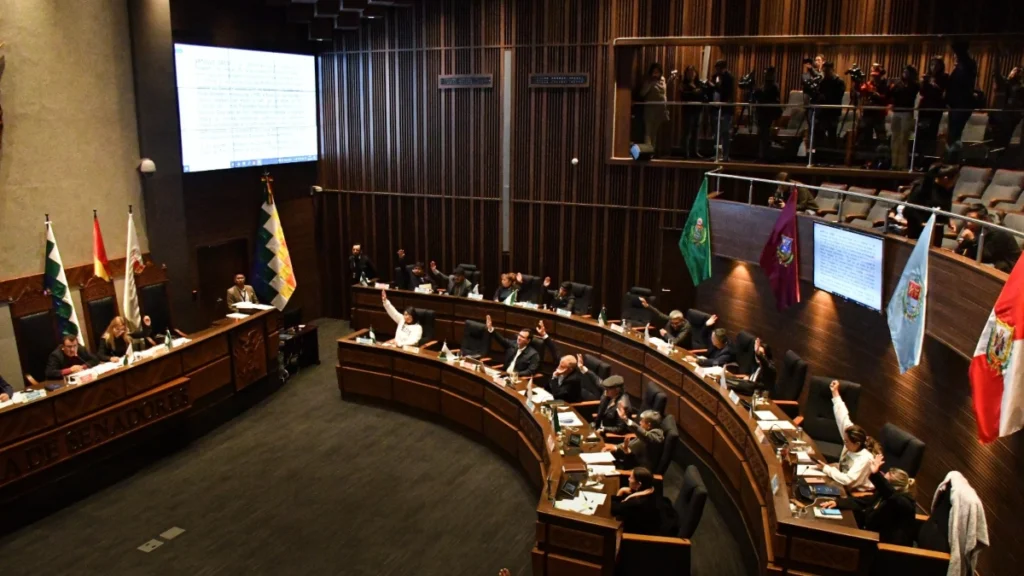
Bolivia’s Senate sanctioned a $1.9 billion financial agreement with the International Monetary Fund (IMF) on Friday to back the economic reforms of Rodrigo Paz’s right-wing government.
The measure was approved in an ordinary session by more than two-thirds of those present and is now ready to be sent to the Executive Branch for promulgation. The legislative process advanced after the upper chamber approved a waiver of procedure at the request of Senate President Diego Ávila, following prior review in the Chamber of Deputies.
RELATED: Bolivia Extends State of Exception Amid Protests Against Neoliberal Measures
During the plenary session, Economy and Public Finance Minister Christian Morales attended the chamber to detail the scope of the loan bill. He said that the funds from the multilateral body, equivalent to 1.369 billion special drawing rights (SDRs), will be used to “stabilize the economy, international reserves and the balance of payments,” ruling out their use for current spending.
The financing provides for a repayment period of up to 10 years from each disbursement, with an amortization period beginning after four years and six months and a disbursement margin of up to 36 months. The initial interest rate was set at 3.47%, which may vary according to the SDR quote.
The approval consolidates the agreements formalized last July 29 between the Bolivian State and the IMF to address fiscal and external imbalances accumulated in recent years.
Among the commitments assumed by the State before the international body is the elimination of the fuel subsidy starting in 2027, meaning the current fixed prices will be maintained until December of this year.
However, during a press conference, Vice President Edmand Lara — at odds with the head of state — said Friday that he has “unofficial” information that President Rodrigo Paz will remove the fuel subsidy “totally” in the coming hours.
#Bolivia | Bolivia has extended its state of emergency for another 90 days amid government warnings that protests and road blockades could resume.
The legislature approved the extension Thursday by 100 votes to 58.#LatinAmerica #teleSUREnglish pic.twitter.com/vhlbOVOHi2— teleSUR English (@telesurenglish) September 18, 2026
Last week, former President Evo Morales called the agreement “a betrayal of the homeland” and denounced that it violates the Political Constitution of the State (CPE). Through his social media, the former leader stated: “The agreement between the government and the IMF is unconstitutional and a betrayal of the homeland. Art. 320 of the CPE prohibits foreign impositions and conditioning on our economic policy.” He maintained that, under the pretext of attracting foreign investment and eliminating the fuel subsidy, the Executive seeks to modify the constitutional order to privatize and hand over the country’s natural resources to transnational corporations.
The former leader rejected the government’s announcement about the closure of 10 public companies — whose identities have not yet been revealed — considering it represents a new stage of privatization aimed at “selling Bolivia.”
From teleSUR English via This RSS Feed.