

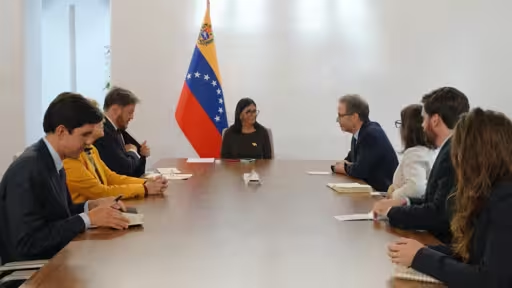
Caracas (OrinocoTribune.com)—On Thursday, Venezuela’s Acting President Delcy Rodríguez received a senior Human Rights Watch (HRW) delegation at Miraflores Palace. She granted the US-based organization renewed high-level access and visibility, despite decades of questioning its independence, financing, and political role by Chavista officials, Global South governments, Nobel Peace Prize laureates, and international human rights advocates.
The delegation was headed by HRW Deputy Executive Director and Chief Programs Officer Federico Borello. Foreign Minister Félix Plasencia, Deputy Foreign Minister Oliver Blanco, and Executive Secretary of the Program for Peace and Democratic Coexistence Ana María Sanjuán also participated.
According to the official report, the meeting formed part of Venezuela’s efforts to strengthen human rights, promote plural expression, and consolidate democratic coexistence. It was also presented as evidence of Venezuela’s willingness to coordinate with international organizations.
However, HRW is not a multilateral or intergovernmental organization. It is a private advocacy group headquartered in New York whose reports and actions have long reinforced regime-change pressure from Western governments, corporate media, and institutions involved in exerting political pressure against the Bolivarian Revolution.
Thursday’s reception marked HRW’s first official high-level visit to Venezuela in 18 years, giving the organization its most important institutional platform in the country since 2008.
HRW uses visit to renew pressure on VenezuelaFollowing the meeting, HRW acknowledged that Venezuelan authorities had released hundreds of detainees, approved an amnesty law, restored access to some media websites, and announced reforms involving the Supreme Tribunal of Justice and the National Electoral Council.
Borello also recognized that Rodríguez’s administration had overseen what he called a “pause in the most overt forms of repression.” Nevertheless, HRW demanded the release of everyone it classifies as a political prisoner, changes to Venezuela’s security institutions, and the repeal or amendment of anti-terrorism, anti-hatred, and media regulations.
Chavista analysts and victims of crimes perpetrated by those whom HRW labels as “political prisoners” argue that reconciliation is one thing, but impunity is another. They complain that the Venezuelan government under Delcy Rodríguez’s leadership has already granted too many benefits to far-right people imprisoned for serious crimes.
HRW also endorsed figures supplied by Foro Penal, a far-right, opposition-aligned Venezuelan organization, claiming that at least 344 people it considers political prisoners remained incarcerated. HRW further called for changes that would allow opposition politicians to participate in future elections and urged the continuation of the controversial United Nations Fact-Finding Mission in Venezuela.
Most notably, the organization concluded its post-visit statement by declaring that “the United States should use its leverage to play a leading role” in pushing for what HRW considers meaningful human rights changes in Venezuela.
The appeal to Washington is especially contentious barely eight months after the US military bombed Venezuelan territory and kidnapped President Nicolás Maduro and First Lady and National Assembly Deputy Cilia Flores. Over 100 people were killed during the January 3 military operation, including 32 Cuban and 47 Venezuelan service members, according to official figures.
For Chavista analysts, calling upon the power responsible for that attack to exercise additional “leverage” over Venezuela illustrates why HRW’s claims of political neutrality and independence have long been treated with skepticism.
The official Venezuelan account did not indicate whether Rodríguez challenged HRW over its description of the January 3 attack, its past support for sanctions, or its repeated reliance on organizations aligned with Venezuela’s far-right opposition.
A record of sanctions advocacyThe meeting also marked a sharp departure from the position adopted by Venezuela in September 2008, when HRW Americas Director José Miguel Vivanco and researcher Daniel Wilkinson were expelled after presenting a report accusing President Hugo Chávez’s government of undermining democracy.
Venezuelan officials accused the organization’s representatives of illegally interfering in the country’s internal affairs. HRW, for its part, described the expulsion as an attack on human rights monitoring.
During the following years, senior HRW officials repeatedly advocated sanctions against Venezuela and other leftist Latin American governments. Vivanco welcomed several rounds of US sanctions and publicly urged European governments to follow Washington’s example, arguing that “targeted sanctions” were the only language the Venezuelan government understood.
He also dismissed warnings issued by United Nations experts that unilateral coercive measures would worsen Venezuelans’ access to food, medicine, and essential services. HRW maintained that sanctions against officials did not harm the broader population, despite a documented effect demonstrating the contrary.
In its latest statement, HRW stated that it had long expressed concern about sanctions worsening Venezuela’s humanitarian situation. That claim contrasts with the public record of its former regional leadership lobbying for additional coercive measures and defending them from criticism.
Questions over funding and independenceHRW states that it refuses direct government funding and carefully reviews private donations to protect its independence. Nevertheless, critics have argued that the scale and political interests of its private donors, together with its institutional links to Washington, complicate that claim.
In 2010, billionaire financier George Soros pledged $100 million to HRW through the Open Society Foundations—the largest donation in the organization’s history. One of HRW’s co-founders, Aryeh Neier, later served as president of the Open Society Foundations.
Concerns about HRW’s independence have not been limited to Chavista or socialist governments. In 2014, Nobel Peace Prize laureates Adolfo Pérez Esquivel and Mairead Maguire, former senior UN official Hans von Sponeck, and over 100 academics and human rights advocates signed an open letter criticizing the organization’s “revolving door” with the US government.
The signatories cited officials who moved between HRW and the US State Department, National Security Council, and intelligence-linked institutions. They argued that these connections contributed to double standards in HRW’s treatment of Washington’s military interventions and the actions of governments targeted by US foreign policy.
Orinoco Tribune previously examined HRW’s financing, institutional links, and advocacy for sanctions against Venezuela and Nicaragua.
Foreign Affairs Minister Plasencia Denounces New HRW Report as Attack Against Venezuela
Dialogue with international organizations can provide Venezuela with opportunities to challenge hostile narratives and present its own evidence. However, critics within Chavismo are likely to question why HRW received a presidential-level reception without any public indication that its past support for coercive measures, its selective reporting, or its treatment of the January 3 US attack were addressed during the meeting.
Orinoco Tribune Special by staff
OT/JRE/SF
From Orinoco Tribune via This RSS Feed.