

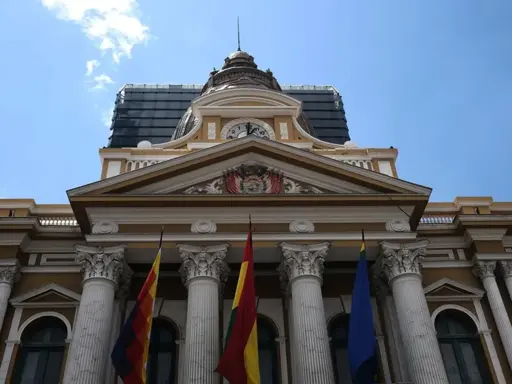
Economic analysts warned that Bolivia could face severe conditions to secure the proposed $1.9 billion loan from the International Monetary Fund (IMF). These reportedly include eliminating fuel, electricity, and gas subsidies, as well as lifting price controls on basic food products.
Days earlier, President Rodrigo Paz’s right-wing government sent the Bolivian Legislative Assembly a memorandum of understanding with the IMF to access that financing, which, if approved, would be disbursed over the next three years. Among its central goals, the document outlines reducing the fiscal deficit from 9.1% to 3.8% by 2028 through a program that includes the total elimination of state subsidies, absolute price liberalization, and a wage freeze in key public administration sectors.
Bolivia extiende el estado de excepción hasta diciembre tras la aprobación de la Asamblea Legislativa, mientras se anuncian nuevas protestas contra las políticas de Rodrigo Paz. ¿Qué implica esta prórroga para el país?
Entra al enlace y conoce los detalles… pic.twitter.com/qI5KZpHZOx
— teleSUR TV (@teleSURtv) September 17, 2026
One of the IMF’s demands is the definitive cancellation of fuel subsidies, set for January 2027. Economic analyst Gonzalo Colque warned about this mechanism’s inflationary dynamics: after a 100% increase last December (from 3.7 to nearly 7 bolivianos per liter), the price adjusted when the official dollar reached 12 bolivianos.
He warned that if demand for foreign currency pushes the exchange rate to 18 bolivianos per US dollar, the official rate could quickly become outdated, lagging behind market pressures by as much as six months.
As a cautionary precedent, he cited Egypt, which entered into an IMF agreement similar to the one proposed for Bolivia. Egypt has doubled its debt to the IMF over the past five years and is undergoing its eighth round of adjustments without closing the gap between the official and parallel exchange rates.
The agreement also stipulates the gradual elimination of subsidies for electricity and household gas, the suspension of price controls on the basic food basket, and the total liberalization of food exports.
Additionally, it contemplates the Central Bank’s purchase of foreign currency from private banks, a factor that would drive further devaluation of the national currency and increase the cost of living. Economists have stated that these measures would negatively impact the working class, with a wage freeze for teachers, medical personnel, police, and the military in addition to rising interest rates.
The memorandum itself warns of the imminent risk of a “reawakening of social unrest” due to deteriorating purchasing power, despite the planned delivery of temporary bonuses as mitigation.
The agreement establishes openness and full guarantees for transnational corporations to invest in strategic sectors such as hydrocarbons, mining, lithium, rare earths, and telecommunications, which would require constitutional changes.
Venezuela Hosts Strategic Dialogue With IMF Mission in Caracas
Although Bolivia’s Ministry of Economy defended the package as an exercise in “economic responsibility” rather than an external imposition, the text commits the State to coordinating directly with International Monetary Fund (IMF) technicians to determine the dollar exchange rate and introduce new taxes.
Legislative approval of this fiscal agenda would, in turn, condition the disbursement of an additional $3 billion in loans—and therefore new debt—from the Inter-American Development Bank (IDB), the Development Bank of Latin America and the Caribbean (CAF), and the World Bank.
(Telesur)
Translation: Orinoco Tribune
OT/JRE/SF
From Orinoco Tribune via This RSS Feed.