


Darren Thompson
Special to ICT
LENAPEHOKING — Indigenous New York Fashion Week’s second annual production made historic firsts for Indigenous fashion designers at this year’s New York Fashion Week.
It is the first listing of an Indigenous-produced event on the official schedule of New York Fashion Week calendar, placing Indigenous designers from around the globe in the official listing of designers for this year’s infamous New York Fashion Week.
New York City Mayor Zohran Mamdani kicked off the event with a letter that was shared with Indigenous New York Fashion Week organizers. Organizers read the letter during the opening show on Friday, Sept. 11. He congratulated the event for its inclusion in the Council of Fashion Designers of America’s fashion week calendar, calling it a historic first for Indigenous fashion designers.

T.O.C. Legends House of Design showcases at the 2nd annual Indigenous New York Fashion Week during Runway 5, Luxury, on Sunday, Sept. 13, 2026. (Darren Thompson/ICT)
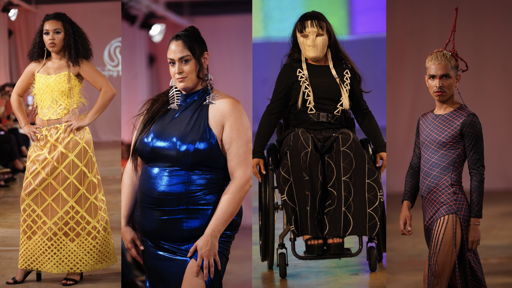
The event was hosted at the American Indian Community House in the Garment District, near Times Square, and brought more than 100 models, a fully Indigenous-led production team, and performers representing many Indigenous cultures to sold-out shows throughout the weekend. Their designs showcased traditional regalia such as beadwork, quillwork, ribbonwork, couture and luxury wear through six themes: Contemporary Culture, Emerging Voice, Knowledge Keepers, Thought Leaders, Luxury and Couture.
“Indigenous New York Fashion Week in New York City was more than a celebration of fashion — it was a celebration of Indigenous culture, creativity, identity, and community,” Patricia Tarrant, the American Indian Community House’s executive director, told ICT. “ It was especially meaningful to have this gathering take place at the American Indian Community House, a space dedicated to serving, supporting, and bringing together Indigenous people in New York City since 1969.”
Indigenous New York Fashion Week was co-founded by Korina Emmerich, Puyallup, and Liana Shewey, Mvskoke, in 2025, where they continue to serve as executive directors. They also serve as co-founders and executive directors of Relative Arts, an Indigenous-owned community arts organization and creative hub based in New York City. Together, they founded Indigenous New York Fashion Week as a nonprofit organization to create a global platform that amplifies Indigenous designers, artists, and storytellers while building opportunities for Indigenous creatives in the fashion industry.
This year’s Indigenous New York Fashion Week had several notable differences from its debut last year, including the venue space, which was entirely hosted at the American Indian Community House in New York City’s Garment District, an official listing on the Council of Fashion Designers of America’s New York Fashion Week Calendar, and runway presentations livestreamed by the council at Rockefeller Center. The council owns and curates the official New York Fashion Week schedule and each designer and their information is listed in the official schedule along with every other fashion designer in the New York Fashion Week calendar.

Creator Complex showcases at the 2nd annual Indigenous New York Fashion Week during Runway 4, Thought Leader, on Saturday, Sept. 12, 2026. (Darren Thompson/ICT)
New York Fashion Week is part of the “Big Four” of the fashion industry, where New York, London, Milan and Paris are considered the four major global fashion weeks. Shows take place throughout New York at galleries, warehouses, hotels, landmarks and other venues and happen twice a year, one in February and one in September.
“Indigenous New York Fashion Week marks a shift in attention toward Native design and places Indigenous fashion on a global stage in the fashion capital of America,” Amber-Dawn Bear Robe told ICT. “New York City is witnessing the emergence of an Indigenous fashion community with incredible energy, creativity, and momentum.”
Bear Robe is an assistant professor of Native and Indigenous Art History and Material Culture at Parsons School of Design in New York City, the top design school in the country. Prior to her tenure at Parsons, she was the Southwestern Association of Indian Arts’ fashion show curator during the Santa Fe Indian Market for 10 years, eventually launching the inaugural Santa Fe Native Fashion Week in 2025.
“This is a moment that people will want to be part of — a moment where new connections are being made, new possibilities are taking shape, and something much bigger is beginning to unfold,” Bear Robe said. “It was deeply fulfilling to be part of this community and to witness this movement taking shape from the ground up.”

A look during Relative Arts’ runway presentation on Friday, Sept. 11, 2026. Relative Arts opened for the 2nd annual Indigenous New York Fashion Week, Sept. 11-13, 2026. (Darren Thompson/ICT)
For many designers, the opportunity to showcase at Indigenous New York Fashion Week is not taken lightly. From production design to display on the runway, each designer brought their own flair, expression, and original designs that premiered for the event.
Michael Chapman, an enrolled member of the Bad River Band of Lake Superior Chippewa and designer of Nonomey Designs, said that representing his work at New York Fashion Week for the first time is a highlight of his career. His designs feature up-cycled garments, decorated with messaging and stories that speak to survival, the experience of being a missing and murdered Indigenous relatives family, and the unfinished work of sovereignty.
“The Tuscaroras are the people of the cloth, it means the world to represent at New York Fashion Week showing my hand-crafted beaded blazer,” Chapman said. “Fashion has always been my voice, it’s an honor to be heard and seen during such an accredited time with Indigenous New York Fashion Week on the CFDA calendar.”
Rebekah Jarvey, a Chippewa-Cree fashion designer from Rocky Boy, Montana, also showcased for Indigenous New York Fashion Week for the first time and also celebrated a milestone — her 99th fashion showcase.
“Indigenous New York Fashion Week was deeply meaningful for me,” she said. “I just finished my 99th fashion show, and this one stands out as one of the best experiences of my career. Showing in the fashion mecca of the world – surrounded by Indigenous designers, models, artists, and relatives from more than a hundred nations created a powerful sense of community as we brought Native fashion into the concrete jungle to celebrate our stories, creativity, and visibility.”

Pre-show anticipation for the opening runway show on Friday, Sept. 11, at the American Indian Community House in New York City. (Darren Thompson/ICT)
Delvene Cockatoo-Collins, a designer from Terrangerri North Stradbroke Island in Australia, told ICT that showing at Indigenous New York Fashion Week is a larger than life experience.
“I”m a long way from home, so to be welcomed here first was a really important part of bringing my sons and collection from the island,” she said. “To be amongst Indigenous designers and artists from around the world to Lenapehoking and show those stories in my work, was more than I imagined. It shows as First Peoples of how similar we are in the way we carry those stories of our home, family, and cultures through design and fashion.”
Beyond runway shows, Indigenous New York Fashion Week also organized pop-up markets, brand announcements, VIP events, designs talk, and concerts throughout the city.
Designers and brands that were featured in the runway productions were Copper Canoe Woman, Hakhu, Josh Tafoya, Kené Kaya, Mobilize waskawewin, Bineshii creations, SIQUICHA, Creator Complex, TXYZ, Homeland, Enfant_Martyr, Kene Kaya, Goompi’s Girl, Upon a Dreamer, Himikalas, and more.
The event producers, Relative Arts, opened the runway shows on Friday. Partners include Decolonizing Wealth Project, The Scherman Foundation, Made In NYC, The Urban Indigenous Collective, Indigiqueer Creative Alliance, Lenape-owned Teton Trade Cloth, Mr. Smith, and community partner, American Indian Community House.
“Holding Indigenous Fashion Week within an Indigenous community center reminds us of the importance of having spaces where our people can gather, create, celebrate, and share our cultures on our own terms,” Tarrant said. “It also reminds us of the importance of supporting and investing in the places that continue to provide a home for Indigenous people in New York City.”
Darren Thompson is a multi-media journalist enrolled at the Lac du Flambeau Band of Lake Superior Chippewa in Northern Wisconsin, where he grew up. He covers breaking news, missing and murdered Indigenous people, environmental and social justice, tribal sovereignty, art, music, and film. He can be reached through his website, www.darrenthompson.net.
The post Indigenous New York Fashion Week returned for second year appeared first on ICT.
From ICT via This RSS Feed.