

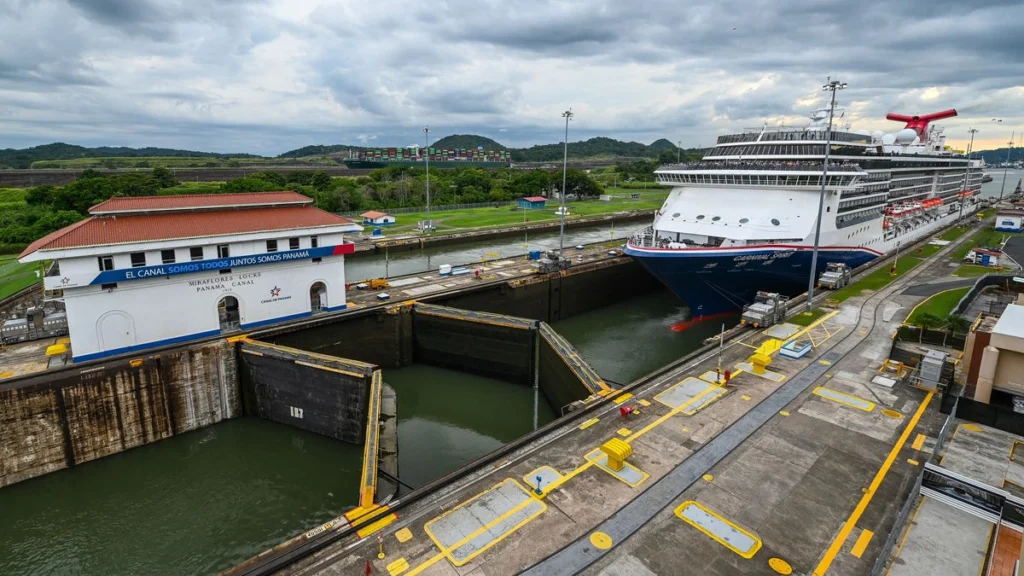
David Sedda, Financial Controller for the Panama Canal Authority’s Finance Vice Presidency, presented an estimate this Friday during a discussion organized by the Panamanian Association of Business Executives (Apede).
RELATED:
Colombia Flags Over 500 Areas at High El Niño Risk
The Panama Canal could lose between $225 million and $400 million in net revenue during fiscal year 2027 due to operational restrictions linked to reduced water availability caused by the El Niño phenomenon, Sedda warned.
According to the official, the economic impact could be partially offset by additional revenue—ranging from $75 million to $200 million—generated through toll rates, auctions, and other sources. However, reduced vessel traffic and cargo volume would limit the waterway’s ability to maintain its usual revenue levels.
Fewer transits and less cargo
The Panama Canal projects 10,750 transits by deep-draft vessels in fiscal year 2027, which begins on October 1, 2026. This figure represents an 11 percent decrease—or 1,265 fewer transits—compared to fiscal year 2025.
Regarding cargo, projections indicate a reduction of 32 million tons (a 7 percent drop) from the 484 million tons moved in 2025, based on the metric the Canal uses to track such operations.
Currently, the waterway accommodates about 32 vessel transits per day, down from the 38 to 40 transits it can handle under normal conditions. These limitations stem from the water levels required to ensure sufficient draft for the vessels. Neopanamax vessels account for between 55% and 60% of the Canal’s earnings, as they require higher water levels to operate at their designated draft. Consequently, a prolonged reduction in water inflow could directly impact the interoceanic route’s revenue.
According to the financial comptroller, extended restrictions could prompt shipping companies to alter their routes, opting for longer and more costly alternatives.
“If this route becomes unreliable, shipping companies won’t plan for medium- or long-term routes via Panama, knowing there is no guarantee they will be able to transit,” he warned.
By way of example, Sedda explained that a voyage between Panama and Korea—normally taking about 26 days via the Canal—could extend to 40 days if routed around the Cape of Good Hope. For a Neopanamax vessel, this detour would entail a cost of nearly $407,000, while for a bulk carrier, it would reach approximately $150,000.
On the route between Shanghai and the U.S. East Coast, a container ship’s transit time could increase from 23 days via Panama to between 28 and 35 days using alternatives such as the Suez Canal or the Cape of Good Hope. Additional costs are estimated at between $439,000 and $796,000, excluding insurance and other commercial impacts.
#EcoNews | Desafíos del Canal de Panamá fueron analizados en el Foro de Competitividadhttps://t.co/uBrndqp1dq
— ECOtvPanamá (@EcoPanamaTV) September 17, 2026
The text reads, “Panama Canal challenges were analyzed at the Competitiveness Forum.”
Rainfall deficit and historical context
Sedda reported that rainfall between May and August was 34% below average, while water inflow into the Canal’s watershed was 44% below normal levels.
Climatic conditions could necessitate maintaining or tightening operational restrictions, affecting both the number of vessels able to traverse the waterway and the volume of cargo transported. Water availability is a critical factor for the operation of the locks and the navigation of larger vessels. The official noted that the risk is not limited to a temporary drop in revenue; the Panama Canal’s reputation for reliability as a route for international trade is also at stake.
“A key point I want to convey here is the reliability offered by the Canal route; it is important to sustain, strengthen, and maintain it so that the business endures and ensures continuity over time,” Sedda stated.
During the 2024 drought, the Canal lost 2,700 transits—representing a 21 percent reduction—and failed to move 88 million tons of cargo.
The economic impact of the volume decline was estimated at $827 million. However, increased tolls and the effect of auctions generated a positive variance of $859 million, resulting in a favorable net outcome of $33 million.
#Panama | The Panama Canal’s Neopanamax locks, in service since June 2016, began operating with a reduced draft of 49.5 feet as a preventative measure against a strong El Niño phenomenon that could last until 2027.https://t.co/nWxXUyTGUE
— teleSUR English (@telesurenglish) July 6, 2026
From teleSUR English via This RSS Feed.