

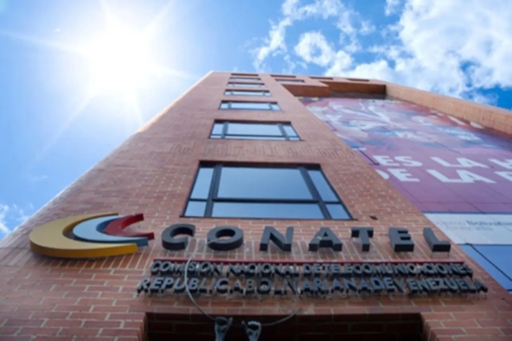
Caracas (OrinocoTribune.com)—Venezuela’s National Telecommunications Commission (CONATEL) has instructed internet service providers to restore access to various national and international digital media outlets, including several far-right portals reported by Chavista analysts to be supporting and amplifying Washington’s regime-change operations against the Bolivarian government.
CONATEL announced the measure in an official statement this Thursday, September 17. Internet providers operating in Venezuela subsequently received technical instructions to enable access to the affected domains through their network infrastructure.
The telecommunications authority claimed the decision would once again guarantee the direct availability of the news platforms within Venezuela. It also reaffirmed its responsibility to supervise the sector and ensure “safe, orderly, and adequate” access to information and communication services.
CONATEL did not identify the outlets included in the measure, nor did they specify how many domains were restored.
Esto que dice @NANANROJA es muy cierto: No hay NADA que la oposición haya querido difundir, que no se haya difundido. Todos los días uno tiene que enterarse de lo último que dijo María Corina, así uno no quiera enterarse de lo que diga esa señora.
Se hace mucha bulla por el… https://t.co/A2Yl3q1txE
— Luigino Bracci Roa (@lubrio) September 17, 2026
USAID-financed Efecto Cocuyo reported, citing the internet monitoring organization VE sin Filtro, that access had been restored so far to at least ten outlets. The reported list included Efecto Cocuyo itself, as well as El Pitazo, Runrunes, Crónica.Uno, El Estímulo, Caraota Digital, Monitoreamos, AlbertoNews, Spain’s EFE news agency, and Colombia’s Semana magazine.
The report also claimed that more than 200 domains, including approximately 90 news websites, remained subject to some form of restriction. Those figures were produced by VE sin Filtro and were not confirmed in CONATEL’s official announcement.
Aporrea has also appeared in reports concerning the restoration of access. Unlike most of the opposition platforms involved, Aporrea originated as a left-wing alternative outlet. However, some Chavista analysts suggest that its increasingly anti-government editorial orientation has led it to converge with the far right in its attacks against Chavismo.
The measure also prompted criticism from within Chavismo, although for reasons very different from the accusations advanced by the far-right outlets. Chavista communicator Luigino Bracci argued that blocking the websites had little practical effect on the circulation of opposition messaging. According to Bracci, virtually everything the opposition wanted to communicate continued to receive widespread exposure, to the point that Venezuelans were constantly confronted with statements by far-right leader María Corina Machado even when they had no interest in hearing them.
Bracci explained that news websites are no longer the principal distribution channel for many outlets, which obtain much of their readership and visibility through foreign-owned platforms such as Instagram, Facebook, TikTok and X. Some digital media organizations, he noted, operate almost entirely through social networks. Chavista social media user Nanan, whose comment prompted Bracci’s response, similarly observed that she had not even realized opposition websites were blocked because their messages continued to circulate “to the point of exhaustion,” particularly among Venezuelans who did not want to receive them.
The two commentators also highlighted what they viewed as a paradox: while the opposition remained highly visible despite the website restrictions, the Venezuelan government often struggled to communicate its policies, achievements, and public programs effectively. Bracci suggested that, in practical terms, the government sometimes appeared to be the censored party because large sections of the population remained unaware of its work. Their observations present the previous blockades as a politically costly but strategically ineffective measure, since opposition outlets could exploit them to allege censorship without suffering a meaningful reduction in their reach.
National dialogue initiative
The decision came just hours after the Program for Peace and Democratic Coexistence initially recommended eliminating restrictions on the domains of national and international media outlets.
The program said the measure would contribute to “greater and better communication, transparency, diversity, and pluralism.” Its recommendations followed working groups and consultations involving representatives of public, private, and alternative media, as well as digital content creators.
The initiative is part of a broader national dialogue promoted by the government of Acting President Delcy Rodríguez to reduce political tensions and strengthen peaceful coexistence.
The restrictions had been imposed during years of intense political confrontation and repeated US empire-backed destabilization operations. Several of the affected media outlets openly supported the self-proclaimed “interim government” of Juan Guaidó, promoted coercive measures against Venezuela, or amplified narratives used by Washington to justify sanctions and other regime-change actions.
Venezuelan officials and media researchers have also condemned the financing of opposition organizations and media projects through US and European government-linked “democracy promotion” programs. The outlets affected by the restrictions, being backed by these imperial powers, have characterized the measures as censorship.
It remains unclear whether Thursday’s measure applies uniformly across all internet providers or whether additional domains will be restored.
Public Ministry reinforces presumption of innocence
In a related institutional development, Venezuelan Attorney General Larry Devoe announced on Wednesday that he had ordered the removal of social media posts that displayed images of detained people or directly presented them as responsible for crimes without a criminal conviction.
Devoe instructed the Public Ministry’s Directorate of Institutional Relations to remove the material from all of the institution’s official social media accounts.
“Every person is innocent until proven guilty in a court of law,” the attorney general reaffirmed. He emphasized that the presumption of innocence “is not a formality,” but rather a constitutional right that the Public Ministry is obligated to guarantee.
The institution also reaffirmed its commitment to transparent and objective justice, respect for due process and the preservation of human dignity.
The Public Ministry’s practice of publicly displaying people detained during criminal investigations became frequent under former Attorney General Tarek William Saab. Some Venezuelan legal specialists objected to the practice on due process grounds, while its defenders argued that it emerged in the context of extreme political polarization, violent destabilization campaigns and successive US empire-led regime-change operations.
These new guidelines seek to end that practice while reinforcing constitutional protections for defendants who have not been convicted.
Venezuela to Ban TikTok Within 72 Hours if ‘Challenges’ Are Not Blocked
Orinoco Tribune has previously reported on the Program for Peace and Democratic Coexistence and the government’s efforts to combine political dialogue with measures intended to safeguard Venezuela from renewed destabilization from colonial influence.
Special for Orinoco Tribune by staff
OT/JRE/AU
From Orinoco Tribune via This RSS Feed.