

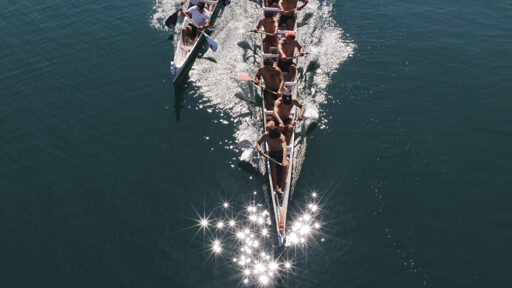

A still from ‘Racing Waters’ shows the Island Brave Canoe Club on the water fighting for the lead. Submitted image
A new docuseries showcases the fast-paced sport of canoe racing — with sprawling overhead views of competitions to close-up shots of rapid-fire paddles on the water.
Over nine episodes, Racing Waters follows Snuneymuxw First Nation’s Island Brave Canoe Club located on “Vancouver Island.”
There are multiple competitions included in the series — including single, double and six person races — but the 11-man war canoe races remain the main event.
“Eleven-man is the main show, and everybody comes out to watch that,“ said Eli Wyse, a paddler on the Island Brave team and a member of Snuneymuxw First Nation.
Beyond the large in-person crowds that races draw on the West Coast and beyond, Racing Waters brings that spirit to audiences across the country, with a high energy and connection to the sport that can be felt through the screen. The in-depth portrayal of the sport includes highlighting the culture and humanity attached to it.
The docuseries premiered on Sept. 13 on APTN. It’s already been renewed and filming is underway for season two.
A family legacy

The Island Brave team carries their canoe. Submitted image
Wyse has been canoe pulling since the age of 12, and has acquired various winning titles in the years since. Before he started, he remembers being home at the Snuneymuxw First Nation and noticing the community feeling empty, and wondering where everyone went — before finding out that they were all out on the water.
The sport has been in his family for generations. Wyse recalled how he has heard stories about his grandparents and great-grandparents canoe racing and said he is proud to continue that family legacy and represent his community.
His uncle, Snuneymuxw Chief Michael Wyse Sr., founded the Island Brave Canoe Club in 2002 and still serves as the team captain. These relational connections are explored throughout the docuseries.
“It was just great to have a sense of belonging and have a community-based sport that I could compete in and represent,” the younger Wyse told IndigiNews.
Wyse said participating in the sport has been deeply restorative for him.
“It’s been a big healing journey for me because you know when I’m out on the water, I’m able to get rid of everything that I hold on [to] through physical activity,” he said.
“Canoe pulling has saved my life more than once. That’s for sure.”
With canoe races every weekend in the summer, the preparation is consistent with training Monday to Thursday, travelling to the race location on Fridays and racing on Saturdays and Sundays. The training can also continue into the winter months with the outrigger canoe.
Each team represents their nation and the communities are showcased in Racing Waters including Brazil, where Island Brave is representing “Canada” in the International Va’a Federation World Distance Championships.
Wyse noted that the whole team has trust in each other and is able to hold their teammates accountable while striving for the best in their divisions.
“We’re constantly pushing each other, motivating each other, and with that said — with how close we are — we’re always checking on each other too,” he said.
The team also looks out for each other on the water as the sport gets intense as they are moving through the water and possibly getting close to their competition.

A still from the documentary series ‘Racing Waters.’ Submitted image
It takes perfect timing to ensure the team is going as fast as they can and movements such as switches — where the paddler moves from paddling on one side of the canoe to the other — needing organization to ensure the canoe stays upright.
“It’s a great sport, but it is called war canoe. So you got to have 11 guys that you trust that are going to be in time, watch your switching, and then watch each other’s backs,” Wyse said.
Before each competition the team gathers with their captain and goes over strategy and the importance of working together.
In one scene, at their second race of the season, the Island Brave team surrounds Chief Wyse Sr. as he commends their racing and gives advice on working as a unified team and to “make it your goal, halfway down the slough, to recover together.”
Turns are where races are “won or lost” remarks one of the team members in the series, as they show canoes taking in water and members bailing off to give their team a chance to get back into the race.
With a mix of the canoe racing action, the team’s preparation and interview style scenes where team members will discuss the sport and their process, the show gives an inside look at the intricacies of war canoe racing.
The series gets more intense as the episodes progress with different competitions and new challenges occurring for the Island Brave as they make their way through the season as a team.

A still from the documentary series ‘Racing Waters.’ Submitted image
Each episode begins with a montage of the canoes and races while a variety of voices discuss the cedar that the canoes are made from, the feeling of ancestors watching while on the water and reclaiming the culture.
The canoes and water both have their part in the story and are respected by the teams.
“All my canoes are in my heart, and they’re alive. They’re alive to me, and I know that they’re alive to my crew,” Wyse said.
“I’ll do anything to protect my canoe, and I’ll do my best to work with it to keep it afloat and get across that line.”
Fellow paddler, Eddie Wyse-Good, echoes these sentiments in the first episode of the series and comments on how they need to “stay true to the canoe,” as they are sacred and can sense your feelings.
As Chief Wyse Sr. is cleaning the canoe in preparation for the races, he remarks how cedar is the closest thing to a living human being in their way of life so the feelings the team brings aboard allow it to “come to life.”
Documentary series ‘motivating’ for the team
Luke Marston (Ts’uts’umutl), an artist and member of the Stz’uminus First Nation located near Snuneymuxw on ”Vancouver Island,” served as producer for Racing Waters.
Marston has a background in canoe building, canoe racing and documentary filmmaking.
He approached producer Mike Wavrecan and filmmaker Carey Newman with the idea for Racing Waters and the team brought it to APTN. The filming process took months, capturing all the races and moments in between — utilizing wide drone shots that displayed the races and audiences and tight close-ups inside the canoe.

A still from the documentary series ‘Racing Waters.’ Submitted image
With scenes that move across the water, showcasing all competitors in their own canoes and following along as they make their turns, you can hear the announcers and audience cheer bringing the sport right to the viewer and allowing an open look at all that surrounds the canoe racing.
“One of my main focuses is just, let’s just show the world how amazing this sport really is,” Marston said.
Marston described the concept of “nuts’amaat shqwaluwun” — working together as one — which encompasses the multigenerational aspect of canoe paddling. This is a main focus of the docuseries, he said, along with the paddlers who are committed to their team.
While Island Brave is the focus of the docuseries, other teams and paddlers are interwoven into the storyline such as the Rikkole Cree Canoe Club, Merisa Mae Canoe Club, Krista Jefferson, Denean Fred and more.
With the docuseries showcasing the sport, the culture is featured as well. Marston ensured that cultural protocols were followed during the process.
“Our culture is alive and well,” Wyse said, adding that seeing his club celebrated “motivates me to continue training.”

A still from the documentary series ‘Racing Waters.’ Submitted image
Wyse also is an outreach worker with Kw’umut Lelum, which involves working with Youth from many First Nations and is able to teach physical activity such as boxing and now showcasing the sport of war canoe racing. He said he is always willing to share any knowledge with the Youth and help them thrive.
Wyse said all the action that was filmed for Racing Waters was “awesome,” and everything portrayed showcases the incredible sport and allows the Youth to look up to their communities and aspire to be involved in the sport.
“I think it’s been motivating for not only our nation and our club, but other nations and other clubs, “ Wyse said.
“I take a lot of pride in knowing that I didn’t have to leave my nation to become something. I was able to stay home and build my championships and my legacy here, and pass that on to the next generation.”
Marston said he hopes people watch the series and “just have a little bit more of an understanding of the war canoe and how top tier athletes there are within the Indigenous community.”
“It’s competitive, but it’s also, you know, it all comes from love as well,” Marston said.
“Love of the sport and love of family, love of one another. So, I just hope that people can see that and they get excited.”
With season two already announced by APTN, Marson comments that there is a lot to look forward to with new storylines such as additional canoe clubs introduced and more of the intense action aboard the canoes.
The post Docuseries features action-packed Snuneymuxw canoe club: ‘Our culture is alive and well’ appeared first on Indiginews.
From Indiginews via This RSS Feed.