

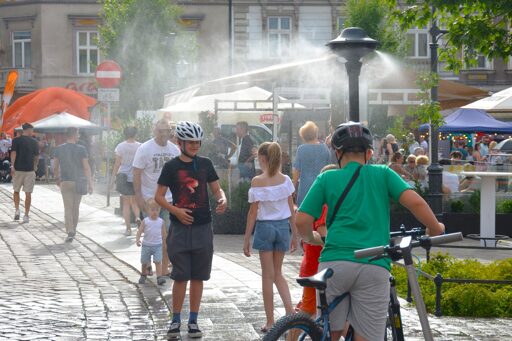
It’s a hot summer day in the city. The sun beats down relentlessly on asphalt and concrete, while tall buildings mercilessly snuff out any hope of a cooling breeze, intensifying urban heat island impacts. Urbanites around the world know the feeling well. And with an increasing number of potentially deadly heat wave days due to a warming climate, it’s only becoming more familiar. But ask the same city dwellers how they feel when the barometer drops and a soft summer rain breaks the heat. That relief is something a group of researchers hope to artificially replicate using widely distributed rainwater collection tanks and smart rooftop sprinkler systems. The team, led by Zhonghua Zheng, an associate professor of urban climate and environmental data science at the University of Manchester in the U.K., used machine learning and artificial intelligence to create a new model that can help cities bring down internal temperatures in buildings and even cool outdoors during heat waves. Their proposed system includes a rooftop rainwater collection tank and a sprinkler system that activates at a specific outdoor temperature threshold to water the roof. Evaporation cools roof temperatures, Zheng explained in a Mongabay interview. “It has a dual benefit to cool both the indoor temperature and outdoor temperature.” The researchers used Tokyo as a case study due to Japan’s temperate climate, seasonal changes, and leadership in rainwater collection. The model found that the strategy would indeed bring down high surface and air temperatures if widely adopted across an urban setting.…This article was originally published on Mongabay
From Conservation news via This RSS Feed.