

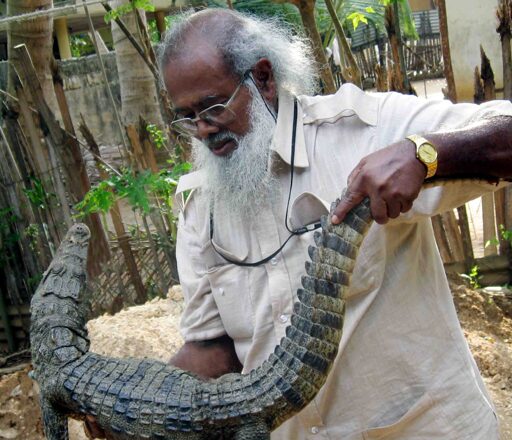
Anslem de Silva is widely regarded as the father of modern herpetology in Sri Lanka. He has spent more than six decades documenting the island’s rich reptile and amphibian diversity while mentoring generations of researchers. De Silva spoke with Mongabay contributor Malaka Rodrigo as he, at 86 years old, prepares to host the first World Congress on Snakes. The conference in October in Sri Lanka’s hill city of Kandy will be an international gathering specifically dedicated to snake conservation and research. Over the course of a distinguished career, de Silva has authored more than 350 scientific papers and more than 25 books. His work began in the 1960s when only a small handful of Sri Lankan researchers were studying the country’s reptiles and amphibians. To build local scientific capacity, he organized the country’s first one-day herpetological conference in the 1960s. He also launched Sri Lanka’s first herpetological research journal, Lyriocephalus, and established the Amphibia and Reptile Research Organization of Sri Lanka in 1990. De Silva’s mentorship has left a lasting legacy across the region. Ruchira Somaweera, a Sri Lankan-born conservation biologist, recalled receiving an inscribed copy of the journal from de Silva when he was just 13. “Most of the herpetologists of my generation were groomed by de Silva, and hundreds, if not thousands, of students have been inspired by him, just like I was,” Somaweera told Mongabay. Born in 1940 in the southern coastal city of Matara, de Silva developed his passion for snakes as a child after rescuing…This article was originally published on Mongabay
From Conservation news via This RSS Feed.