

Thousands of Palestinian children are returning to education in damaged schools and makeshift classrooms after years of disruption.
Gaza’s schools are set to reopen Saturday, sending tens of thousands of Palestinian children back to classrooms after three years of war that has devastated the territory’s education system.
RELATED: 20 Palestinians Die in Residential Building Collapse in Gaza
About 85% of Gaza’s schools have been damaged, according to Mohamed Hamdan, director of education for the Deir al-Balah governorate. In the Central Governorate, one of the least affected areas, 13 of its 30 schools have been completely destroyed, Hamdan told EFE from his office in Nuseirat.
With many school buildings no longer available, classes will be held in tents this year. The Palestinian Education Ministry delayed the start of the school year until Saturday because of the high temperatures inside the makeshift classrooms.
The reopening marks the fourth school year since the Israeli offensive began in October 2023. Gaza’s Health Ministry says at least 21,289 children and adolescents have been killed and another 44,500 wounded during the three years of conflict.
Displaced families in Gaza welcome the new school year amid shortages of essential supplies and widespread damage to schools. pic.twitter.com/dFMkelsO6f
— WAFA News Agency – English (@WAFANewsEnglish) September 12, 2026
Three years of disrupted education
In Nuseirat refugee camp, students have been preparing for lessons inside a tent converted into a classroom. They will sit on mats on the floor, without desks or chairs, in a cramped space replacing classrooms destroyed by bombardment.
“We are launching an educational and recreational program to help compensate students for the huge educational deficit caused by the war. But, as you can see, these places are not equipped for studying,” said mathematics teacher Ali Jihad al-Durra.
“Mobile schools would have saved us a lot of effort and inconvenience. These tents do not even have enough space for students to sit,” he added.
For students who have spent years moving between displacement sites without regular schooling, the return to class underscores the extent of the educational disruption.
“I am displaced from Gaza City in the north, and these three years of war have been very difficult because I have not been able to attend school regularly. We moved from one place to another, without a fixed place to study,” said Razan al-Naji, who hopes to become a surgeon.
“Now we study in tents, without desks or chairs, and we sit on the floor for many hours,” she added.
Haya Tafesh, a final-year secondary school student, described the academic consequences of the prolonged interruption.
“For three years, we have not been taught anything, and I do not understand what is being taught,” she said.
“My dream was to become a journalist and work in the media, but unfortunately that dream will not come true because I have not attended school for three years. Now I am in my final year of secondary school and I do not understand anything — not English, not mathematics, nothing,” Tafesh added.
Rising costs for families
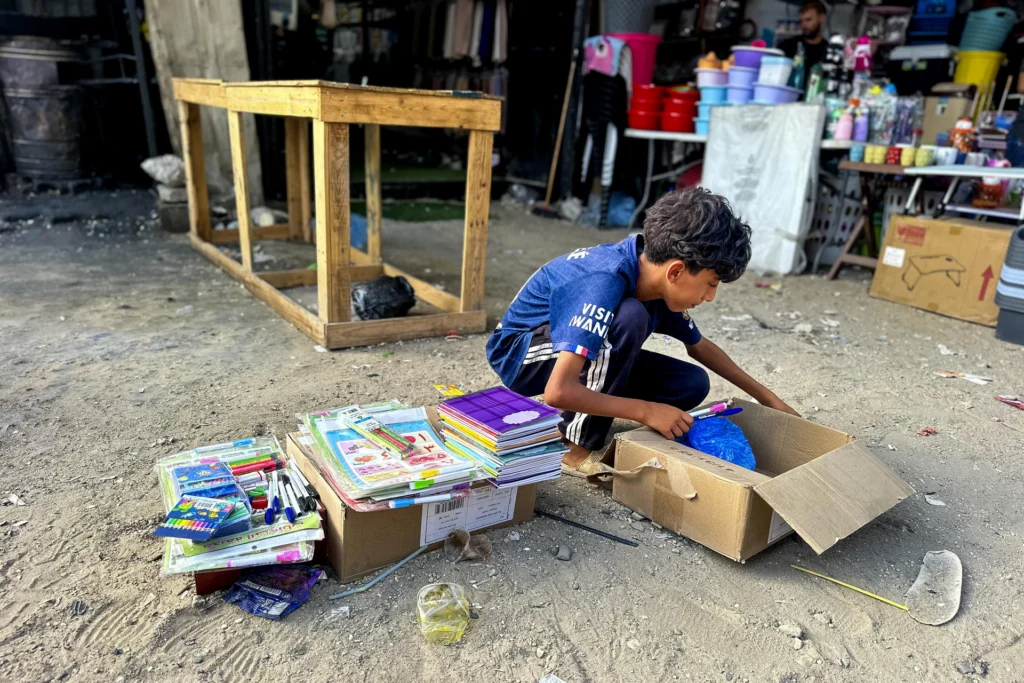
The return to school is also bringing a financial burden for families. In markets in Khan Younis in southern Gaza, the prices of school supplies have risen sharply while household purchasing power has fallen, according to local shopkeepers.
Some merchants have been forced to set up makeshift stalls outside their destroyed stores to continue selling.
Ahmed Ashraf al-Qarnawi, who owns a stationery shop and has three children, said a schoolbag that cost 10 shekels (2.80 euros) before the war now sells for as much as 80 shekels (22.70 euros).
“The situation is very difficult. A shirt that used to cost 10 now costs 50. A notebook that cost one shekel or half a shekel now costs 10,” he said.
Maysa Abu Taha, a mother of two children who will begin first grade and preschool, said the cost of returning to school was becoming increasingly difficult for families.
“Prices are exorbitant. There is nothing but expenses: the children also need clothes, and you cannot afford all these costs. It is difficult for someone with one child, but for someone with two or three, it is impossible,” she said.
As classes resume, students and teachers face a school year in which damaged facilities, tent classrooms and years of interrupted education remain central challenges.
From teleSUR English via This RSS Feed.