


Kevin AbourezkICT
As she drove toward the burning building, Celestine Stadnick whispered to herself, “Oh my God.” Her community’s only apartment complex, which housed 17 families, was burning to the ground.
It was early on the morning of January 21, 2026. By that afternoon, Stadnick – a middle school principal in Kyle, South Dakota, on the Pine Ridge Indian Reservation – had marshalled residents and students to gather donations for the fire victims in her school’s auditorium. By that night, after distributing clothes and diapers and non-perishable foods to mothers and children and elders who had just lost their homes – and even wiping the smoke from children’s faces with her T-shirt – she wrote a post on her Facebook page thanking those who helped.
“Sixty-three people lost their homes today. Sixty-three people’s lives were protected by Wakan Tanka and ancestors today. Sixty-three people were loved by their people today. This is what it’s like to be Lakota,” she wrote.
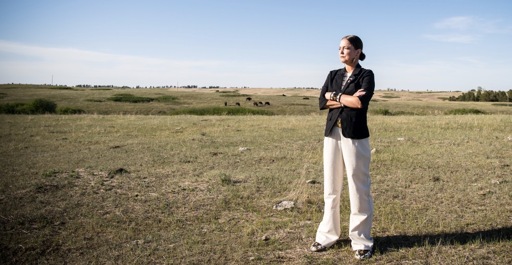
A little more than four months later, the Oglala Lakota woman announced her plans to seek a state legislative seat representing her people.
Come Nov. 3, voters in District 27 of the South Dakota State Senate will decide whether to send Stadnick to Pierre, the state capital.
She is facing two opponents, Republican Anthony Kathol and Independent Peri Pourier, Oglala Lakota, who is a registered Republican. Kathol declined to comment on the race, and Pourier initially agreed to talk to ICT but didn’t respond to follow-up messages. Pourier currently holds the South Dakota House of Representatives District 27 seat.
State Senator Red Dawn Foster, Oglala Lakota, is leaving the Senate District 27 seat this year after reaching her term limit of eight years.
Stadnick said she waited for someone to file as a Democratic candidate for the seat who she felt would represent her people well but when she didn’t see that happen, she decided to seek the office.
“I love my people so much, and it comes from being raised by my people, and them always taking care of me and taking care of each other,” she told ICT.
Stadnick, whose mother is Swedish and father was Lakota, spent part of her youth in Sweden, where she was able to experience one of the best educational systems in the world. Later, her family moved to the Pine Ridge Reservation, and in 1992 her parents and a group of Lakota elders decided to open a school near Kyle that would educate Lakota children while incorporating their culture and history into the curriculum.
The Lakota Waldorf School officially opened in 1994, and Celestine Stadnick eventually became a teacher there before becoming a middle school principal at Little Wound School in Kyle.
She said teaching Lakota language and culture to Lakota students taught her how beautiful and rich the Lakota way of life is and how important it is to protect that way of life.

Celestine Stadnick, upper left holding a book, teaches children at the Lakota Waldorf School near Kyle, South Dakota. Stadnick, Oglala Lakota, is seeking the District 27 South Dakota State Senate seat during the Nov. 3, 2026, general eleciton. (Photo courtesy of Celestine Stadnick)
As a state senator, she said, she would be able to help preserve Lakota language and culture, as well as seek to improve the lives of her people and all of the people of South Dakota. She said she would be an effective state legislator largely because of her ability to bring together people with different political views but who share the same goals in other areas.
She learned long ago that Lakota people often have different views on tribal leadership and local, state and national politics, but they all want to improve the lives of their people. She learned that focusing on similarities rather than differences can help build coalitions that can effectively accomplish goals, she said.
Somewhat jokingly, she said she has found that she tends to get along with white male legislators who she said treat her like they would a grandmother – respectfully and delicately. Another reason she gets along with non-Native people, she said, is because she is half Swedish.
“I know how to navigate those worlds, and I really do think that I can bring legislators together,” she said. “And I think that translators back in the day used to translate language, but today we have to translate culture, and we have to translate politics into real-life experiences. So that’s what I look at as my job.”
Stadnick said she wants to empower her people so they can begin to overcome the hopelessness and helplessness that so many of them feel as they struggle to survive a capitalistic, colonial society that refuses to confront its own history or the ways it continues to oppress people of color.
Today, tribes’ elected leaders, typically organized as tribal councils, conduct business on behalf of their tribes, and their executive leaders call themselves presidents, chairmen and chairwomen, and chiefs, Stadnick said.
But, she said, true Indigenous leaders often don’t need titles. They just help the people. They are servants more than masters, she said. And while people may rely on their fair judgement and wisdom to help make important decisions, their word is not law.
Tribal councils were created by federal lawmakers as a way to strip them of their traditional leadership structures. Stadnick said she considers those leaders more as administrative executives than actual leaders, though some of them may actually be leaders within their communities.
She said politicians often fail to live by Lakota spiritual laws – like respect, compassion and humility – and provide their people with visions for the future. And when they run for office, they often focus on attacking their political opponents rather than giving people hope and potential solutions to societal problems. To remedy this, Stadnick said she has focused on building a solution-focused political platform backed by visionary leadership.
“What is our vision?” she said. “What do we as Indian Country, Native Americans, Alaskan, Indigenous people, what do we need?”
“I really do think that politicians, or just leaders in general, have to tap into that spiritual revolution that’s going on right now and walk with political power but also that spiritual power that we as Indigenous people inherently live with,” she said.
Indigenous people need to be involved in decision-making related to public lands, she said, especially considering that tribal lands and their sacred sites so often are impacted by mining and other extractive industries. As it stands, the federal government is only required to consult with tribes before making decisions that might affect those tribes, Stadnick said.
“They have to do, like, a land assessment and make sure they don’t ruin everything, but other than that, they pretty much can do whatever they want,” she said.
She also said tribes should be granted co-ownership of public lands and that landowners who are selling large tracts of land should be required to give tribes the right to bid first on those lands before opening them up to public bids.
“That doesn’t mean that we’re all going to buy all the land,” she said. “We have big issues that we’re dealing with, and we’re not rich.”
She said public safety is an important issue on the Pine Ridge Reservation, and she said there has been a raft of killings there this summer alone.
She said she has proven herself as someone who can create systemic change, having helped to establish the Lakota Waldorf School, which provides tuition-free education to students in kindergarten through eighth grade. The school’s curriculum integrates Lakota culture and language teachings with an educational philosophy focused on individualized instruction and reaching students through their hands, hearts and minds.
And Stadnick said her work at Little Wound Middle School in Kyle has led to dramatic improvements in student performance, which she attributes in part to increased cultural education. She said she started a hunting program in which boys learn to ride horses and hunt, in part to remind them that they are warriors.
“So many of our young men are lost because the Eurocentric expectation for young men, or men in general, is to be capitalists,” she said. “Your worth is measured by your ability to get money, get power, have powerful friends around you that rub your ego. But men are so much more sacred than that, that it’s an insult to what manhood is.”
Teaching boys Lakota cultural and spiritual values and traditional customs has helped her students find purpose.
“We have to go back to that, and it’s possible but we just have to see it in our imagination, and that’s how visions come to us,” she said. “You just have to picture it in your mind.”
Stadnick also oversees the educational programs at a local juvenile detention center, where she volunteers her time and where she visits each Christmas bearing gifts and goodwill.
Alice Phelps, the principal of American Horse School in Allen, South Dakota, met Stadnick nearly 25 years ago when she was a young girl. She described her as smart, kind and generous and always focused on empowering youth.
“She’s always selfless, always wanting to do for others and help others,” Phelps said. “She’s so proud to be Lakota. She’s so proud of her people but sad because we have no business being so impoverished.”
She said Stadnick lost her father and brother at a young age, experiences that gave her greater compassion for others who’ve had to endure loss. When Phelps lost her own mother to COVID, Stadnick brought food and tried to support her friend in any way she needed.
“She wants to be there for those that are in grieving and having a hard time as well and to try to provide a bright future for our youth because many times they just feel a sense of hopelessness, that there is no future and she’s fighting tooth and nail to do all she can to make that change, to give them hope, to have them something to look forward to and goals to attain,” Phelps said.
The post South Dakota state senate candidate wants to give Lakota people hope appeared first on ICT.
From ICT via This RSS Feed.